Reusability in MLOps: Leveraging Ports and Adapters to Build a Microservices Architecture for the Maritime Domain
Reading time: 5 minute
...
📝 Original Info
Title: Reusability in MLOps: Leveraging Ports and Adapters to Build a Microservices Architecture for the Maritime Domain
ArXiv ID: 2512.08657
Date: 2025-12-09
Authors: ** - Renato Cordeiro Ferreira – Jheronimus Academy of Data Science (JADS), Tilburg University (TiU), ’s‑Hertogenbosch, Netherlands (ORCID: 0000‑0001‑7296‑7091) - Aditya Dhinavahi – Jheronimus Academy of Data Science (JADS), Technical University of Eindhoven (TU/e), ’s‑Hertogenbosch, Netherlands (ORCID: 0009‑0004‑5203‑551X) - Rowanne Trapmann – Jheronimus Academy of Data Science (JADS), Technical University of Eindhoven (TU/e), ’s‑Hertogenbosch, Netherlands (ORCID: 0000‑0001‑5746‑4154) - Willem‑Jan van den Heuvel – Jheronimus Academy of Data Science (JADS), Tilburg University (TiU), ’s‑Hertogenbosch, Netherlands (ORCID: 0000‑0003‑2929‑413X) **
📝 Abstract
ML-Enabled Systems (MLES) are inherently complex since they require multiple components to achieve their business goal. This experience report showcases the software architecture reusability techniques applied while building OCEAN GUARD, an MLES for anomaly detection in the maritime domain. In particular, it highlights the challenges and lessons learned to reuse the PORTS AND ADAPTERS pattern to support building multiple microservices from a single codebase. This experience report hopes to inspire software engineers, machine learning engineers, and data scientists to apply the HEXAGONAL ARCHITECTURE pattern to build their MLES.
💡 Deep Analysis
📄 Full Content
Reusability in MLOps:
Leveraging Ports and Adapters
to Build a Microservices Architecture
for the Maritime Domain
Renato Cordeiro Ferreira
Jheronimus Academy of Data Science (JADS)
Tilburg University (TiU)
’s-Hertogenbosch, The Netherlands
0000-0001-7296-7091
Aditya Dhinavahi
Jheronimus Academy of Data Science (JADS)
Technical University of Eindhoven (TU/e)
’s-Hertogenbosch, The Netherlands
0009-0004-5203-551X
Rowanne Trapmann
Jheronimus Academy of Data Science (JADS)
Technical University of Eindhoven (TU/e)
’s-Hertogenbosch, The Netherlands
0000-0001-5746-4154
Willem-Jan van den Heuvel
Jheronimus Academy of Data Science (JADS)
Tilburg University (TiU)
’s-Hertogenbosch, The Netherlands
0000-0003-2929-413X
Abstract—ML-Enabled
Systems
(MLES)
are
inherently
complex since they require multiple components to achieve their
business goal. This experience report showcases the software
architecture reusability techniques applied while building OCEAN
GUARD, an MLES for anomaly detection in the maritime
domain. In particular, it highlights the challenges and lessons
learned to reuse the PORTS AND ADAPTERS pattern to support
building multiple microservices from a single codebase. This
experience report hopes to inspire software engineers, machine
learning engineers, and data scientists to apply the HEXAGONAL
ARCHITECTURE pattern to build their MLES.
Index
Terms—MLOps,
Software
Architecture,
Ports
and
Adapters,
Machine
Learning-Enabled
Systems,
Reusability,
Maritime Domain, Experience Report.
I. INTRODUCTION
Maritime transport is important for the functioning of
global trade and commerce. Operations in the maritime
domain are dynamic and complex for multiple reasons,
including vulnerable weather and sea conditions, movement
across international boundaries, and compliance with varying
regulatory frameworks [1].
The maritime industry faces the challenge of illicit trade,
which is a threat to peace and security [2], [3]. Among
existing products that identify potential illegal activity at sea,
the OCEAN GUARD tool is an extensible Machine Learning–
Enabled System (MLES) whose goal is to analyze and detect
anomalies across multiple types of data [4].
This study was financed in part by the Coordenac¸˜ao de Aperfeic¸oamento
de Pessoal de N´ıvel Superior – Brasil (CAPES) – Finance Code 001. It also
received support from the MARIT-D project, co-funded from the Internal
Security Fund – Police programme under grant agreement no. 101114216.
This experience report describes the software architecture
reusability techniques used to develop the OCEAN GUARD
tool. It builds upon our first description of the system [4],
detailing how our development team applied the PORTS AND
ADAPTERS pattern to implement multiple microservices of the
MLES from a single monorepo codebase.
II. FUNDAMENTALS
This section introduces the key concepts and techniques
used throughout the paper.
A. Machine Learning–Enabled Systems (MLES)
MLES are software systems that include components based
on Machine Learning (ML) as part of their business logic [5],
[6]. OCEAN GUARD is an MLES because it uses ML to
implement anomaly detection techniques over maritime data.
MLES are complex systems because they rely on multiple
components to achieve their task [5]. The usage of different
component types and their most common roles has been
summarized in different reference architectures available in
the literature [7], [8].
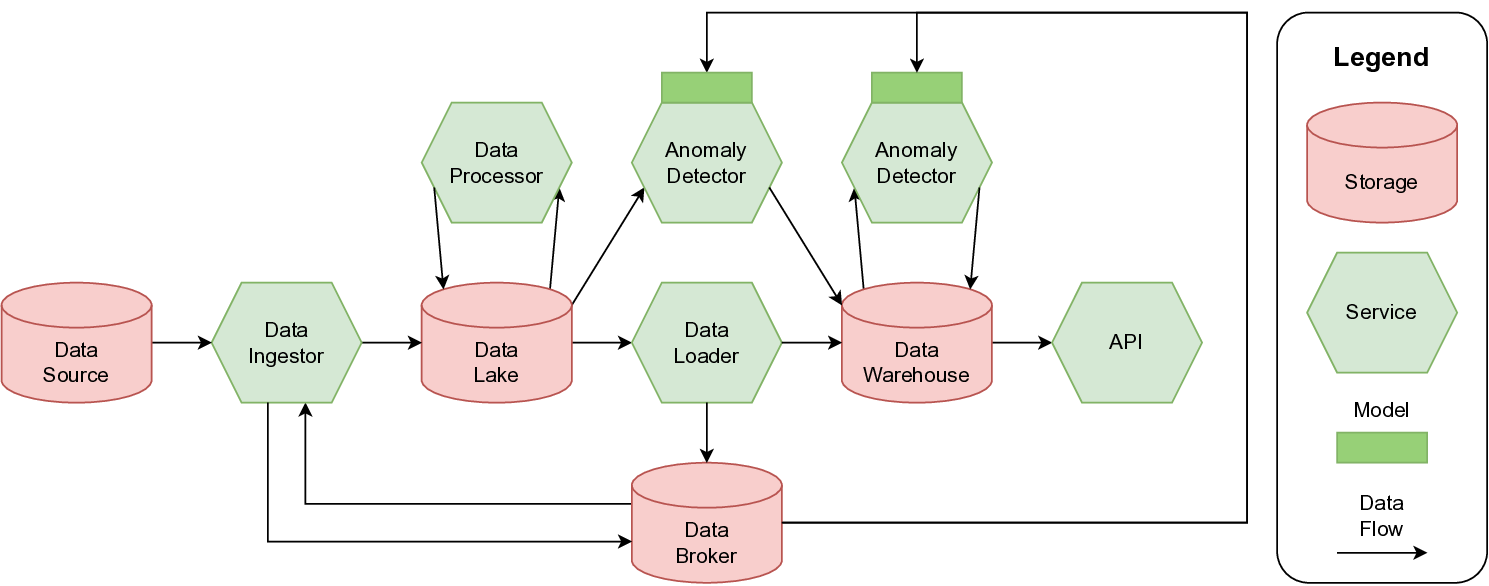
The OCEAN GUARD tool follows the reference architecture
proposed by Ferreira [9], as detailed in section V.
B. Hexagonal Architecture
The HEXAGONAL ARCHITECTURE pattern, also known
as the PORTS AND ADAPTERS pattern, was first described
by Cockburn [10]. Its goal is to decouple the application’s
core business logic from external dependencies [11], such as
storage or presentation.
arXiv:2512.08657v1 [cs.SE] 9 Dec 2025
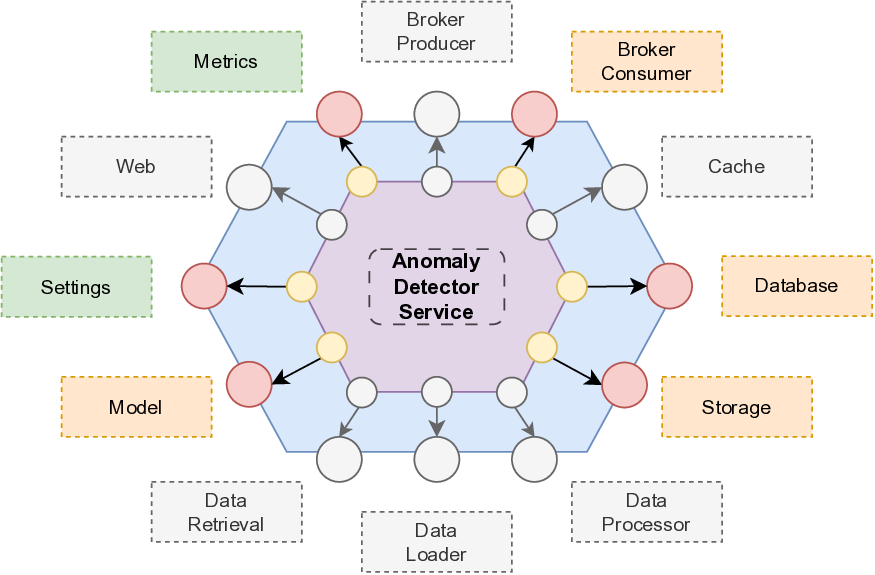
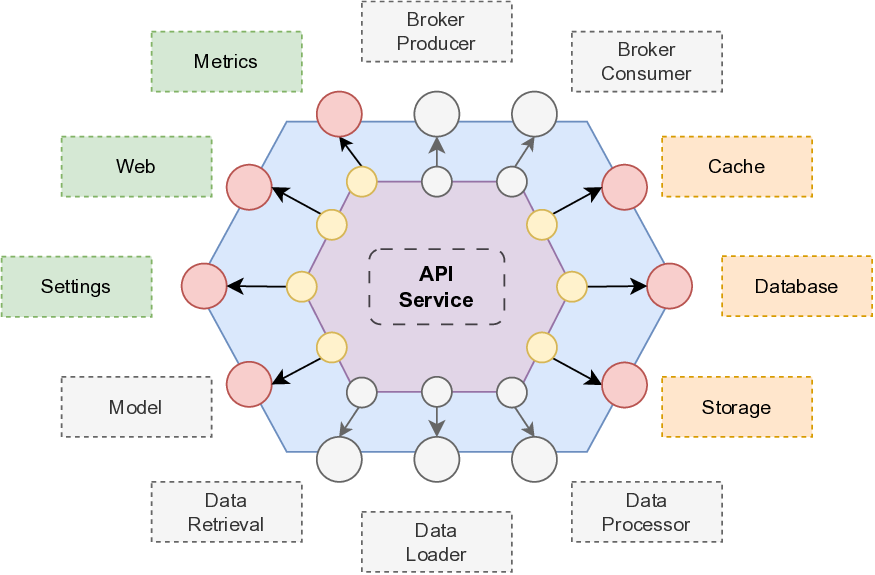
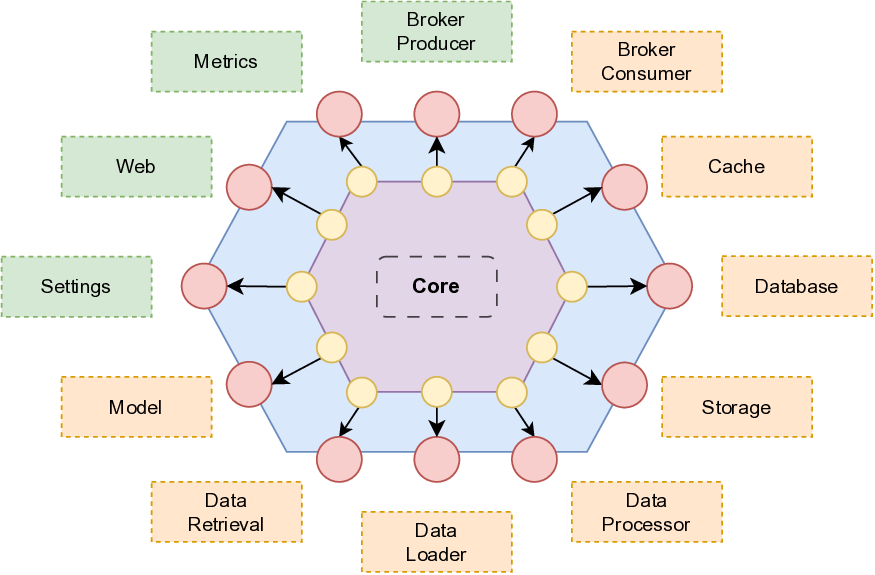
This pattern is commonly described for implementing
microservices [12], [13]. The code of an application that
follows the HEXAGONAL ARCHITECTURE pattern usually can
be divided in three layers:
• core, which implements the business logic, usually by
following Domain-Driven Design patterns [14];
• ports, which defines contracts for the interaction between
the core and external dependencies; and
• adapters, which implement the contracts defined by the
ports, communicating with the external dependencies.
Moreover, such an application requires an entry point that can
connect these components via DEPENDENCY INJECTION [11].
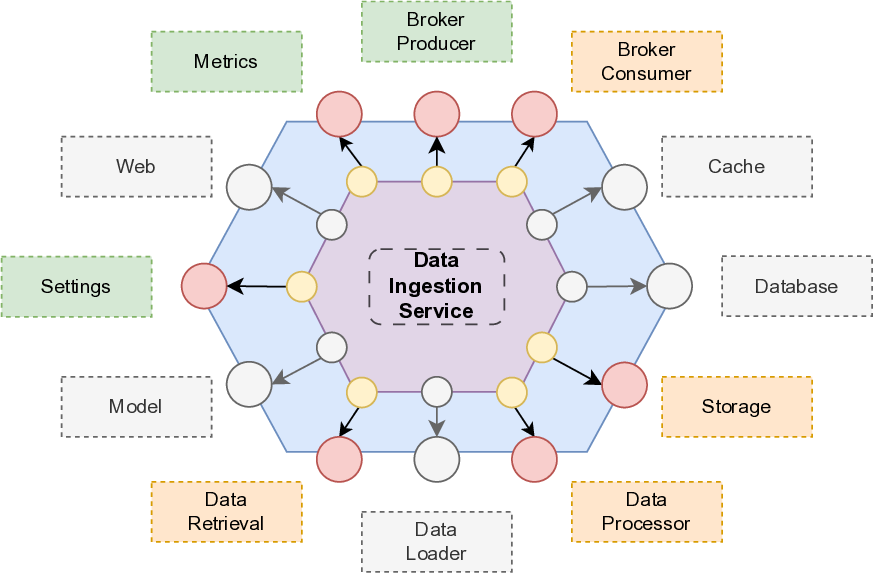
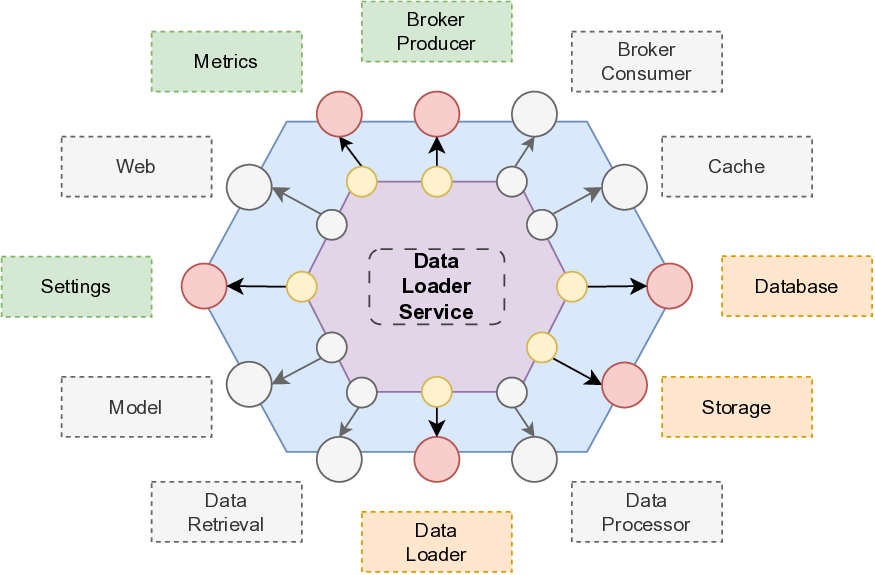
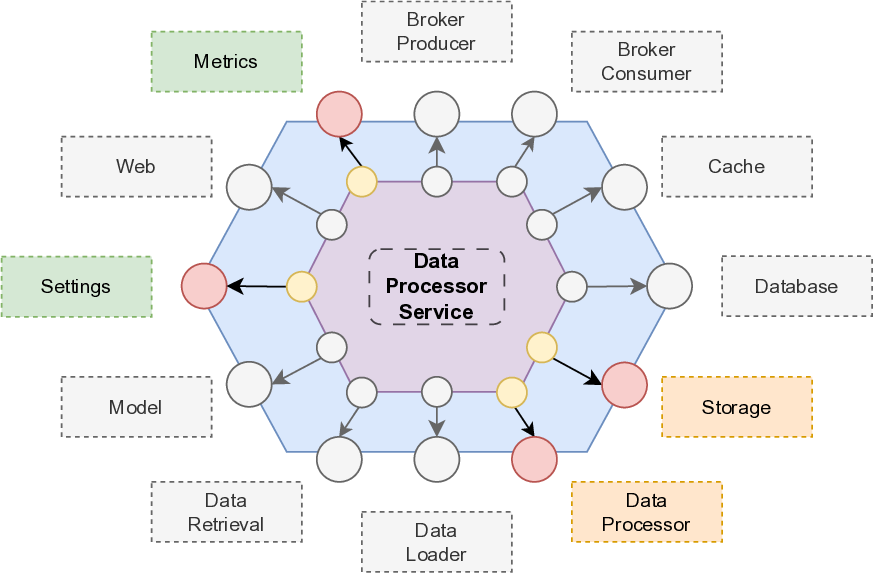
The OCEAN GUARD tool has microservices implemented
using the HEXAGONAL ARCHITECTURE pattern, as detailed
in section VI.
III. RELATED LITERATURE
Few
works
in
the
literature
focus
on
the
use
of
microservices for MLOps. Searching with the keywords
“Maritime Microservices with MLOps” on Google Scholar
does not provide any meaningful related results.
A search for the keywords “Microservices with MLOps”
and “Maritime Microservices” results in few related results.
Liu et al. [15] proposes the use of microservices to efficiently
serve mari