Authors: Besm Osman, Ruben Vink, Andrei Jalba, Maxime Chamberland
📝 Abstract
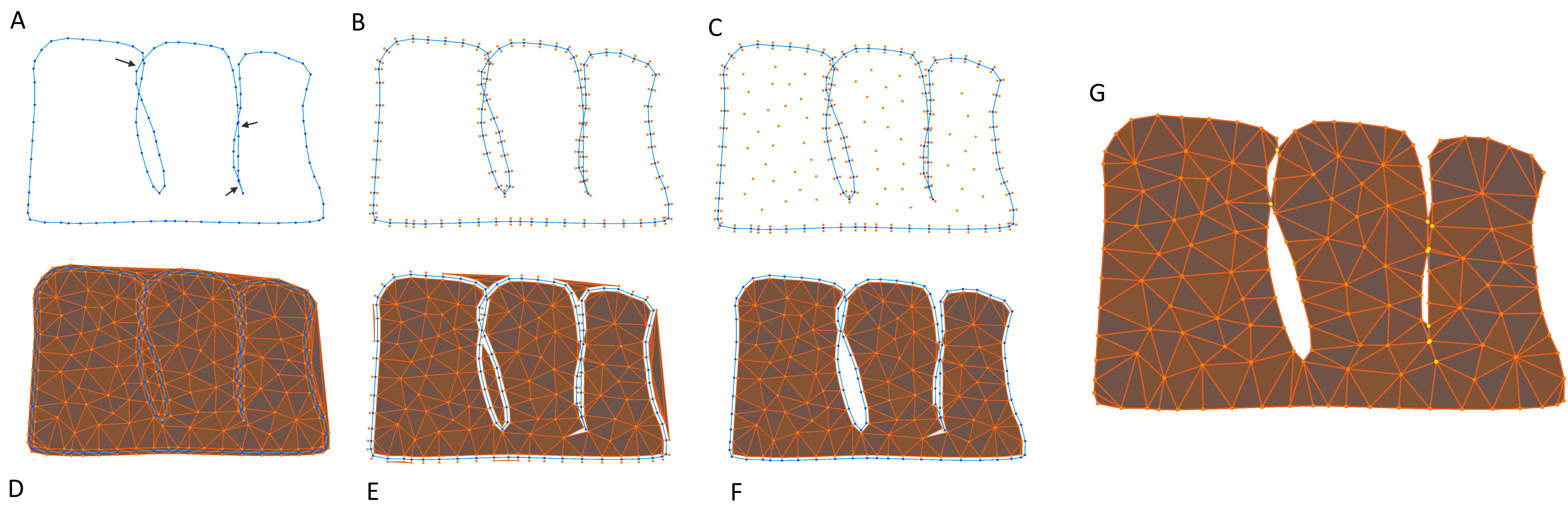
A prerequisite for many biomechanical simulation techniques is discretizing a bounded volume into a tetrahedral mesh. In certain contexts, such as cortical surface simulations, preserving input surface connectivity is critical. However, automated surface extraction often yields meshes containing self-intersections, small holes, and faulty geometry, which prevents existing constrained and unconstrained meshers from preserving this connectivity. We address this issue by developing a novel tetrahedralization method that maintains input surface connectivity in the presence of such defects. We also present a metric to quantify the preservation of surface connectivity and demonstrate that our method correctly maintains connectivity compared to existing solutions.
💡 Deep Analysis
📄 Full Content
Connectivity-Preserving Cortical Surface
Tetrahedralization
Besm Osman1, Ruben Vink1, Andrei Jalba1, and Maxime Chamberland1
1. Department of Mathematics and Computer Science, Eindhoven University of
Technology, Eindhoven, The Netherlands
Abstract. A prerequisite for many biomechanical simulation techniques
is discretizing a bounded volume into a tetrahedral mesh. In certain con-
texts, such as cortical surface simulations, preserving input surface con-
nectivity is critical. However, automated surface extraction often yields
meshes containing self-intersections, small holes, and faulty geometry,
which prevents existing constrained and unconstrained meshers from
preserving this connectivity. We address this issue by developing a novel
tetrahedralization method that maintains input surface connectivity in
the presence of such defects. We also present a metric to quantify the
preservation of surface connectivity and demonstrate that our method
correctly maintains connectivity compared to existing solutions.
1
Introduction
Tetrahedralization is the process of decomposing a bounded volume, typically
defined by a surface mesh, into discrete tetrahedra. This step is often required
for computational simulations in biomechanics. When tetrahedra are uniform in
size, computational simulations tend to be more accurate and stable (Taniguchi
2000). Therefore, Delaunay tetrahedralization is often preferred, as it ensures
that no point lies inside the circumsphere of any tetrahedron, avoiding poorly
shaped elements that can lead to numerical instability. Specifically, constrained
tetrahedralization, which guarantees that all faces from the input surface remain
in the final result, is generally desired.
However, constrained tetrahedralization is not achievable for all surfaces.
Constrained methods, such as TetGen (Si and Sadrehaghighi 2022) and Gmsh
(Geuzaine and Remacle 2009), require a Piecewise Linear Complex (PLC) as
input. This input must be free from geometric inconsistencies, such as self-
intersections and topological errors that render the mesh non-manifold. While
mesh repair tools exist to detect problematic regions and attempt to heal them,
these tools may delete large portions of the mesh or merge self-intersecting
regions, effectively fusing regions that are meaningfully distinct (Attene 2014;
Campen and Kobbelt 2010).
This limitation is particularly acute in the context of cortical surface meshing.
The human brain is characterized by a highly folded geometry, where deep folds
arXiv:2512.08450v1 [cs.CG] 9 Dec 2025
2
B. Osman et al.
(sulci) and ridges (gyri) are packed tightly together. To generate surface meshes
for these structures, standard pipelines like FreeSurfer (Fischl 2012) and Brain-
Suite (Shattuck and Leahy 2002) are used. These tools classify tissue from MRI
scans to construct an inner white-gray matter interface, which is then ‘pushed’
outwards along its normals to map the outer pial surface (Eskildsen and Oster-
gaard 2007).
While this method captures anatomical structure with high accuracy, the ex-
pansion process frequently generates self-intersections within the narrow spaces
of the cortical folds. Furthermore, mesh simplification is often required for com-
putational efficiency, which increases the prevalence of these intersections. Differ-
ent software packages also use inconsistent methods for self-intersection detection
with varying floating-point tolerances; consequently, constrained meshing soft-
ware may report self-intersections on surfaces seen as ‘intersection-free’ by other
tools. Due to these geometric issues, generating constrained volumetric models
of cortical surfaces is difficult and error-prone.
Alternatively, to circumvent the strict requirements of constrained methods,
researchers often use unconstrained tetrahedralization. These methods do not
require the input to be free from self-intersections, but they also do not guaran-
tee that the output will retain the input surface faces. Existing neuroanatomical
meshing pipelines use variations of these methods to allow for finite element
simulations (Fang and Boas 2009; Lederman et al. 2011; Tran, Yan, and Fang
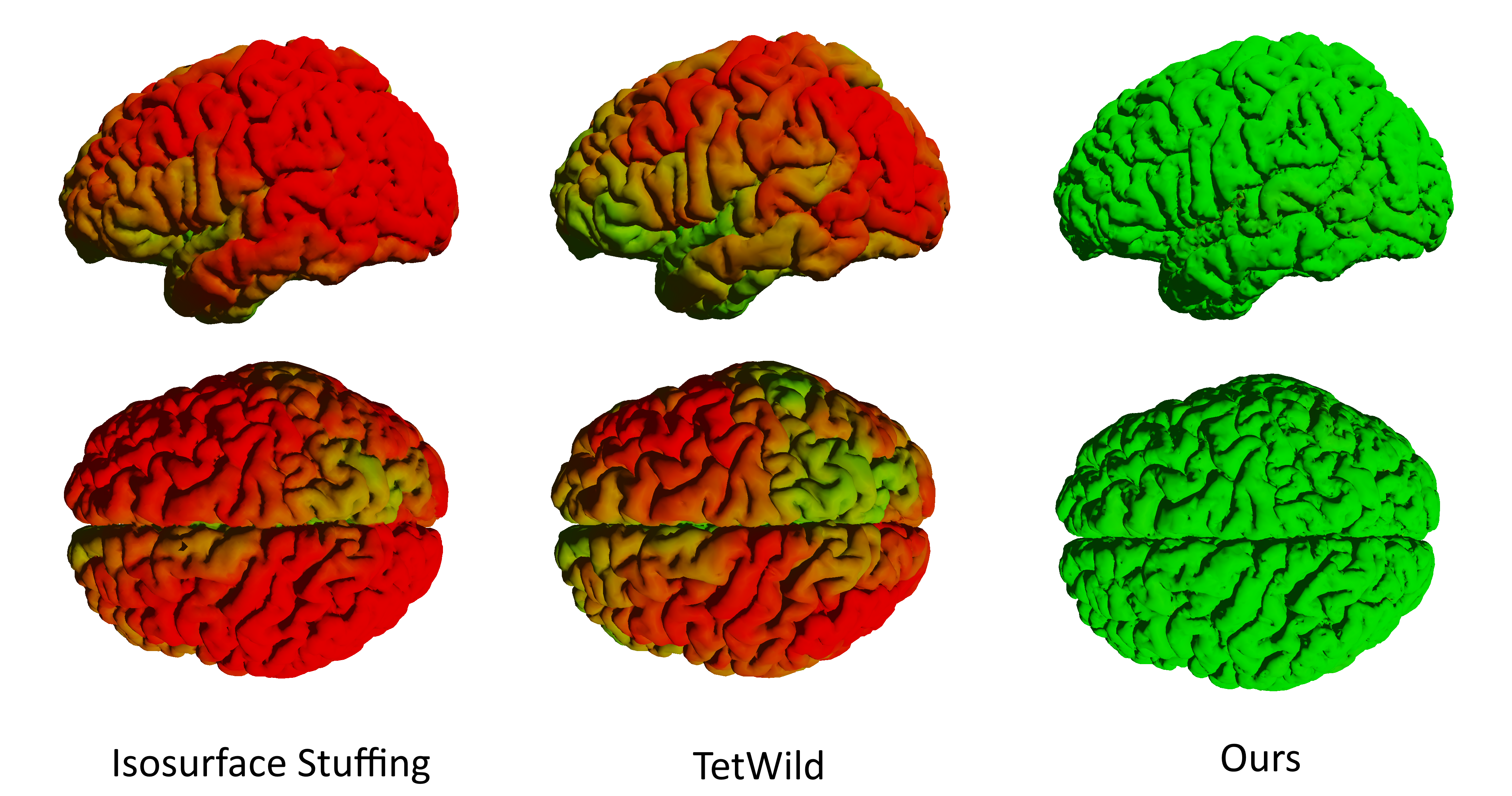
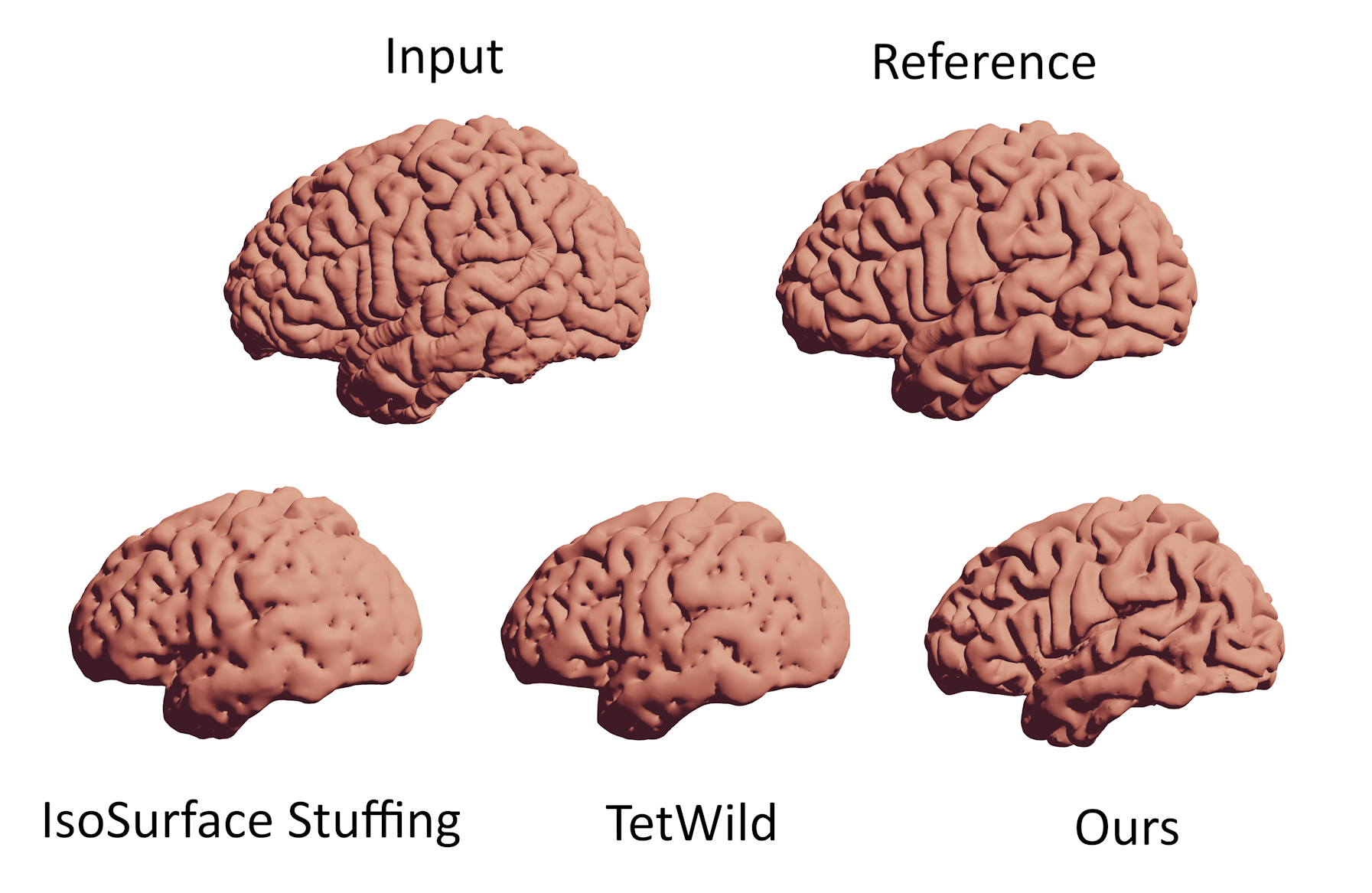
2020). Recent general meshing methods like TetWild (Hu, Schneider, et al. 2020)
aim to preserve most input surface faces while remaining robust to faulty input
geometry, targeting an almost-Delaunay tetrahedralization rather than a strictly
constrained one. However, these approaches do not preserve the anatomical con-
nectivity of the cortical folds. For instance, if a cortical surface contains two gyri
(convex hills) that self-intersect due to extraction inaccuracies, these methods
often create erroneous connections between them. These artificial fusions drasti-
cally reduce accuracy in both deformation and non-deformation studies, limiting
the feasibility of subject-specific volumetric cortical fold studies.
In this study, we present a novel tetrahedralization method that maintains the
surface connectivity of cortical