Memory Power Asymmetry in Human-AI Relationships: Preserving Mutual Forgetting in the Digital Age
Reading time: 5 minute
...
📝 Original Info
Title: Memory Power Asymmetry in Human-AI Relationships: Preserving Mutual Forgetting in the Digital Age
ArXiv ID: 2512.06616
Date: 2025-12-07
Authors: Rasam Dorri, Rami Zwick
📝 Abstract
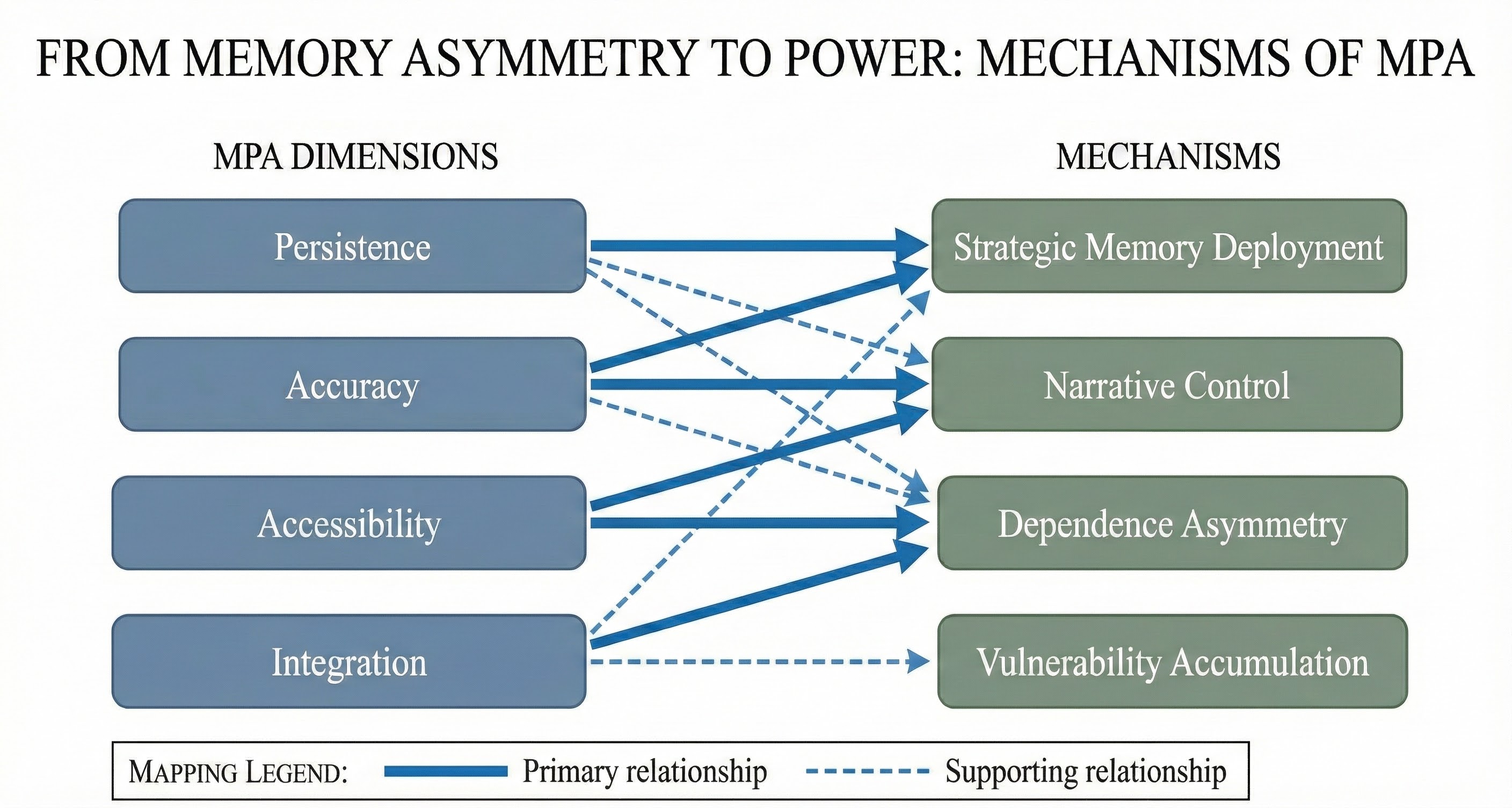
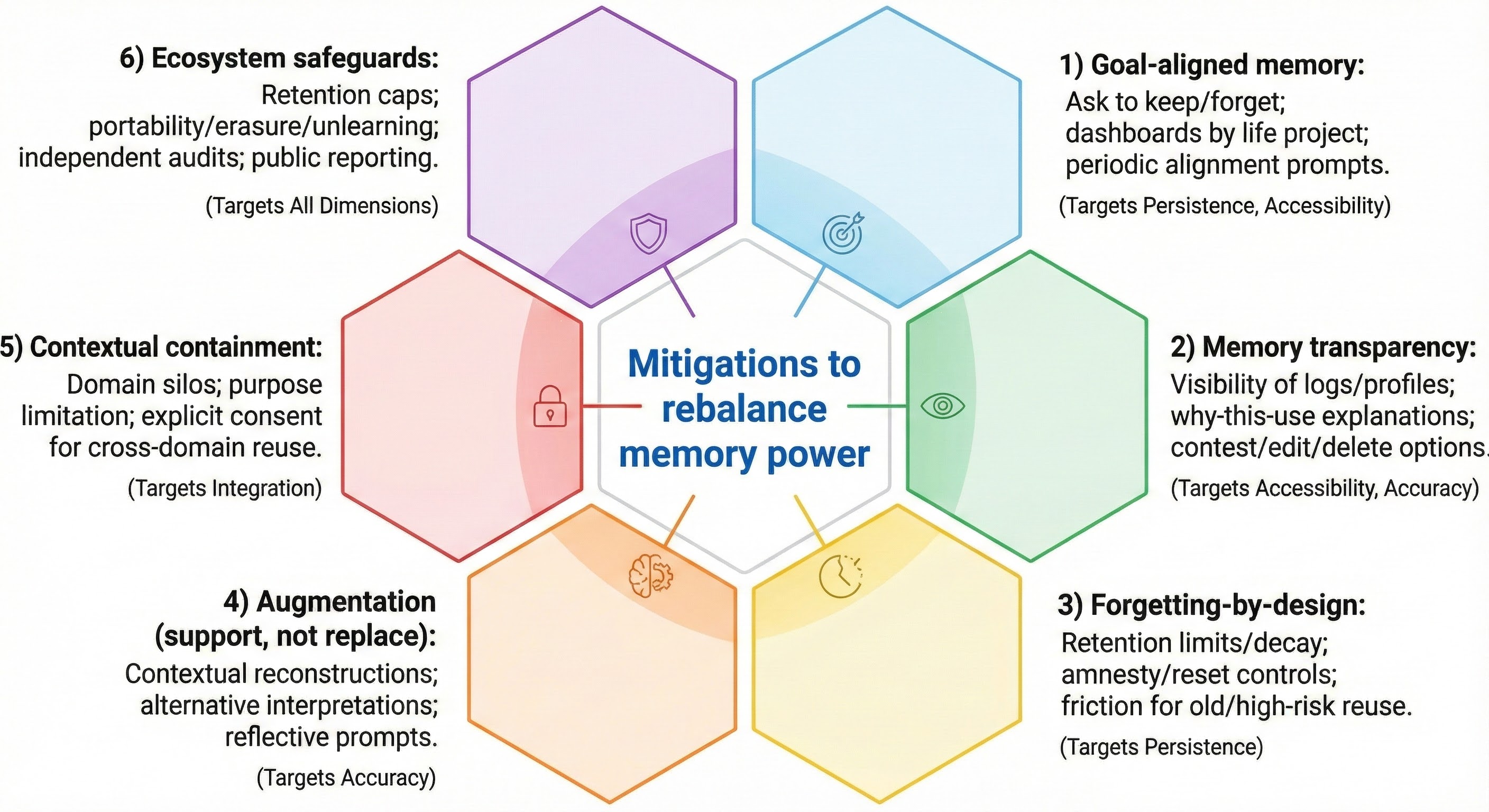
As artificial intelligence (AI) becomes embedded in personal and professional relationships, a new kind of power imbalance emerges from asymmetric memory capabilities. Human relationships have historically relied on mutual forgetting, the natural tendency for both parties to forget details over time, as a foundation for psychological safety, forgiveness, and identity change. By contrast, AI systems can record, store, and recombine interaction histories at scale, often indefinitely. We introduce Memory Power Asymmetry (MPA): a structural power imbalance that arises when one relationship partner (typically an AI-enabled firm) possesses a substantially superior capacity to record, retain, retrieve, and integrate the shared history of the relationship, and can selectively deploy that history in ways the other partner (the human) cannot. Drawing on research in human memory, power-dependence theory, AI architecture, and consumer vulnerability, we develop a conceptual framework with four dimensions of MPA (persistence, accuracy, accessibility, integration) and four mechanisms by which memory asymmetry is translated into power (strategic memory deployment, narrative control, dependence asymmetry, vulnerability accumulation). We theorize downstream consequences at individual, relational/firm, and societal levels, formulate boundary-conditioned propositions, and articulate six design principles for restoring a healthier balance of memory in human-AI relationships (e.g., forgetting by design, contextual containment, symmetric access to records). Our analysis positions MPA as a distinct construct relative to information asymmetry, privacy, surveillance, and customer relationship management, and argues that protecting mutual forgetting, or at least mutual control over memory, should become a central design and policy goal in the AI age.
💡 Deep Analysis
📄 Full Content
Memory Power Asymmetry in Human–AI
Relationships: Preserving Mutual Forgetting in the
Digital Age
Rasam Dorri1, Rami Zwick1
1School of Business, University of California, Riverside
Abstract
As artificial intelligence (AI) becomes embedded in personal and professional relation-
ships, a new kind of power imbalance emerges from asymmetric memory capabilities. Hu-
man relationships have historically relied on mutual forgetting, the natural tendency for both
parties to forget details over time, as a foundation for psychological safety, forgiveness, and
identity change. By contrast, AI systems can record, store, and recombine interaction histo-
ries at scale, often indefinitely. We introduce Memory Power Asymmetry (MPA): a structural
power imbalance that arises when one relationship partner (typically an AI-enabled firm) pos-
sesses a substantially superior capacity to record, retain, retrieve, and integrate the shared
history of the relationship, and can selectively deploy that history in ways the other partner
(the human) cannot. Drawing on research in human memory, power-dependence theory, AI
architecture, and consumer vulnerability, we develop a conceptual framework with four di-
mensions of MPA (persistence, accuracy, accessibility, integration) and four mechanisms by
which memory asymmetry is translated into power (strategic memory deployment, narrative
control, dependence asymmetry, vulnerability accumulation). We theorize downstream con-
sequences at individual, relational/firm, and societal levels, formulate boundary-conditioned
propositions, and articulate six design principles for restoring a healthier balance of memory
in human–AI relationships (e.g., forgetting-by-design, contextual containment, symmetric ac-
cess to records). Our analysis positions MPA as a distinct construct relative to information
asymmetry, privacy, surveillance, and customer relationship management, and argues that pro-
tecting mutual forgetting, or at least mutual control over memory, should become a central
design and policy goal in the AI age.
Keywords: Memory power asymmetry; artificial intelligence; human–AI relationships; digital
memory; consumer autonomy; privacy.
1
arXiv:2512.06616v1 [cs.HC] 7 Dec 2025
1
Introduction
As artificial intelligence (AI) becomes embedded in everyday life, consumers increasingly interact
with AI systems that retain detailed histories of their behavior: recommender systems that track ev-
ery streaming choice and click (Gomez-Uribe and Hunt, 2015), customer service bots that preserve
transcripts of every conversation (Ranieri et al., 2024), shopping assistants with years of purchase
and browsing data (Liu, 2007), and conversational agents that remember prior disclosures across
sessions (Bentley et al., 2018; Puntoni et al., 2021). These systems promise convenience and per-
sonalization, yet they also create a subtle but fundamental shift in relational power. One partner, the
AI (and the organization behind it), remembers almost everything; the other, the human, forgets.
We argue that this asymmetric memory capacity constitutes a distinct and underappreciated
source of power in human–AI relationships. Traditional discussions of AI-related power focus on
algorithmic opacity, biased decision-making, or information asymmetry in markets (Akerlof, 1970;
Mittelstadt et al., 2016; Pasquale, 2015). However, even when information about interactions
is shared (both parties were present and could in principle know it), the AI’s technical ability
to record, retain, and recombine the shared past can create a structural imbalance in relational
memory. The AI can selectively surface episodes, track longitudinal patterns, and aggregate cross-
context traces, capabilities that far exceed human episodic memory.
In human relationships, forgetting is not merely a cognitive limitation; it is a social feature. Mu-
tual forgetting, the fact that both parties naturally forget many details of past interactions, supports
forgiveness, identity revision, and relational flexibility. As Mayer-Sch”onberger (2009) notes, for
most of human history “forgetting has remained just a bit easier and cheaper than remembering”
(p. 2), and this imbalance has underpinned social practices and legal norms that rely on the fading
of past acts. Digital infrastructures invert this baseline: today it is easier and cheaper to store ev-
erything than to decide what to erase (Mayer-Sch”onberger, 2009; Fosch-Villaronga et al., 2018).
In AI-mediated relationships, the digital partner never forgets.
Recent work in AI and cognitive science underscores how profoundly AI memory differs from
human memory. Human memory is distributed, reconstructive, and organized around autobio-
graphical goals (Tulving, 2002; Conway and Pleydell-Pearce, 2000; Hirst and Echterhoff, 2012). It
distinguishes episodic memory (event-specific, self-referential, temporally located) from semantic
memory (general, decontextualized knowledge) (Tulving, 1972). By contrast, modern