Title: ChargingBoul: A Competitive Negotiating Agent with Novel Opponent Modeling
ArXiv ID: 2512.06595
Date: 2025-12-06
Authors: ** Joe Shymanski **
📝 Abstract
Automated negotiation has emerged as a critical area of research in multiagent systems, with applications spanning e-commerce, resource allocation, and autonomous decision-making. This paper presents ChargingBoul, a negotiating agent that competed in the 2022 Automated Negotiating Agents Competition (ANAC) and placed second in individual utility by an exceptionally narrow margin. ChargingBoul employs a lightweight yet effective strategy that balances concession and opponent modeling to achieve high negotiation outcomes. The agent classifies opponents based on bid patterns, dynamically adjusts its bidding strategy, and applies a concession policy in later negotiation stages to maximize utility while fostering agreements. We evaluate ChargingBoul's performance using competition results and subsequent studies that have utilized the agent in negotiation research. Our analysis highlights ChargingBoul's effectiveness across diverse opponent strategies and its contributions to advancing automated negotiation techniques. We also discuss potential enhancements, including more sophisticated opponent modeling and adaptive bidding heuristics, to improve its performance further.
💡 Deep Analysis
📄 Full Content
ChargingBoul: A Competitive Negotiating Agent
with Novel Opponent Modeling
Joe Shymanski
December 9, 2025
Abstract
Automated negotiation has emerged as a critical area of research in
multiagent systems, with applications spanning e-commerce, resource allo-
cation, and autonomous decision-making. This paper presents Charging-
Boul, a negotiating agent that competed in the 2022 Automated Negoti-
ating Agents Competition (ANAC) and placed second in individual utility
by an exceptionally narrow margin. ChargingBoul employs a lightweight
yet effective strategy that balances concession and opponent modeling to
achieve high negotiation outcomes. The agent classifies opponents based
on bid patterns, dynamically adjusts its bidding strategy, and applies a
concession policy in later negotiation stages to maximize utility while fos-
tering agreements. We evaluate ChargingBoul’s performance using com-
petition results and subsequent studies that have utilized the agent in ne-
gotiation research. Our analysis highlights ChargingBoul’s effectiveness
across diverse opponent strategies and its contributions to advancing au-
tomated negotiation techniques. We also discuss potential enhancements,
including more sophisticated opponent modeling and adaptive bidding
heuristics, to improve its performance further.
1
Introduction
Automated negotiation has long been a critical area of research in artificial intel-
ligence, with applications ranging from e-commerce and diplomatic mediation to
resource allocation in multiagent systems. The Automated Negotiating Agents
Competition (ANAC) serves as a benchmark for advancing the field, challenging
participants to develop autonomous agents capable of strategic, adaptive, and
efficient negotiation.
In 2022, we entered ChargingBoul into the Automated Negotiation League
(ANL) of ANAC, where it competed against dozens of agents submitted by
teams from around the world. The competition featured bilateral multiattribute
negotiations, where each agent sought to maximize its utility while interacting
with diverse opponents.
Each negotiation session consisted of 50 sequential,
timed rounds, with agents alternately exchanging bids based on predefined pref-
1
arXiv:2512.06595v1 [cs.MA] 6 Dec 2025
erence profiles. The final agreement, if reached before time expired, determined
the agents’ respective utilities, calculated via a linear additive utility function.
Performance in the competition was assessed using two primary metrics:
1. Individual Utility: The average utility an agent secured across negoti-
ations.
2. Social Welfare: The sum of utilities between both negotiating agents
per round.
ChargingBoul proved to be highly competitive, securing second place in in-
dividual utility, falling short of first place by only 0.001 utility points on average.
Its success stemmed from a straightforward yet effective negotiation strategy,
leveraging opponent modeling and adaptive bidding techniques. This paper de-
tails the design choices that contributed to ChargingBoul’s performance, com-
pares its results to previous approaches, and discusses potential improvements
for future autonomous negotiating agents.
2
Literature Review
Automated negotiation has been widely studied within the domains of multi-
agent systems and game theory. Early approaches to autonomous negotiation
were inspired by classical economic models, such as Nash bargaining solutions
and concession-based tactics. More recent research has emphasized adaptive
strategies that leverage opponent modeling, machine learning, and utility-driven
decision-making.
The ANAC competition has provided a valuable testing ground for these
advancements, with previous studies analyzing both individual agent strategies
and broader trends in competitive negotiation. Notable approaches include de
Jonge’s MiCRO strategy [3], the ANOTO agent [2], and Luckyagent2022 [4],
which have demonstrated the effectiveness of heuristic-based bidding, learning-
based adaptation, and opponent classification techniques.
Like many of its predecessors, ChargingBoul builds upon existing method-
ologies, employing a structured opponent modeling framework alongside a dy-
namically adaptive strategy. Additionally, ChargingBoul introduces two novel
statistics by which it classifies opponent negotiation tactics and subsequently
adjusts its bidding strategy. By evaluating its performance within ANAC 2022,
this paper contributes to the ongoing discourse on effective autonomous negotia-
tion and explores how lightweight yet effective strategies can achieve competitive
results.
3
Methodology
An automated negotiation agent typically contains three main components: its
own bidding strategy, an acceptance strategy, and a method for modeling the op-
ponent’s bidding strategy. ChargingBoul implements all three. We will present
2
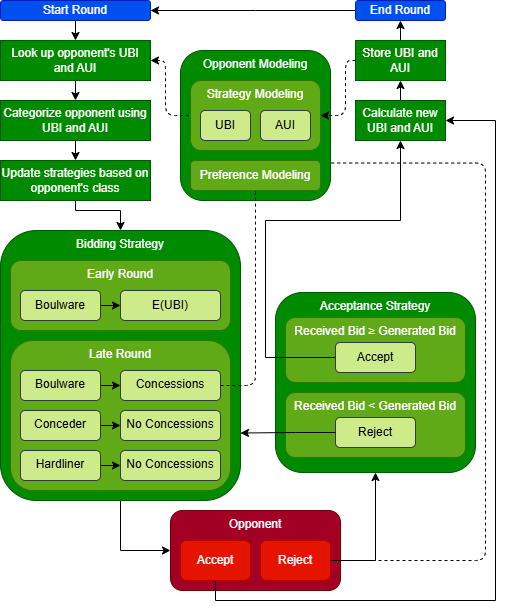
Figure 1: Overview of ChargingBoul’s entire negotiation strategy.
its novel opponent modeling first to introduce a few key terms that are neces-
sary to understand th