Authors: ** Niccol`o Covoni¹², Carlo Rovelli³⁴ ¹ DISPeA, University of Urbino, Italy ² USI, University of Svizzera Italiana, Lugano, Switzerland ³ Aix‑Marseille University, CPT‑CNRS, France ⁴ The Rotman Institute of Philosophy, University of Toronto, Canada **
📝 Abstract
This is a re-editing, which takes quantum mechanics into account, of Wittgenstein's famous Tractatus. The operation has a playful side in the form, but is a serious attempt to capture possible philosophical implications of the Relational Interpretation of Quantum Mechanics, and formalize the naturalistic third-way between realism and instrumentalism explored by this interpretation.
💡 Deep Analysis
📄 Full Content
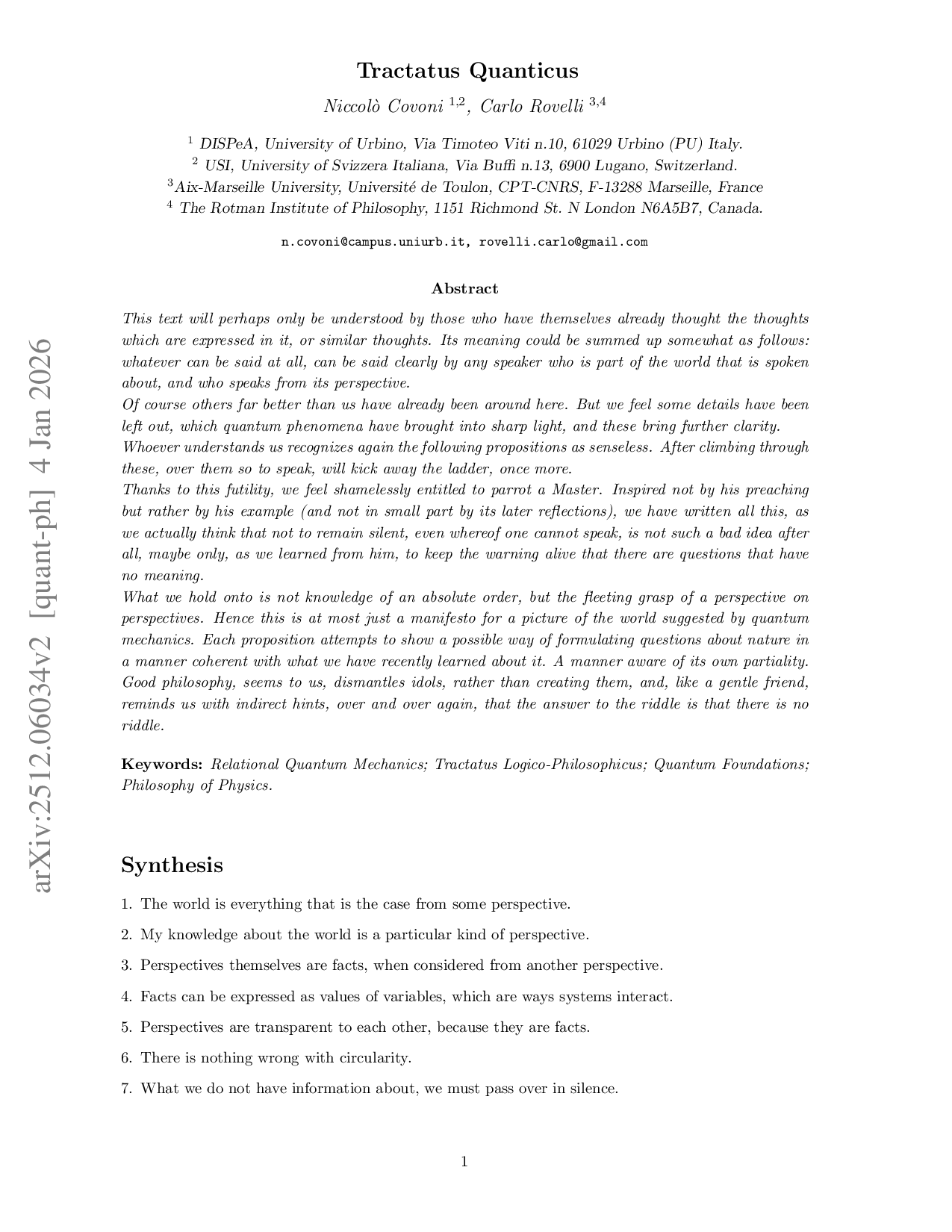
Tractatus Quanticus
Niccol`o Covoni 1,2, Carlo Rovelli 3,4
1 DISPeA, University of Urbino, Via Timoteo Viti n.10, 61029 Urbino (PU) Italy.
2 USI, University of Svizzera Italiana, Via Buffi n.13, 6900 Lugano, Switzerland.
3Aix-Marseille University, Universit´e de Toulon, CPT-CNRS, F-13288 Marseille, France
4 The Rotman Institute of Philosophy, 1151 Richmond St. N London N6A5B7, Canada.
n.covoni@campus.uniurb.it, rovelli.carlo@gmail.com
Abstract
This text will perhaps only be understood by those who have themselves already thought the thoughts
which are expressed in it, or similar thoughts. Its meaning could be summed up somewhat as follows:
whatever can be said at all, can be said clearly by any speaker who is part of the world that is spoken
about, and who speaks from its perspective.
Of course others far better than us have already been around here. But we feel some details have been
left out, which quantum phenomena have brought into sharp light, and these bring further clarity.
Whoever understands us recognizes again the following propositions as senseless. After climbing through
these, over them so to speak, will kick away the ladder, once more.
Thanks to this futility, we feel shamelessly entitled to parrot a Master. Inspired not by his preaching
but rather by his example (and not in small part by its later reflections), we have written all this, as
we actually think that not to remain silent, even whereof one cannot speak, is not such a bad idea after
all, maybe only, as we learned from him, to keep the warning alive that there are questions that have
no meaning.
What we hold onto is not knowledge of an absolute order, but the fleeting grasp of a perspective on
perspectives. Hence this is at most just a manifesto for a picture of the world suggested by quantum
mechanics. Each proposition attempts to show a possible way of formulating questions about nature in
a manner coherent with what we have recently learned about it. A manner aware of its own partiality.
Good philosophy, seems to us, dismantles idols, rather than creating them, and, like a gentle friend,
reminds us with indirect hints, over and over again, that the answer to the riddle is that there is no
riddle.
Keywords: Relational Quantum Mechanics; Tractatus Logico-Philosophicus; Quantum Foundations;
Philosophy of Physics.
Synthesis
1. The world is everything that is the case from some perspective.
2. My knowledge about the world is a particular kind of perspective.
3. Perspectives themselves are facts, when considered from another perspective.
4. Facts can be expressed as values of variables, which are ways systems interact.
5. Perspectives are transparent to each other, because they are facts.
6. There is nothing wrong with circularity.
7. What we do not have information about, we must pass over in silence.
1
arXiv:2512.06034v2 [quant-ph] 4 Jan 2026
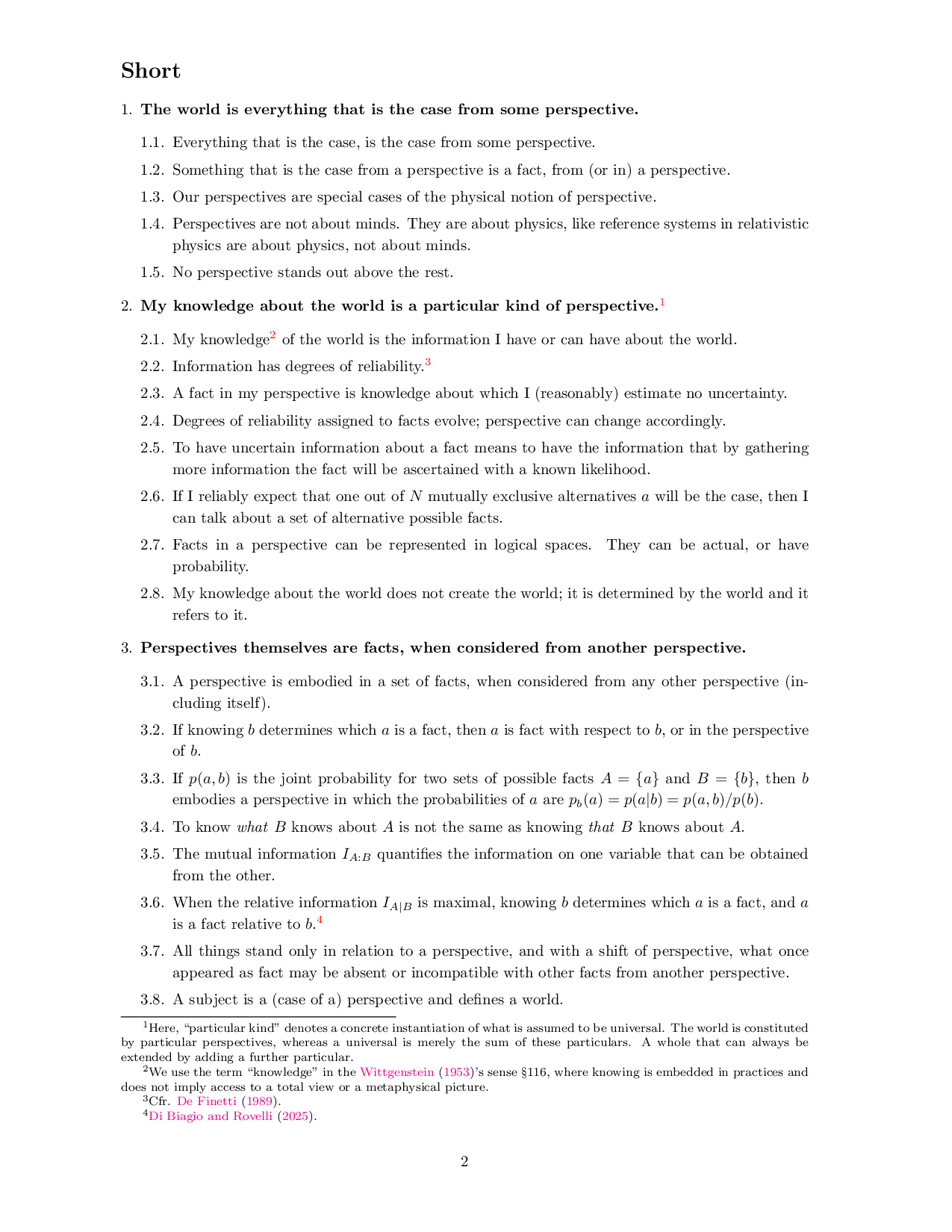
Short
1. The world is everything that is the case from some perspective.
1.1. Everything that is the case, is the case from some perspective.
1.2. Something that is the case from a perspective is a fact, from (or in) a perspective.
1.3. Our perspectives are special cases of the physical notion of perspective.
1.4. Perspectives are not about minds. They are about physics, like reference systems in relativistic
physics are about physics, not about minds.
1.5. No perspective stands out above the rest.
2. My knowledge about the world is a particular kind of perspective.1
2.1. My knowledge2 of the world is the information I have or can have about the world.
2.2. Information has degrees of reliability.3
2.3. A fact in my perspective is knowledge about which I (reasonably) estimate no uncertainty.
2.4. Degrees of reliability assigned to facts evolve; perspective can change accordingly.
2.5. To have uncertain information about a fact means to have the information that by gathering
more information the fact will be ascertained with a known likelihood.
2.6. If I reliably expect that one out of N mutually exclusive alternatives a will be the case, then I
can talk about a set of alternative possible facts.
2.7. Facts in a perspective can be represented in logical spaces.
They can be actual, or have
probability.
2.8. My knowledge about the world does not create the world; it is determined by the world and it
refers to it.
3. Perspectives themselves are facts, when considered from another perspective.
3.1. A perspective is embodied in a set of facts, when considered from any other perspective (in-
cluding itself).
3.2. If knowing b determines which a is a fact, then a is fact with respect to b, or in the perspective
of b.
3.3. If p(a, b) is the joint probability for two sets of possible facts A = {a} and B = {b}, then b
embodies a perspective in which the probabilities of a are pb(a) = p(a|b) = p(a, b)/p(b).
3.4. To know what B knows about A is not the same as knowing that B knows about A.
3.5. The mutual information IA:B quantifies the information on one variable that can be obtained
from the other.
3.6. Wh