The quantum principle of relativity (QPR) puts forward an ambitious idea: extend special relativity with a formally superluminal branch of Lorentz-type maps, and treat the resulting consistency constraints as hints about why quantum theory has the structure it does [1]. The discussion that followed has emphasized a basic point: writing down coordinate maps is not the same thing as providing a physical theory. In particular, quantum superposition is not operationally defined by drawing multiple paths on paper: it is defined by what happens when alternatives recombine in an interference loop [2, 3]. In parallel, careful 1+1 analyses have clarified how sign conventions and time-orientation choices enter the superluminal formulas [4]. Finally, tachyonic QFT proposals suggest a possible mathematical bridge via an enlarged (twin) Hilbert space [5], although this proposal remains contested (e.g., on commutator covariance and microcausality grounds) [6]. The aim of this short note is organizational. We keep three layers separate: (K) kinematics (which maps exist and what they preserve), (O) operational content (what an experiment must actually reproduce, especially closed-loop interference), and (D/B) dynamics and bridges (how amplitudes and probabilities are generated, and how subluminal and superluminal sectors might be linked). The goal is not relativity derives quantum theory, but a clear checklist of what must be added for that ambition to become a well-posed programme.
It is easy to see why QPR is appealing. Special relativity is driven by a crisp invariance idea: the form of the laws should not depend on which inertial frame you use. QPR asks whether one can push that mindset further by allowing "superluminal" descriptions, and then reading any resulting tensions as clues about quantum structure [1].
The main criticism is just as straightforward. A new class of coordinate maps, by itself, does not tell you what a detector records, what counts as an outcome, or why an interferometer produces fringes. Those are operational questions, and they are exactly where quantum theory earns its keep. In particular, “superposition” is not a slogan about having several pictures of one trajectory; operationally it is about recombination and phase dependence in closed loops [2]. This is why several comments insist that any claimed “derivation” must be explicit about which extra assumptions are being introduced [3].
This paper does not try to settle the debate, and it does not defend the strong claim that relativity alone implies quantum theory. Instead, it tries to do three practical things:
• keep the 1+1 kinematics tidy (including sign and orientation choices that are easy to gloss over);
• state operational requirements in a way that cannot be evaded by coordinate relabeling;
• spell out what a genuine “bridge” would have to provide if one wants more than a suggestive narrative.
The overall message is constructive. One can write down a coherent programme (call it “QPR+”)-but it needs deliberate additions. Kinematics alone will not produce loop interference; and a serious superluminal sector requires an explicit dynamical framework that outputs observable statistics.
Writing Lorentz-like formulas for |V | > c is the easy part. The hard questions are different:
• Do such maps correspond to anything like physical “frame changes” in 1+3?
• Even if we accept them as auxiliary redescriptions, do they force genuinely quantum phenomena, such as loop interference, rather than merely suggestive stories?
To keep these issues from being mixed together, we separate three layers.
A kinematic layer specifies a class of affine linear maps between coordinate systems (including translations) used to relate descriptions of events and worldlines, together with their algebraic properties and stated domain of use. A kinematic map need not be a physical symmetry of Minkowski spacetime.
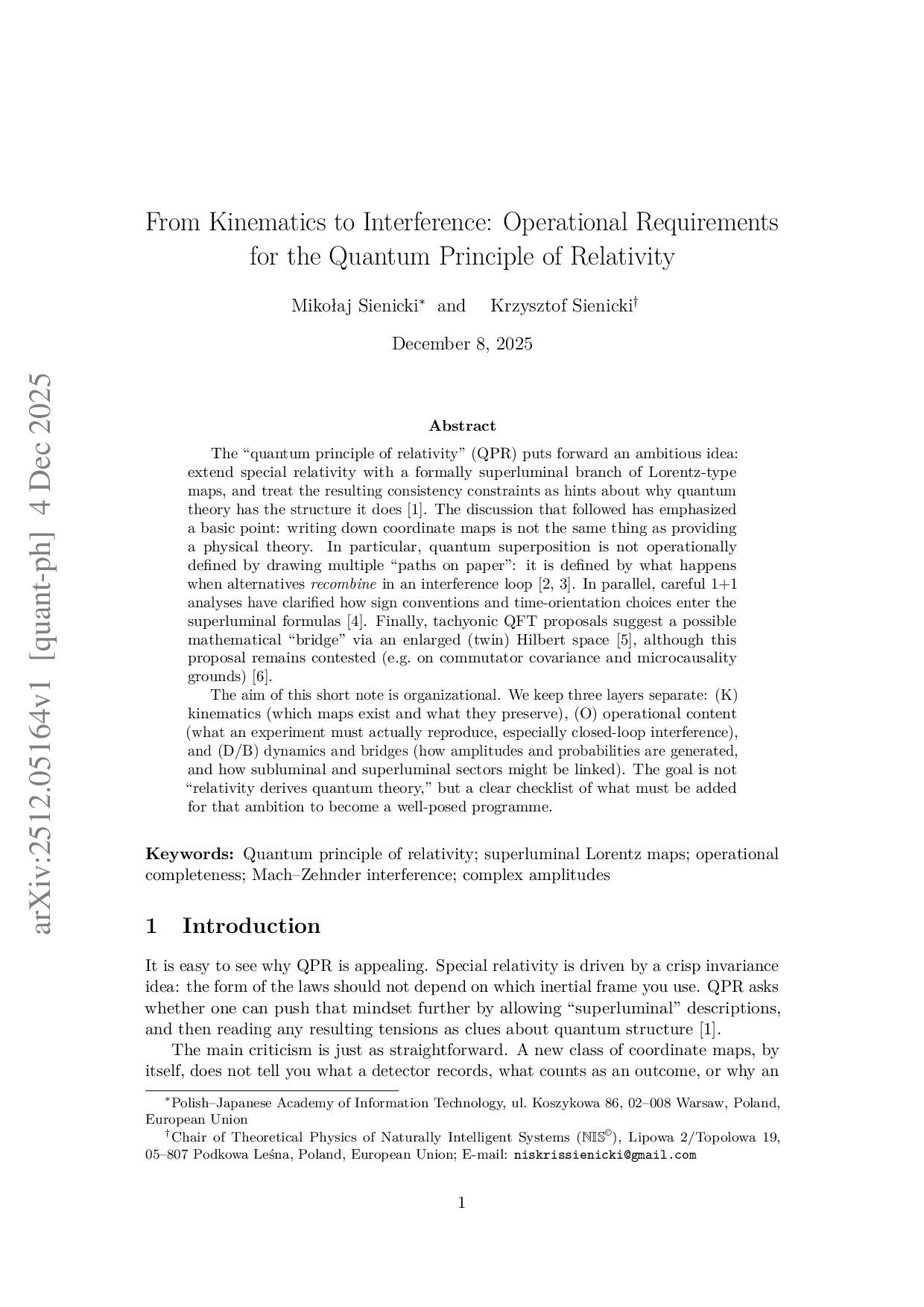
1+1 formulas and the extra sign choice. In 1+1 spacetime, standard Lorentz transformations between inertial coordinates (t, x) and (t ′ , x ′ ) are
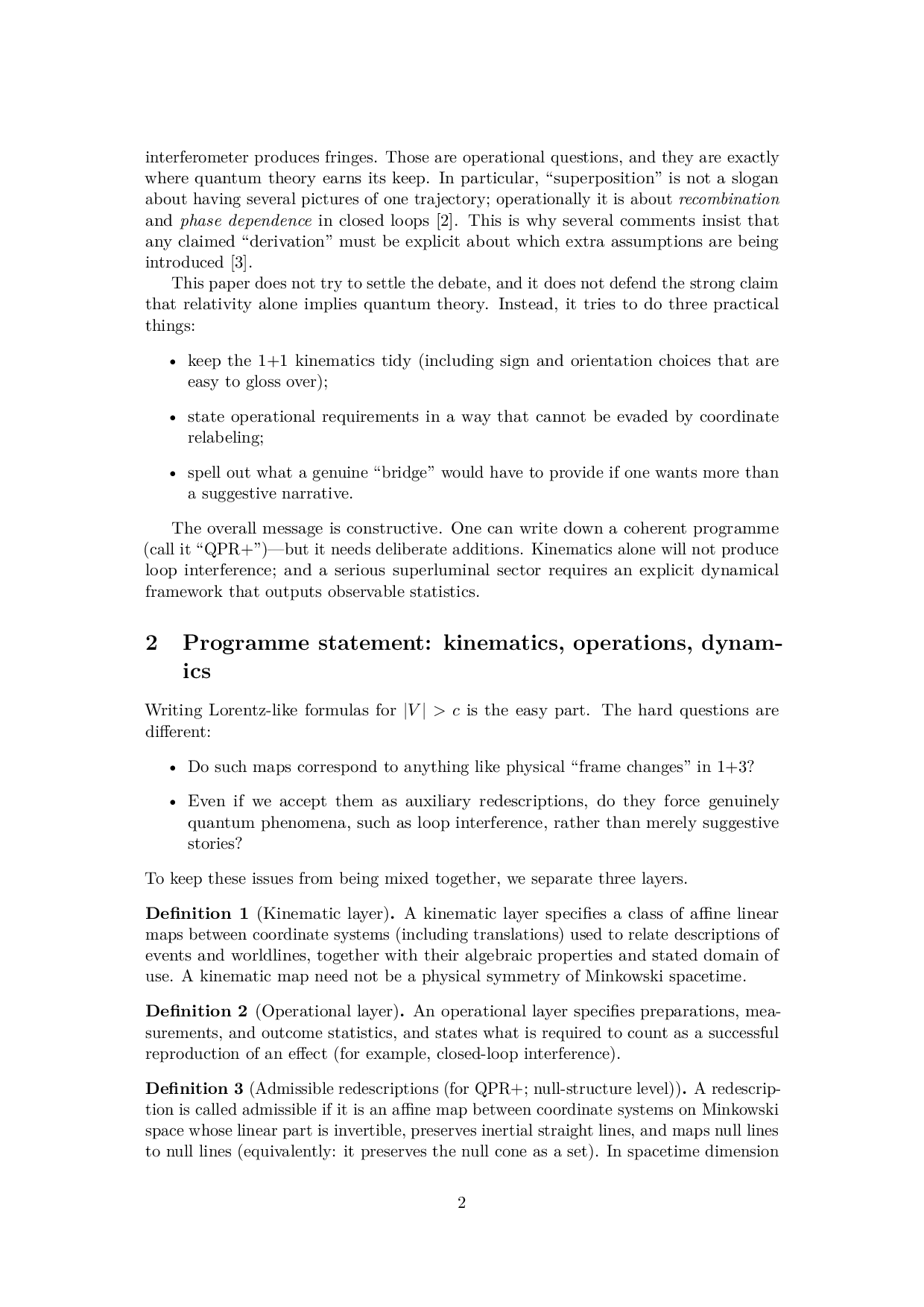
Under certain assumption sets (and in some “algebraic extension” discussions), one also writes a second branch, formally defined for |V | > c (see also Damski 4):
where η(V ) ∈ {±1}. Unlike the subluminal case, there is no V → 0 limit that fixes η by continuity. So even in 1+1, the formulas themselves do not settle their physical interpretation.
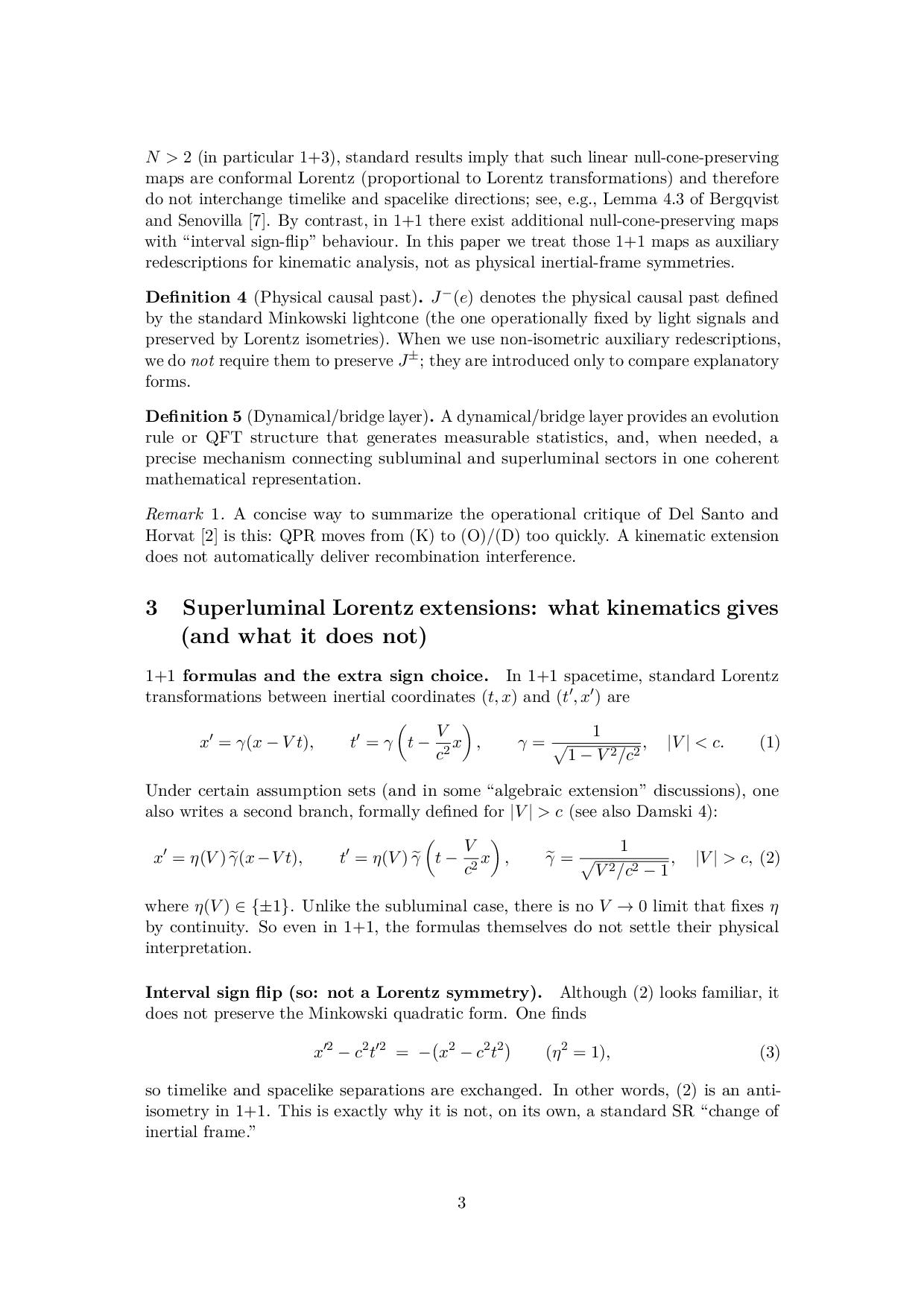
Interval sign flip (so: not a Lorentz symmetry). Although (2) looks familiar, it does not preserve the Minkowski quadratic form. One finds
so timelike and spacelike separations are exchanged. In other words, ( 2) is an antiisometry in 1+1. This is exactly why it is not, on its own, a standard SR “change of inertial frame.”
Why 1+3 is different. In 1+3, QPR’s key warning is that if one tries to treat subluminal Lorentz transformations and a superluminal branch on equal “relativity” footing, one is pushed toward non-isometric maps (e.g. anisotropic scalings) as putative symmetries, which is not empirically acceptable [1]. So in 1+3, superluminal maps should not be treated as physical observer equivalences. At most, they can serve as auxiliary redescriptions, typically with altered roles for time and space.
Damski’s contribution is clean and kinematic: it clarifies parametrizations and sign/time-orientation conventions for 1+1 superluminal maps [4]. It does not (and does not claim to) produce operational predictions such as loop interference, nor a probability rule.
Definition 6 (Past-worldline data). Let S be an emitting system with timelike worldline Γ S , equipped with an intrinsic time order (e.g. proper time τ ). For an event e ∈ Γ S , define Γ - S (e) := {e ′ ∈ Γ S : τ (e ′ ) < τ (e)}.
The past-worldline data at e is I - S (e), the restriction of the system’s classical state variables to Γ - S (e).
. A process involving an event e on Γ S is locally deterministic if there exists a function F such that an operational parameter of the event (for example, its proper-time location τ (e), or a binary occurrence indicator χ(e) ∈ {0, 1}) is determined by I - S (e):
QPR as a programme-level requirement. Because superluminal maps are not physical symmetries in 1+3, treating them “like” frame changes is ultimately a normative move: it states what the programme wants to be true, rather than what SR already guarantees.
Postulate 1 (QPR (invariance of local-deterministic admissibility)). For any process P in the theory’s domai
This content is AI-processed based on open access ArXiv data.