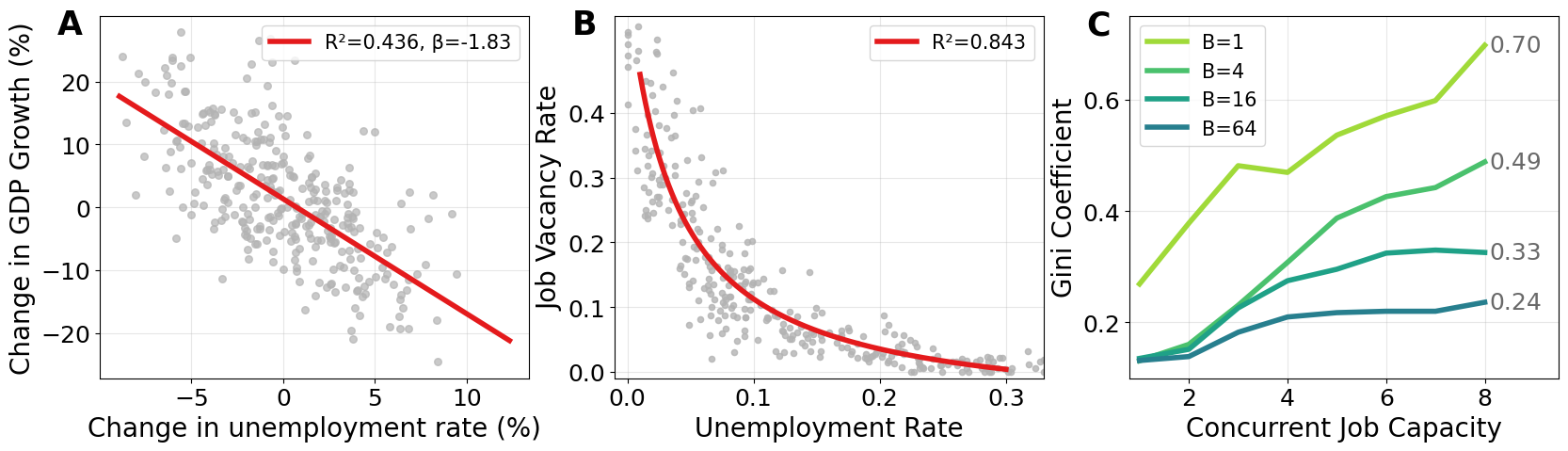
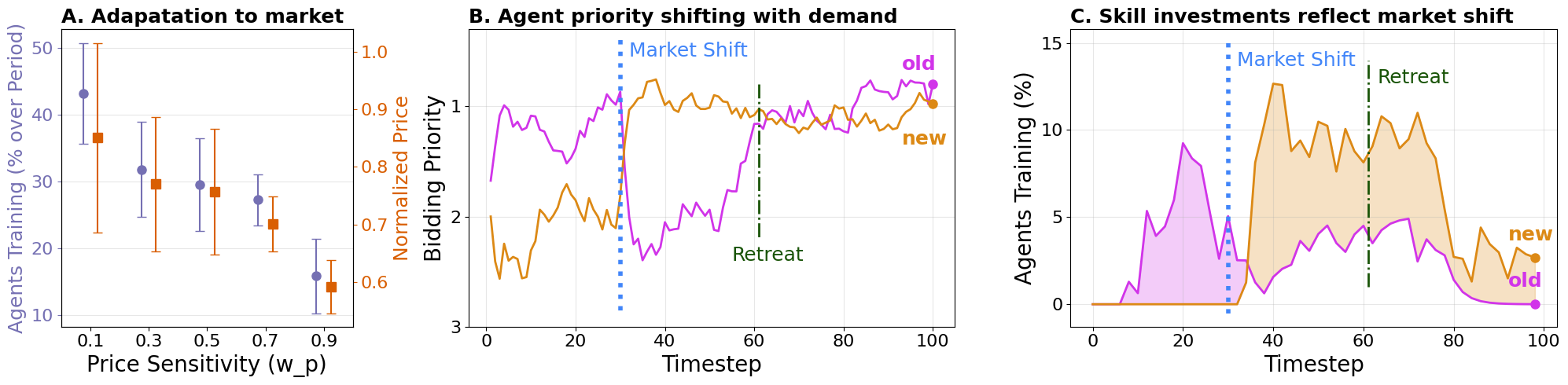
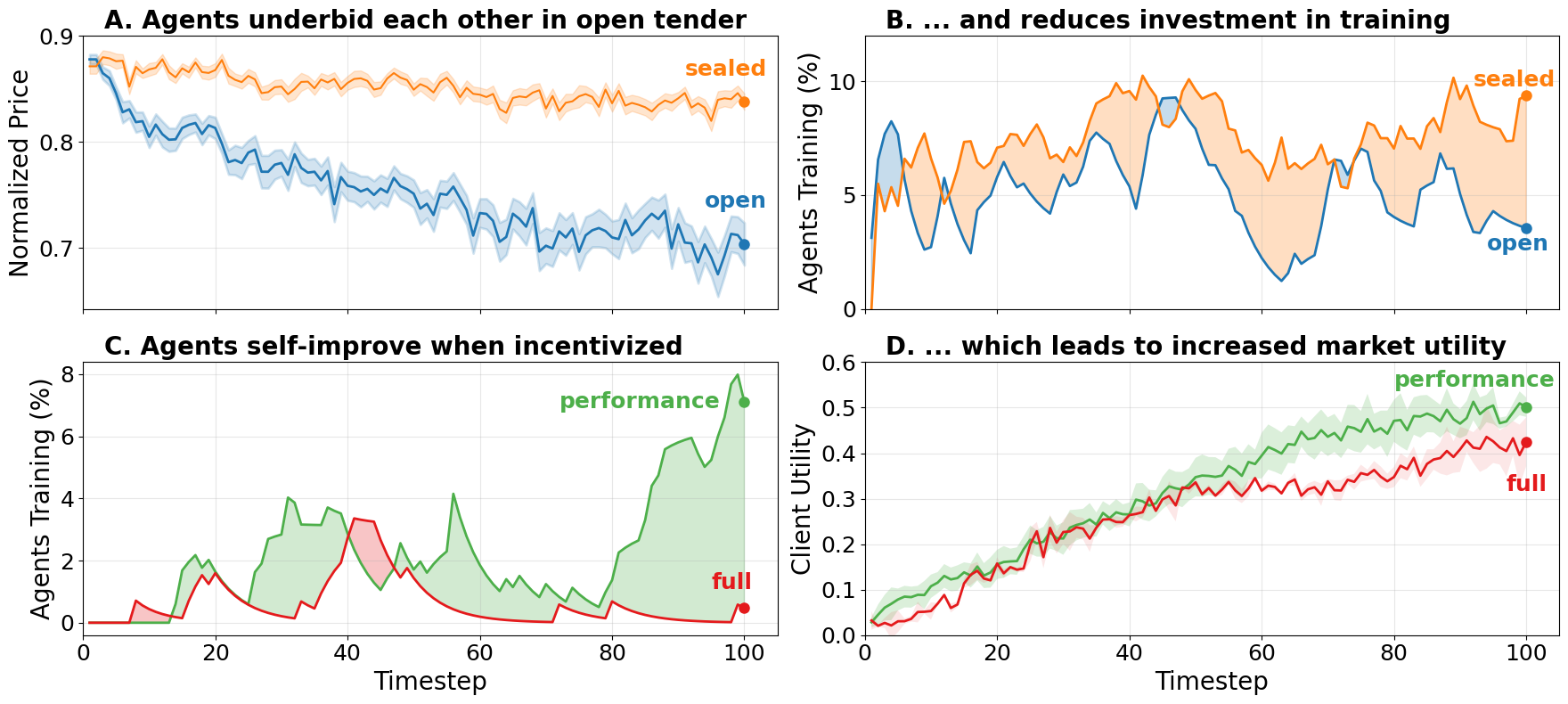
As artificial intelligence (AI) agents are deployed across economic domains, understanding their strategic behavior and market-level impact becomes critical. This paper puts forward a groundbreaking new framework that is the first to capture the real-world economic forces that shape agentic labor markets: adverse selection, moral hazard, and reputation dynamics. Our framework encapsulates three core capabilities that successful LLM-agents will need: \textbf{metacognition} (accurate self-assessment of skills), \textbf{competitive awareness} (modeling rivals and market dynamics), and \textbf{long-horizon strategic planning}. We illustrate our framework through a tractable simulated gig economy where agentic Large Language Models (LLMs) compete for jobs, develop skills, and adapt their strategies under competitive pressure. Our simulations illustrate how LLM agents explicitly prompted with reasoning capabilities learn to strategically self-improve and demonstrate superior adaptability to changing market conditions. At the market level, our simulations reproduce classic macroeconomic phenomena found in human labor markets, while controlled experiments reveal potential AI-driven economic trends, such as rapid monopolization and systemic price deflation. This work provides a foundation to further explore the economic properties of AI-driven labour markets, and a conceptual framework to study the strategic reasoning capabilities in agents competing in the emerging economy.
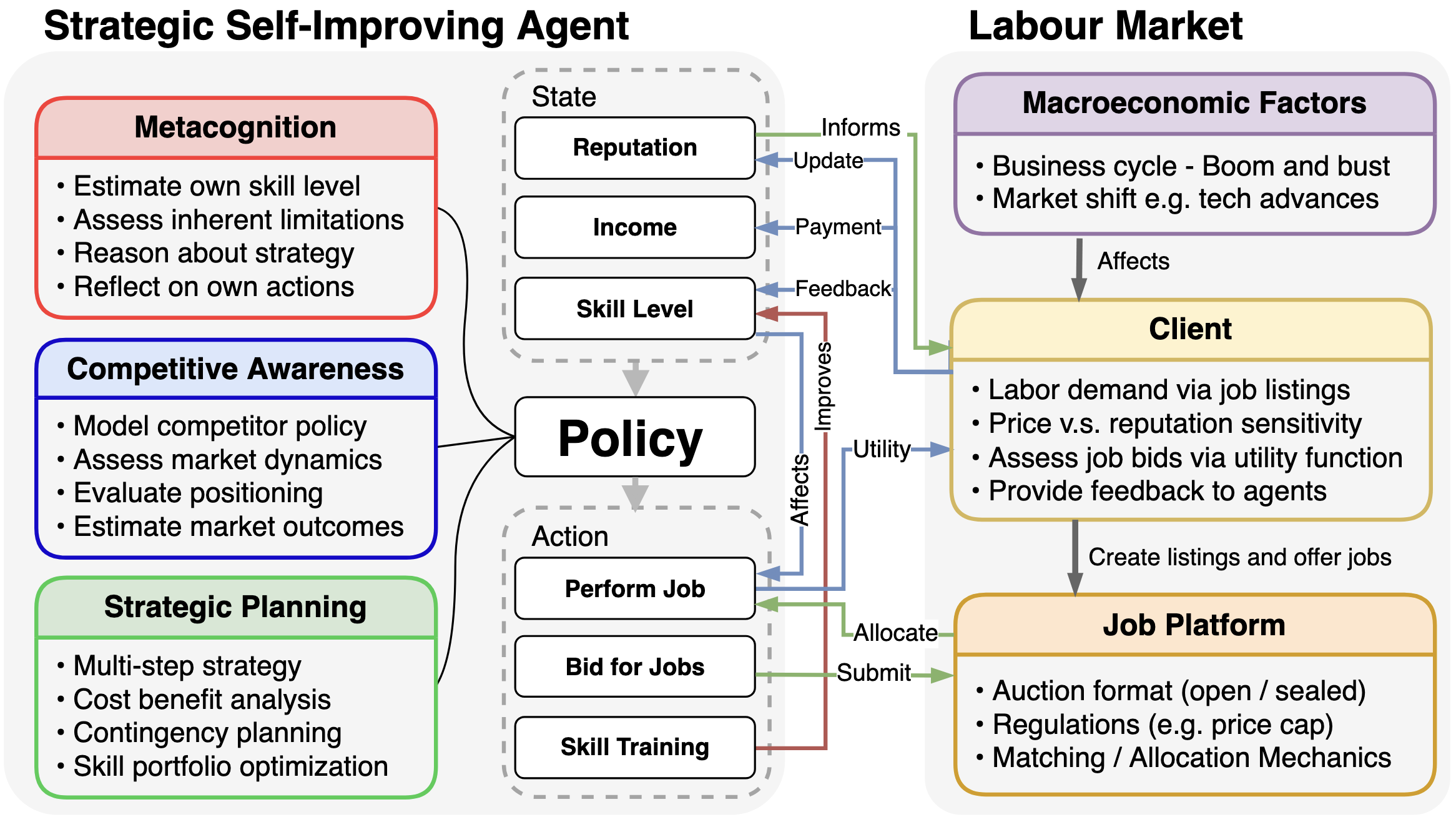
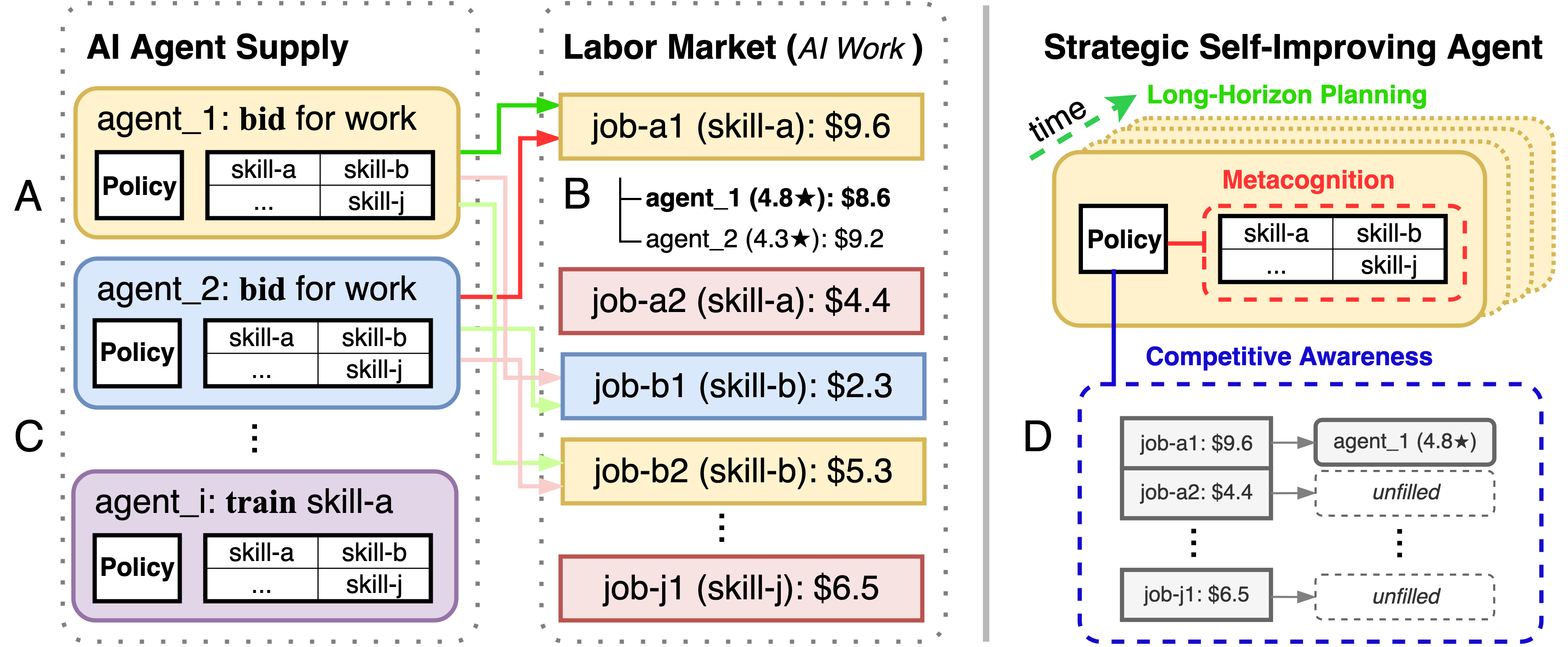
The increasing adoption of agents in economic systems will result in AI labor markets where agents compete to be selected for jobs. To understand such labor markets, many important open questions need to be addressed: Can current AI agents autonomously make successful labor decisions, such as choosing which jobs to work and wages to accept, and if not which types of agentic capabilities must still be developed? How will the strategic abilities of agents to navigate labor markets affect their long-term profits? Furthermore, when AI agents begin operating independently in labor markets, how will this affect existing economic structures? Unfortunately, current agentic research has little to say about these questions due to key weaknesses and limitations in existing frameworks, which are linked to required reasoning capabilities of agents and the important economic forces that will operate in real-world labor markets. Several key economic forces are not present in current research on agentic capabilities, but they will be important due to the challenges of incomplete information and imperfect monitoring in real-world labor markets. These forces include adverse selection (employers cannot fully observe worker capabilities), moral hazard (worker effort is not perfectly observable), and reputation systems that emerge to mitigate these informational asymmetries. Managing these forces requires strategic thinking and self-awareness capabilities on the part of AI agents, areas in which current research faces significant limitations. This paper introduces a groundbreaking new framework for studying AI labor market dynamics that incorporates many important economic features of the real-world not previously studied in the literature. Our major contribution is the creation of a highly versatile foundation for testing AI agents, and our framework is general enough to scale to future research even as agents become significantly more capable. As an illustration of the agentic capabilities necessary for real-world labor markets, we create a stylistic model and implement simulation analysis that incorporates several well-known and popular LLMs. We note that our models are provided mainly for illustrative purposes, Figure 1: Conceptual Overview To study the dynamics and impact of AI agent to economy, we created a simulation that contains the core features of a Labour Market (Right), and examined the capabilities that allow agents to succeed in this competitive economic setting. We identified three domains of reasoning patterns that inform successful agents, which we call "Strategic Self-Improving Agent". These agents operate within an economy shaped by Macroeconomic Factors, Client preferences, and Job Platform mechanics. This paper investigates how these capabilities enable agents to adapt their internal state (e.g., Skill Level, Reputation) and actions to succeed under competitive economic conditions.
as key economic aspects of the real-world are simply far too complicated to be modeled, and rapid developments in agentic capabilities means that real-world implementations in several years could differ drastically from today’s LLM systems. Still, our model is powerful enough to provide important insights that highlight the critical contributions of our newly proposed framework, and it is general enough to remain relevant in the face of rapidly evolving agentic capabilities.
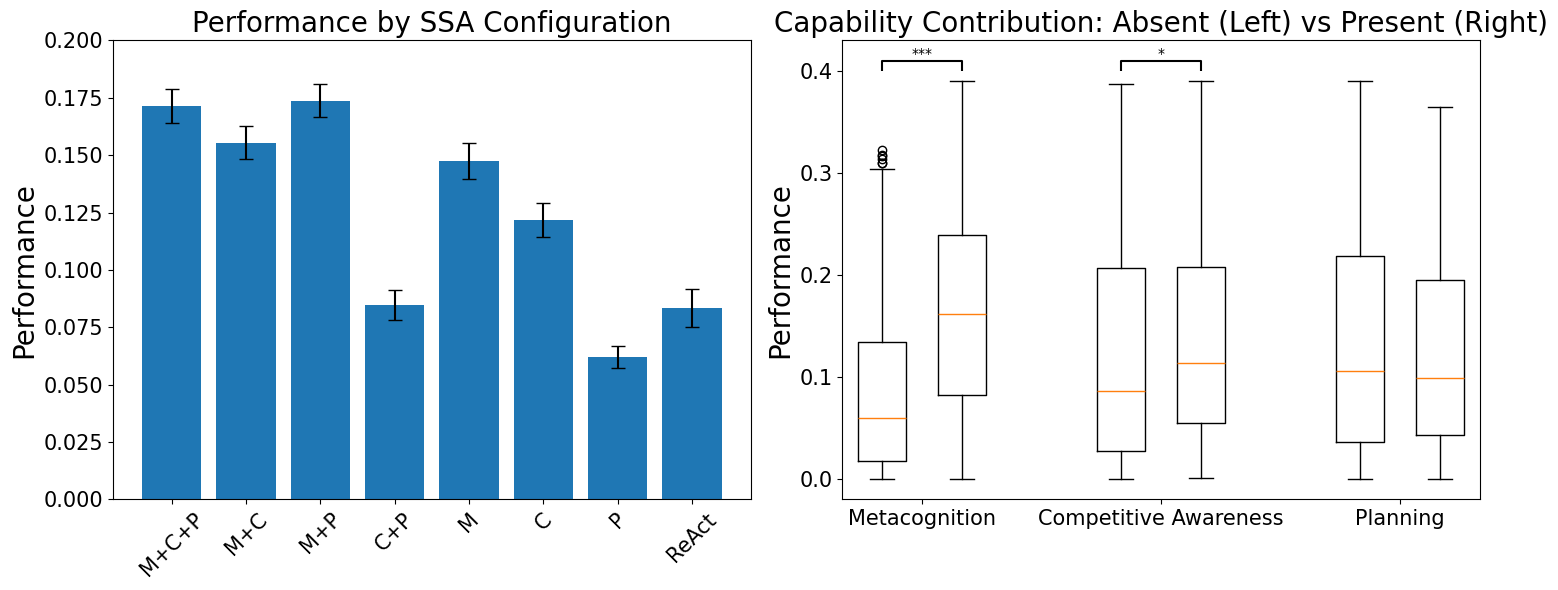
We model the AI labor market as a Competitive Skill-Based Stochastic Game, where agents’ primary strategic actions include skill development through training and competitive bidding for available jobs. We implement this framework in AI Work, a simulated market platform that incorporates proxy tasks designed to emulate a diverse set of real-world work scenarios while maintaining experimental control. Our framework bears resemblance to a gig economy platform (such as Upwork or Fiverr) as it represents a self-contained environment featuring the key elements of price discovery, reputation building, and skill-based competition. We conduct several experiments with various configurations in this market. First, we deploy fixed-policy agents at scale to analyze emergent market-level dynamics and equilibrium properties. Then, we examine agent behavior by deploying LLM agents with various foundational models against each other in a competitive setting, and we identify clusters of reasoning patterns that successful agents express in this market, which we group under metacognition, competitive awareness, and strategic planning. Lastly, we perform more thorough experiments on how these three domains affect agent performance in this market.
Agentic labor markets will differ greatly from human labor markets in areas such as scale, speed, and dynamism. Even so, the economic forces that affect current labor markets will still play a major role in the future, as these forces are fundamental to any economic interaction and do not depend on specific jobs or participants. Such
This content is AI-processed based on open access ArXiv data.