Robustness Test for AI Forecasting of Hurricane Florence Using FourCastNetv2 and Random Perturbations of the Initial Condition
Reading time: 5 minute
...
📝 Original Info
Title: Robustness Test for AI Forecasting of Hurricane Florence Using FourCastNetv2 and Random Perturbations of the Initial Condition
ArXiv ID: 2512.05323
Date: 2025-12-04
Authors: : Adam Lizerbrama, Shane Stevensona, Iman Khadirb, Matthew Tub, Samuel S. P. Shenb
📝 Abstract
Understanding the robustness of a weather forecasting model with respect to input noise or different uncertainties is important in assessing its output reliability, particularly for extreme weather events like hurricanes. In this paper, we test sensitivity and robustness of an artificial intelligence (AI) weather forecasting model: NVIDIAs FourCastNetv2 (FCNv2). We conduct two experiments designed to assess model output under different levels of injected noise in the models initial condition. First, we perturb the initial condition of Hurricane Florence from the European Centre for Medium-Range Weather Forecasts (ECMWF) Reanalysis v5 (ERA5) dataset (September 13-16, 2018) with varying amounts of Gaussian noise and examine the impact on predicted trajectories and forecasted storm intensity. Second, we start FCNv2 with fully random initial conditions and observe how the model responds to nonsensical inputs. Our results indicate that FCNv2 accurately preserves hurricane features under low to moderate noise injection. Even under high levels of noise, the model maintains the general storm trajectory and structure, although positional accuracy begins to degrade. FCNv2 consistently underestimates storm intensity and persistence across all levels of injected noise. With full random initial conditions, the model generates smooth and cohesive forecasts after a few timesteps, implying the models tendency towards stable, smoothed outputs. Our approach is simple and portable to other data-driven AI weather forecasting models.
💡 Deep Analysis
📄 Full Content
Generated using the official AMS LATEX template v6.1
Robustness Test for AI Forecasting of Hurricane Florence Using
FourCastNetv2 and Random Perturbations of the Initial Condition
Adam Lizerbrama , Shane Stevensona , Iman Khadirb , Matthew Tub , Samuel S. P. Shenb
a Department of Computer Science, San Diego State University, San Diego, California, United States
b Department of Mathematics, San Diego State University, San Diego, California, United States
Corresponding author: Samuel S. P. Shen, sshen@sdsu.edu
1
arXiv:2512.05323v1 [cs.LG] 4 Dec 2025
ABSTRACT: Understanding the robustness of a weather forecasting model with respect to input
noise or different uncertainties is important in assessing its output reliability, particularly for
extreme weather events like hurricanes. In this paper, we test sensitivity and robustness of an
artificial intelligence (AI) weather forecasting model: NVIDIA’s FourCastNetv2 (FCNv2). We
conduct two experiments designed to assess model output under different levels of injected noise in
the model’s initial condition. First, we perturb the initial condition of Hurricane Florence from the
European Centre for Medium-Range Weather Forecasts (ECMWF) Reanalysis v5 (ERA5) dataset
(September 13–16, 2018) with varying amounts of Gaussian noise and examine the impact on
predicted trajectories and forecasted storm intensity. Second, we start FCNv2 with fully random
initial conditions and observe how the model responds to nonsensical inputs. Our results indicate
that FCNv2 accurately preserves hurricane features under low to moderate noise injection. Even
under high levels of noise, the model maintains the general storm trajectory and structure, although
positional accuracy begins to degrade. FCNv2 consistently underestimates storm intensity and
persistence across all levels of injected noise. With full random initial conditions, the model
generates smooth and cohesive forecasts after a few timesteps, implying the model’s tendency
towards stable, smoothed outputs. Our approach is simple and portable to other data-driven AI
weather forecasting models.
2
SIGNIFICANCE STATEMENT:
The robustness of an AI weather forecasting model must be
quantified for forecasters to have confidence using the tool. This paper provides a robustness test
of NVIDIA’s AI weather forecasting model FourCastNetv2 for the scenario of tracking Hurricane
Florence in September 2018.
By adding different levels of noise to the initial condition, we
find that the model produces accurate hurricane paths under moderate noise, while high noise
degrades accuracy but still preserves the rough trajectory. However, the model predicts a lower
storm intensity whether or not influenced by the initial noise. Under completely random initial
conditions, the model still generates smooth forecasts. These results suggest that FourCastNetv2
is resilient to imperfect inputs and tends to produce robust predictions.
1. Introduction
Inevitable noise in atmospheric measurements and nonlinear interactions among many weather
variables lead to a level of uncertainty in any weather forecast model. Quantifying this uncertainty
is critically important, particularly when tracking severe weather events, such as hurricanes. Would
small perturbations in the initial atmospheric condition significantly change the predicted storm path
and strength? In this paper, we address this kind of robustness problem by focusing on trajectory
and intensity predictions of Hurricane Florence with NVIDIA’s FourCastNetv2 (FCNv2) (Bonev
et al. 2023). Specifically, we evaluate the robustness of the AI weather forecasting model to
imperfect initial conditions.
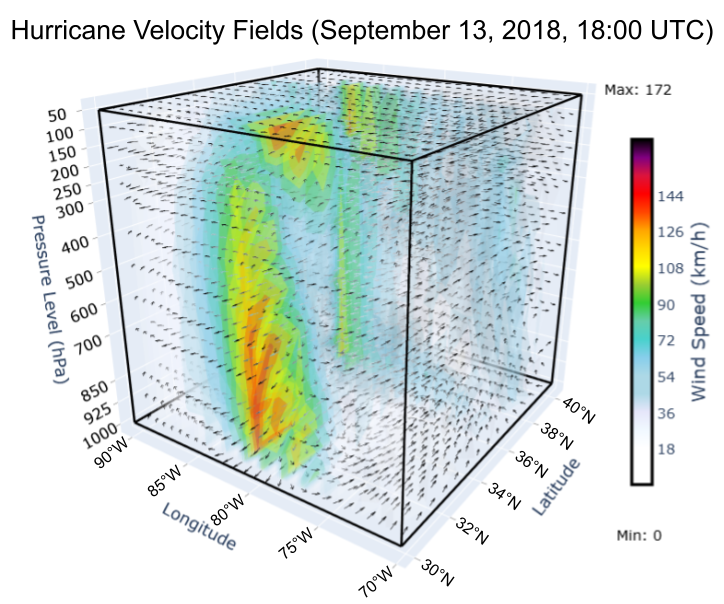
To illustrate the motivation of this study, Fig.
1 presents a 3-dimensional visualization of
Hurricane Florence’s true wind velocity field, depicting the storm’s structure through wind speeds
and directions.
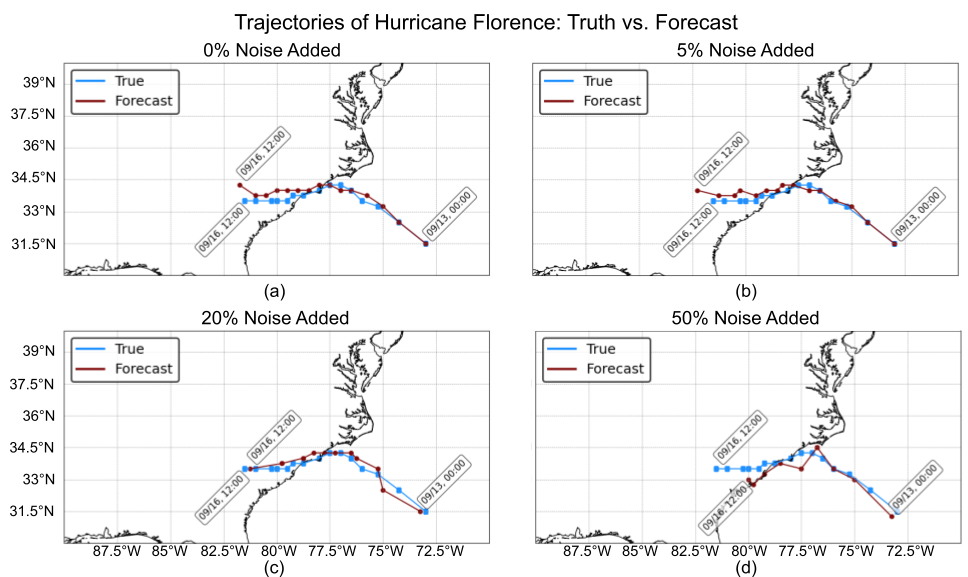
Figure 2 then compares the true trajectory of Hurricane Florence and track
predictions generated by FCNv2 under different levels of noise applied to the initial conditions.
Each panel shows the median outcome from 30 repeated runs at a given noise level, demonstrating
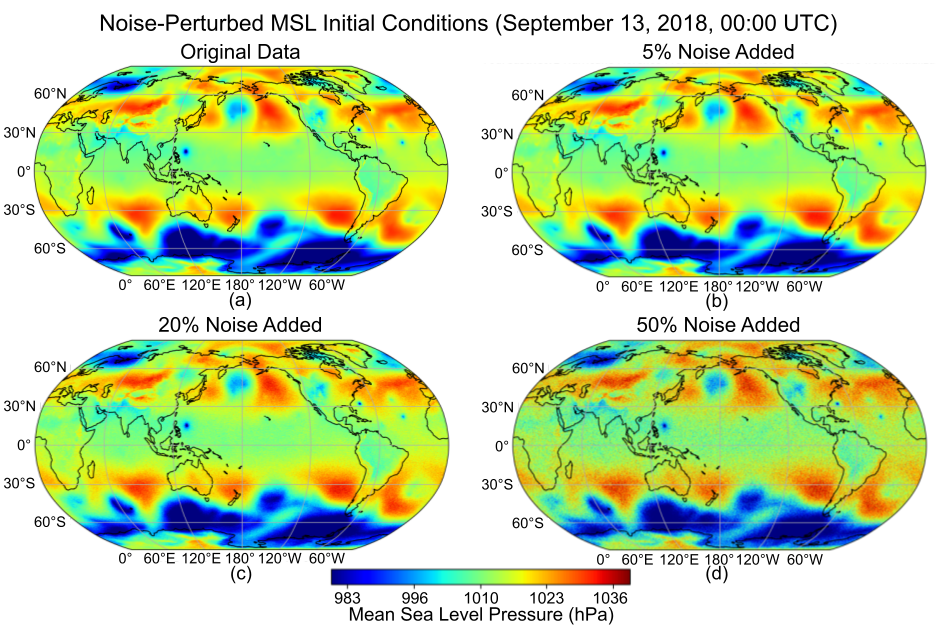
the effect of noise on forecasts. The procedure of applying noise to the initial condition is explained
in Section 2c. With little to no added noise, the model closely follows the true trajectory until the last
timesteps, where it slightly deviates. With moderate noise, the start and end of the predicted track
is accurate, with some displacement mid-forecast. When large amounts of noise are introduced,
the prediction degrades but continues to follow the general direction of the storm.
3
Fig. 1. The wind velocity field of Hurricane Florence at 18:00 UTC, September 13, 2018: Wind speed
(depicted by the color bar) and direction (depicted by the arrows) for the central Atlantic area (30°N–40°N
latitude, 70°W–90°W longitude) over all 13 pressure levels.
These two figures highlight the central question of this paper: how robust are AI weather
forecasting mo