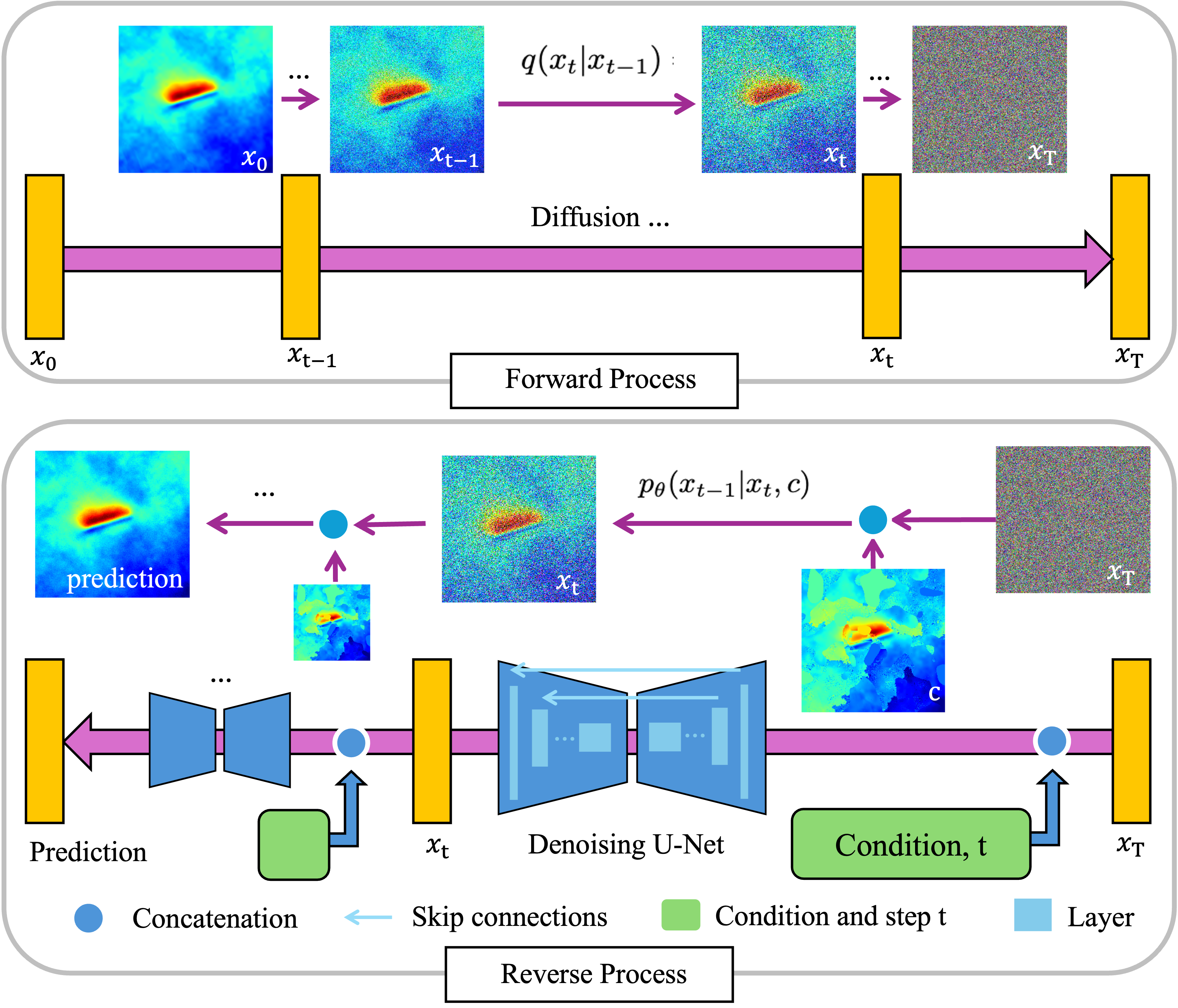
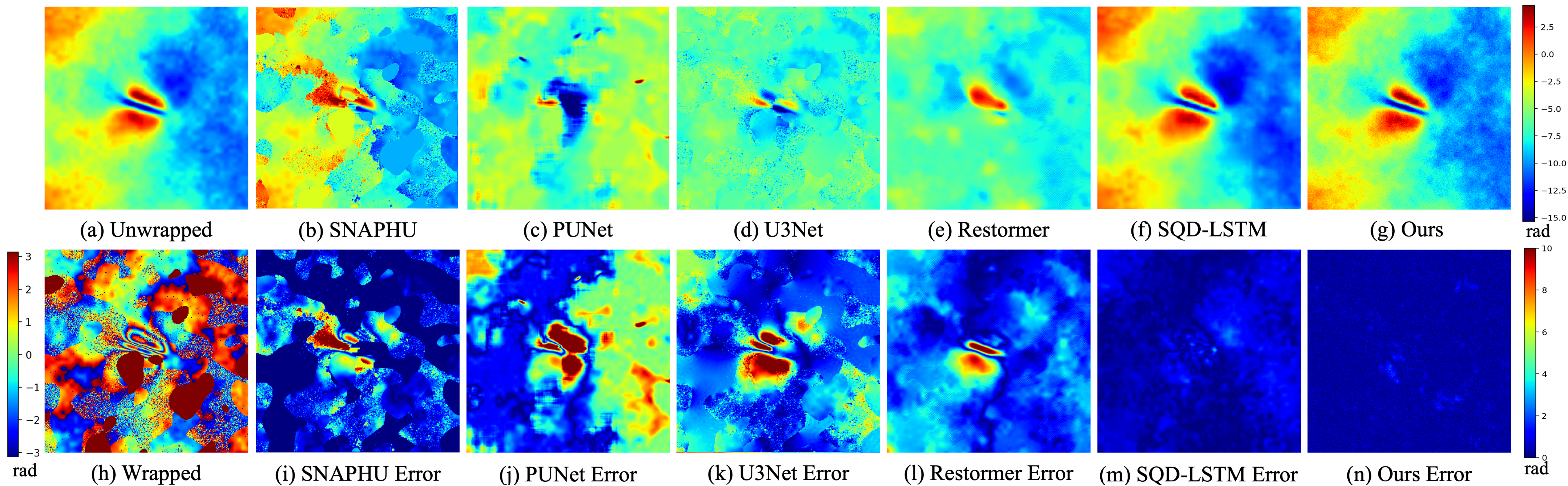
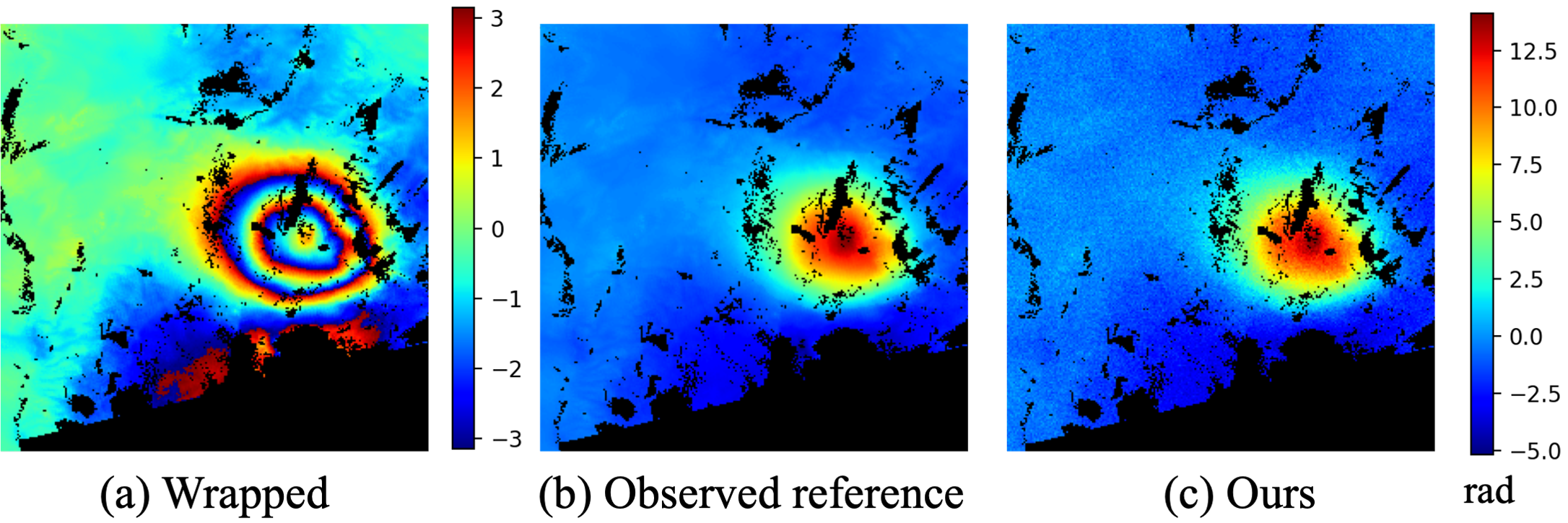
Phase unwrapping is a fundamental problem in InSAR data processing, supporting geophysical applications such as deformation monitoring and hazard assessment. Its reliability is limited by noise and decorrelation in radar acquisitions, which makes accurate reconstruction of the deformation signal challenging. We propose a denoising diffusion probabilistic model (DDPM)-based framework for InSAR phase unwrapping, UnwrapDiff, in which the output of the traditional minimum cost flow algorithm (SNAPHU) is incorporated as conditional guidance. To evaluate robustness, we construct a synthetic dataset that incorporates atmospheric effects and diverse noise patterns, representative of realistic InSAR observations. Experiments show that the proposed model leverages the conditional prior while reducing the effect of diverse noise patterns, achieving on average a 10.11\% reduction in NRMSE compared to SNAPHU. It also achieves better reconstruction quality in difficult cases such as dyke intrusions.
Interferometric Synthetic Aperture Radar (InSAR) is a powerful technique for monitoring ground deformation related to earthquakes, volcanic activity and other geophysical processes [1][2][3]. A key step in InSAR processing is phase unwrapping. Radar phase measurements are recorded modulo 2π, which introduces discontinuities in the observed signal. The unwrapped phase represents the true ground deformation and can be directly used for subsequent geophysical analysis. The goal is to reconstruct the absolute interferometric phase from wrapped observations. The problem is inherently ill-posed, because both the continuous phase and the integer ambiguity must be determined. Accurate unwrapping is essential for reliable deformation mapping. However, it remains challenging in certain cases, particularly where noise, decorrelation, or sharp deformation gradients occur [4].
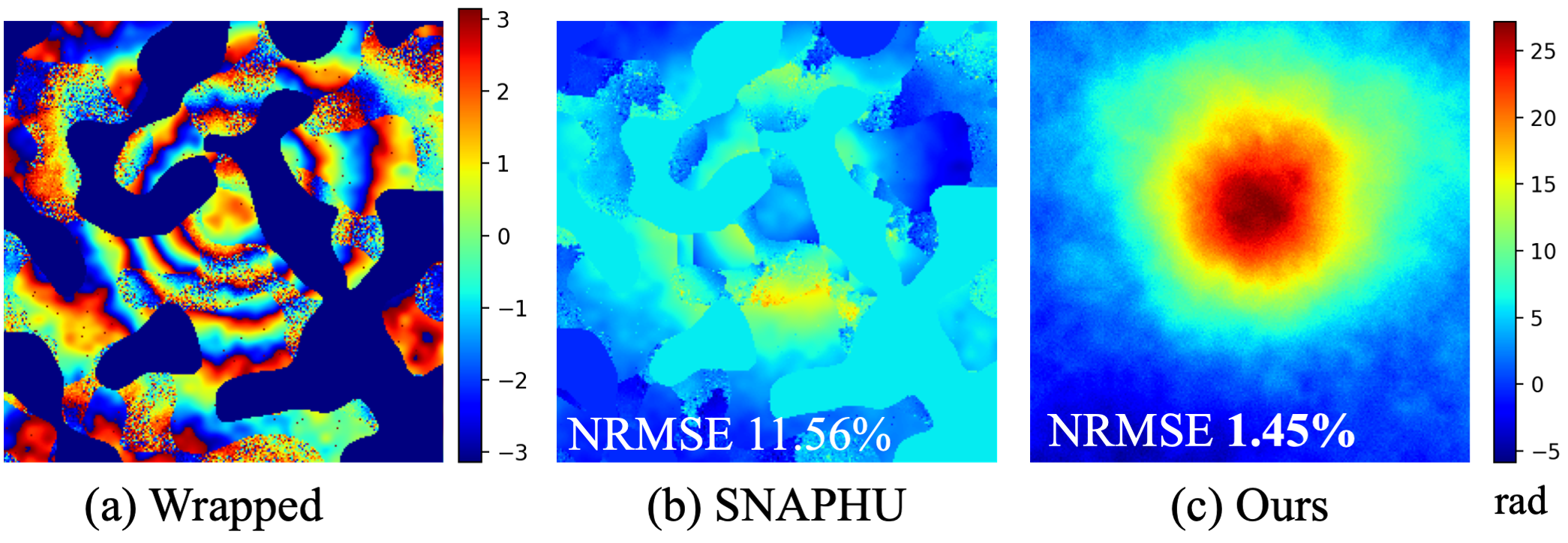
Traditional phase unwrapping methods can be grouped into path-following and optimization-based approaches. Path-following methods, such as branch-cut [5], unwrap phase by integrating along paths while cutting around residues. Optimization-based methods, such as Statistical-cost, Networkflow Algorithm for Phase Unwrapping (SNAPHU) [6], solve a minimum-cost flow problem to enforce global consistency. These approaches are effective in simple cases, but they perform poorly in low-coherence regions (e.g. water bodies) or under sharp deformation gradients (as shown in Fig. 1), where discontinuities and incorrect branch cuts often appear.
Deep learning has only recently been applied to InSAR phase unwrapping, and the number of task-specific designs remains limited. PhaseNet [7] first formulated unwrapping as a multi-class classification task by predicting wrap counts, and was later extended by PhaseNet 2.0 [8], which improved the network architecture and training objectives to enhance robustness. U3Net [9] introduces an unsupervised strategy using deep unrolling that leverages coherence-driven and reconstruction losses to reduce dependence on paired ground truth. SQD-LSTM [10] captures sequential dependencies in the wrapped-to-unwrapped mapping through recurrent modeling. Beyond methods designed specifically for unwrapping, the networks originally designed for image restoration have also been adapted to this task. Transformer-based architectures, such as Restormer [11], have been applied to phase unwrapping by modifying their loss functions [9]. More recently, generative approaches have been considered [12]. Diffusion probabilistic models [13,14] learn to reverse a progressive noising process and have achieved state-of-the-art performance in image restoration. Although diffusion models have shown high potential in image generation and reconstruction tasks, their potential for phase unwrapping remains unexplored.
In this paper, we address the aforementioned challenges by proposing UnwrapDiff, a conditional diffusion framework for InSAR phase unwrapping. The method uses SNAPHU outputs as priors to provide global consistency while correcting local errors in noisy and high-gradient regions as shown in Fig. 1c. Diffusion models offer unique advantages for this task: their iterative denoising process not only captures local textures and global spatial structures, but also enables stable reconstruction across phase discontinuities. This property is consistent with their demonstrated success in image inpainting and missing-data restoration, where diffusion-based methods recover continuous spatial fields despite gaps, noise, or severe corruption. Compared to direct regression or discriminative networks, diffusion models are therefore particularly suited to enforcing spatial constraints and global consistency in phase unwrapping.
To enable systematic evaluation, we construct a synthetic dataset that integrates deformation, atmospheric effects, and multiple noise patterns to enable systematic robustness evaluation. Experiments demonstrate that the proposed approach achieves higher reconstruction accuracy than exiting methods, particularly under decorrelation and complex deformation. These results suggest that diffusion models have strong potential as a robust alternative for InSAR phase unwrapping.
Phase Unwrapping Problem: Phase unwrapping seeks to recover a continuous phase field from wrapped interferometric observations. For an interferogram ϕ wrap ∈ (-π, π], the objective is to reconstruct the true unwrapped signal ϕ. Formally, the wrapped measurement is expressed as
where ϕ(x) is the continuous phase and ϕ w (x) its wrapped counterpart. In practice, ϕ w (x) is the observed signal, while ϕ(x) is the unknown quantity to be recovered. Algorithms such as SNAPHU address this problem by estimating the correct integer multiple of 2π across all pixels through global optimization strategies. This can be equivalently viewed as recovering an integer offset field that links the wrapped and unwrapped phases. In the ideal case, the phase gradient is preserved under wr
This content is AI-processed based on open access ArXiv data.