The central theorem of topological graph theory states that the graph minor relation is a well-quasi-order on graphs. It has far-reaching consequences, in particular in the study of graph structures and the design of (parameterized) algorithms. In this article, we study two embedded versions of classical minor relations from structural graph theory and prove that they are also well-quasi-orders on general or restricted classes of embedded planar graphs. These embedded minor relations appear naturally for intrinsically embedded objects, such as knot diagrams and surfaces in $\mathbb{R}^3$.
Handling the extra topological constraints of the embeddings requires careful analysis and extensions of classical methods for the more constrained embedded minor relations. We prove that the embedded version of immersion induces a well-quasi-order on bounded carving-width plane graphs by exhibiting particularly well-structured tree-decompositions and leveraging a classical argument on well-quasi-orders on forests. We deduce that the embedded graph minor relation defines a well-quasi-order on plane graphs via their directed medial graphs, when their branch-width is bounded. We conclude that the embedded graph minor relation is a well-quasi-order on all plane graphs, using classical grids theorems in the unbounded branch-width case.
💡 Deep Analysis
📄 Full Content
Well-quasi-orders on embedded planar graphs
Corentin Lunel∗
Clément Maria†
Abstract
The central theorem of topological graph theory states that the graph minor relation is
a well-quasi-order on graphs. It has far-reaching consequences, in particular in the study of
graph structures and the design of (parameterized) algorithms. In this article, we study two
embedded versions of classical minor relations from structural graph theory and prove that they
are also well-quasi-orders on general or restricted classes of embedded planar graphs. These
embedded minor relations appear naturally for intrinsically embedded objects, such as knot
diagrams and surfaces in R3.
Handling the extra topological constraints of the embeddings requires careful analysis and
extensions of classical methods for the more constrained embedded minor relations. We prove
that the embedded version of immersion induces a well-quasi-order on bounded carving-width
plane graphs by exhibiting particularly well-structured tree-decompositions and leveraging a
classical argument on well-quasi-orders on forests. We deduce that the embedded graph minor
relation defines a well-quasi-order on plane graphs via their directed medial graphs, when their
branch-width is bounded.
We conclude that the embedded graph minor relation is a well-
quasi-order on all plane graphs, using classical grids theorems in the unbounded branch-width
case.
1
Introduction
An abstract graph H is a minor of an abstract graph G if a graph isomorphic to H can be obtained
from G by a sequence of edge contractions and edge or vertex deletions. Equivalently, H is a minor
of G if the vertices of H can be sent to disjoint subgraphs of G, and the edges of H sent to vertex-
disjoint paths connecting the images of their endpoints. In a series of twenty papers, written over
the course of twenty years, Robertson and Seymour proved the graph minor theorem, stating that
the minor relation is a well-quasi-order on the set of graphs. It implies that any class of graph
that is closed under taking minors can be characterized by a finite set of excluded minors. This
exceptional achievement has had vast consequences in mathematics and computer science, and in
particular for our understanding of graph structures and the design of algorithms.
The theory has close ties with topology. Notably, for a graph to be embeddable on a surface of
genus g is a property closed under taking minors, which implies that the family of genus g graphs
is characterized by a finite set of excluded minors. For example, planar graphs are exactly those
graphs which exclude the clique K5 and the complete bipartite graph K3,3 as minors. In a somehow
opposite direction, a byproduct of Robertson-Seymour theory is the graph structure theorem, which
∗Charles University, Prague, Czechia, corentin.lunel@kam.mff.cuni.cz
†INRIA UniCA, clement.maria@inria.fr
1
arXiv:2512.04074v1 [cs.CG] 3 Dec 2025
e
G
H
G′
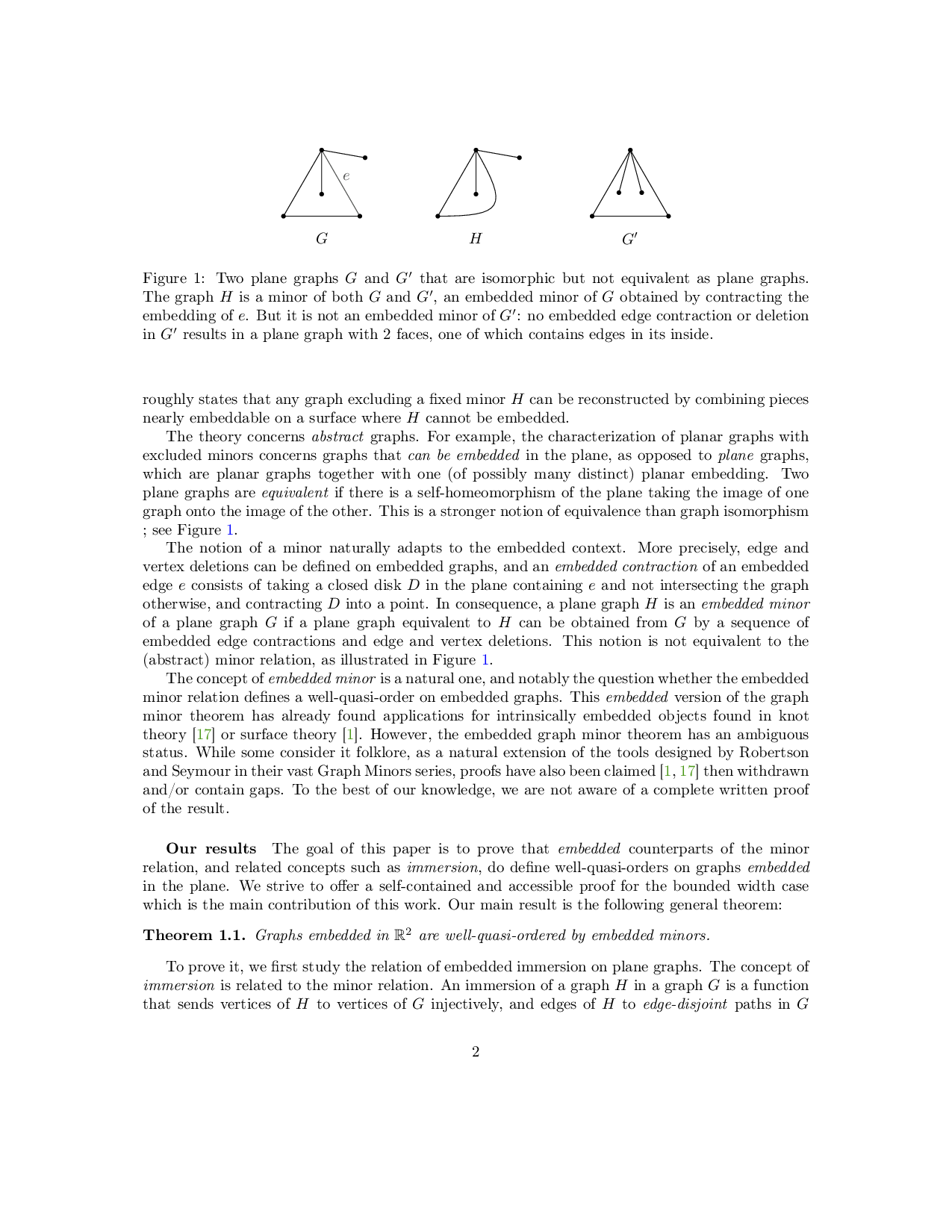
Figure 1: Two plane graphs G and G′ that are isomorphic but not equivalent as plane graphs.
The graph H is a minor of both G and G′, an embedded minor of G obtained by contracting the
embedding of e. But it is not an embedded minor of G′: no embedded edge contraction or deletion
in G′ results in a plane graph with 2 faces, one of which contains edges in its inside.
roughly states that any graph excluding a fixed minor H can be reconstructed by combining pieces
nearly embeddable on a surface where H cannot be embedded.
The theory concerns abstract graphs. For example, the characterization of planar graphs with
excluded minors concerns graphs that can be embedded in the plane, as opposed to plane graphs,
which are planar graphs together with one (of possibly many distinct) planar embedding. Two
plane graphs are equivalent if there is a self-homeomorphism of the plane taking the image of one
graph onto the image of the other. This is a stronger notion of equivalence than graph isomorphism
; see Figure 1.
The notion of a minor naturally adapts to the embedded context. More precisely, edge and
vertex deletions can be defined on embedded graphs, and an embedded contraction of an embedded
edge e consists of taking a closed disk D in the plane containing e and not intersecting the graph
otherwise, and contracting D into a point. In consequence, a plane graph H is an embedded minor
of a plane graph G if a plane graph equivalent to H can be obtained from G by a sequence of
embedded edge contractions and edge and vertex deletions. This notion is not equivalent to the
(abstract) minor relation, as illustrated in Figure 1.
The concept of embedded minor is a natural one, and notably the question whether the embedded
minor relation defines a well-quasi-order on embedded graphs. This embedded version of the graph
minor theorem has already found applications for intrinsically embedded objects found in knot
theory [17] or surface theory [1]. However, the embedded graph minor theorem has an ambiguous
status. While some consider it folklore, as a natu