Over-the-Air Federated Learning (AirFL) is an emerging paradigm that tightly integrates wireless signal processing and distributed machine learning to enable scalable AI at the network edge. By leveraging the superposition property of wireless signals, AirFL performs communication and model aggregation of the learning process simultaneously, significantly reducing latency, bandwidth, and energy consumption. This article offers a tutorial treatment of AirFL, presenting a novel classification into three design approaches: CSIT-aware, blind, and weighted AirFL. We provide a comprehensive guide to theoretical foundations, performance analysis, complexity considerations, practical limitations, and prospective research directions.
The convergence of edge AI and wireless communications is shaping the next generation of intelligent, networked systems. At the core of this paradigm lies Federated Learning (FL), a distributed machine learning framework in which devices such as smartphones, IoT sensors, and autonomous vehicles collaboratively train a global model without sharing their raw data [1]. The fundamental process involves each device performing local model updates based on its private data and then transmitting these updates to a central server, where aggregation takes place to refine the global model. This cycle is repeated across multiple rounds until convergence.
Originally introduced to preserve privacy and data locality in decentralized environments, FL has rapidly evolved to address broader challenges inherent to large-scale networked systems. However, its real-world deployment remains hindered by a critical limitation: communication overhead. In traditional FL setups, S. M. Azimi-Abarghouyi and C. Fischione are with the School of Electrical Engineering and Computer Science, KTH Royal Institute of Technology, Stockholm, Sweden (Emails: seyaa, carlofi @kth.se). K. Huang is with the Department of Electrical and Electronic Engineering, The University of Hong Kong, Hong Kong SAR, China (Email: huangkb@hku.hk). each device must reliably send high-dimensional model updates to the central server at every round. These frequent transmissions often occur over limited-bandwidth, energy-constrained wireless links, resulting in a significant mismatch between the communication-intensive nature of FL and the capacity of existing wireless networks-especially as the number of participating devices grows.
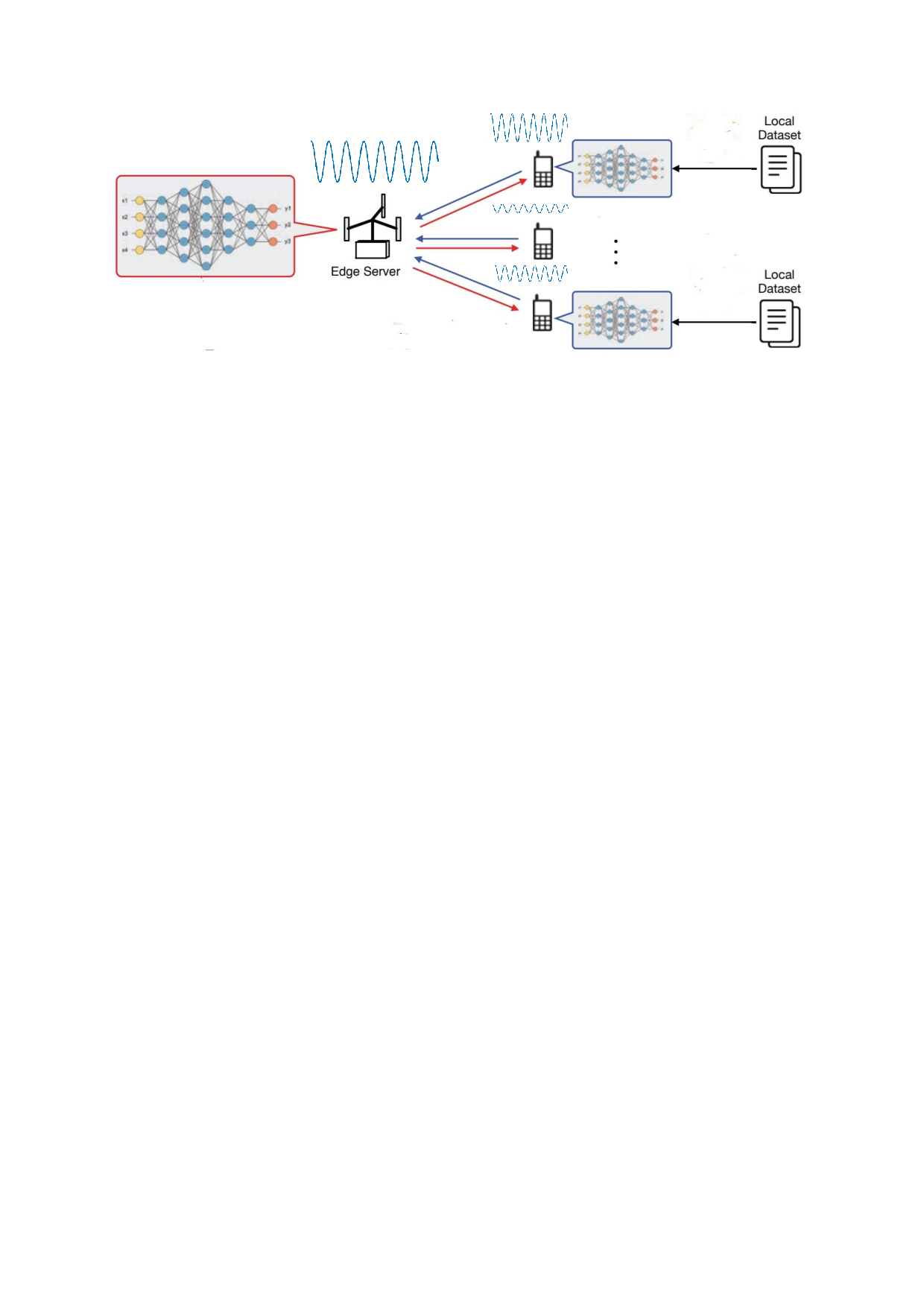
To overcome this bottleneck, Over-the-Air Computation (AirComp) has emerged as a transformative solution [2], [3]. Unlike conventional methods that recover individual messages, AirComp exploits the superposition property of wireless signals to compute desired functions-such as sums-directly over the multiple-access channel. AirComp should thus be viewed as one component within the broader problem of FL, where its function-aggregation capability is leveraged as a building block toward a larger objective. This forms the foundation of Over-the-Air Federated Learning (AirFL), a new class of FL systems where all devices transmit simultaneously, and the server receives a naturally aggregated signal. By collapsing communication and aggregation into a single step, AirFL significantly reduces latency, bandwidth consumption, and energy usage. This makes it a highly promising approach for achieving scalable, efficient FL in resource-constrained wireless environments. However, realizing this potential requires machine-learning-aware wireless signal-processing techniques-capable of handling statistical and computational heterogeneity across devices and of providing unbiased (or controllably biased) aggregation while ensuring privacy, fairness, and convergence.
The benefits of AirFL come with significant challenges. Unlike orthogonal schemes, AirFL is highly sensitive to channel impairments, synchronization errors, and hardware limitations. In particular, the accuracy of signal aggregation depends on the precise alignment of transmitted signals. One early approach to address this relies on accurate Channel State Information at the Transmitter (CSIT) and power control to compensate for channel gains and phase shifts. However, acquiring and maintaining CSIT in practical wireless environments-especially in large-scale or rapidly varying systems-remains a major challenge.
These difficulties have sparked growing interest in methods that require only local CSIT [4]. Nonetheless, approaches based on global CSIT [5] continue to be explored due to their potential for achieving optimal performance.
More recently, CSIT-free approaches-most notably blind AirFL [6] and weighted AirFL [7]-have emerged as promising practical alternatives. These approaches eliminate the reliance on channel estimation and power control at transmitters through partial phase compensation, leveraging massive MIMO and high-dimensional processing at the server, or by applying adaptive weighting within aggregation. By offloading complexity from edge devices and avoiding fine synchronization and feedback overhead, these solutions reduce device complexity-albeit at the cost of higher processing demands on the server or a potential risk of aggregation bias (objective drift).
This section presents the fundamental principles of AirComp over the standard multiple access channel (MAC).
A. Signal Model over the MAC Consider a wireless system comprising K single-antenna transmitting devices and a receiver with M antennas. This is the most widely adopted wireless model, as devices typically have limited hardware capabilities and physical constraints that restrict them to a single antenna. Each transmitter k sends a scaled version of its data symbol x k using a complex precoding scalar
which contr
This content is AI-processed based on open access ArXiv data.