The 3rd Generation Partnership Project (3GPP), the standards body for mobile networks, is in the final phase of Release 19 standardization and is beginning Release 20. Artificial Intelligence/ Machine Learning (AI/ML) has brought about a paradigm shift in technology and it is being adopted across industries and verticals. 3GPP has been integrating AI/ML into the 5G advanced system since Release 18. This paper focuses on the AI/ML related technological advancements and features introduced in Release 19 within the Service and System Aspects (SA) Technical specifications group of 3GPP. The advancements relate to two paradigms: (i) enhancements that AI/ML brought to the 5G advanced system (AI for network), e.g. resource optimization, and (ii) enhancements that were made to the 5G system to support AI/ML applications (Network for AI), e.g. image recognition.
💡 Deep Analysis
📄 Full Content
AI/ML in 3GPP 5G Advanced - Services and
Architecture
Pradnya Taksande∗, Shwetha Kiran†, Pranav Jha‡ and Prasanna Chaporkar§
Department of Electrical Engineering, Indian Institute of Technology Bombay, India
Email: 20001816@iitb.ac.in∗, shwethak@iitb.ac.in†, pranavjha@ee.iitb.ac.in‡, chaporkar@ee.iitb.ac.in§
Abstract—The 3rd Generation Partnership Project (3GPP), the
standards body for mobile networks, is in the final phase of
Release 19 standardization and is beginning Release 20. Artificial
Intelligence/ Machine Learning (AI/ML) has brought about a
paradigm shift in technology and it is being adopted across
industries and verticals. 3GPP has been integrating AI/ML into
the 5G advanced system since Release 18. This paper focuses
on the AI/ML related technological advancements and features
introduced in Release 19 within the Service and System Aspects
(SA) Technical specifications group of 3GPP. The advancements
relate to two paradigms: (i) enhancements that AI/ML brought
to the 5G advanced system (AI for network), e.g. resource
optimization, and (ii) enhancements that were made to the 5G
system to support AI/ML applications (Network for AI), e.g.
image recognition.
Index Terms—AI/ML, 3GPP, standards.
I. INTRODUCTION
Artificial Intelligence (AI) and Machine Learning (ML)
are transforming numerous industries and multiple aspects of
modern life. From personalized recommendations on stream-
ing platforms to real-time fraud detection in banking, AI/ML
technologies are driving smarter decision-making across in-
dustries. In retail, they assist in inventory and supply chain
management. In transportation, automotive vehicles rely on
ML for object detection and navigation. Businesses leverage
AI/ML for predictive analytics, customer insights, and opera-
tional efficiency. As data continues to grow, these technologies
are evolving rapidly, reshaping how we work, interact, and
solve complex problems, making them central to innovation
in today’s world.
AI/ML is playing a transformative role in mobile networks
to enhance task efficiency, optimize network management and
configuration, predict fault detection, and improve end-user
experience. The 3rd Generation Partnership Project (3GPP), a
global body responsible for mobile network standardization,
began incorporating AI/ML features starting from Release
17 of the 5th Generation (5G) system. The 3GPP Standards
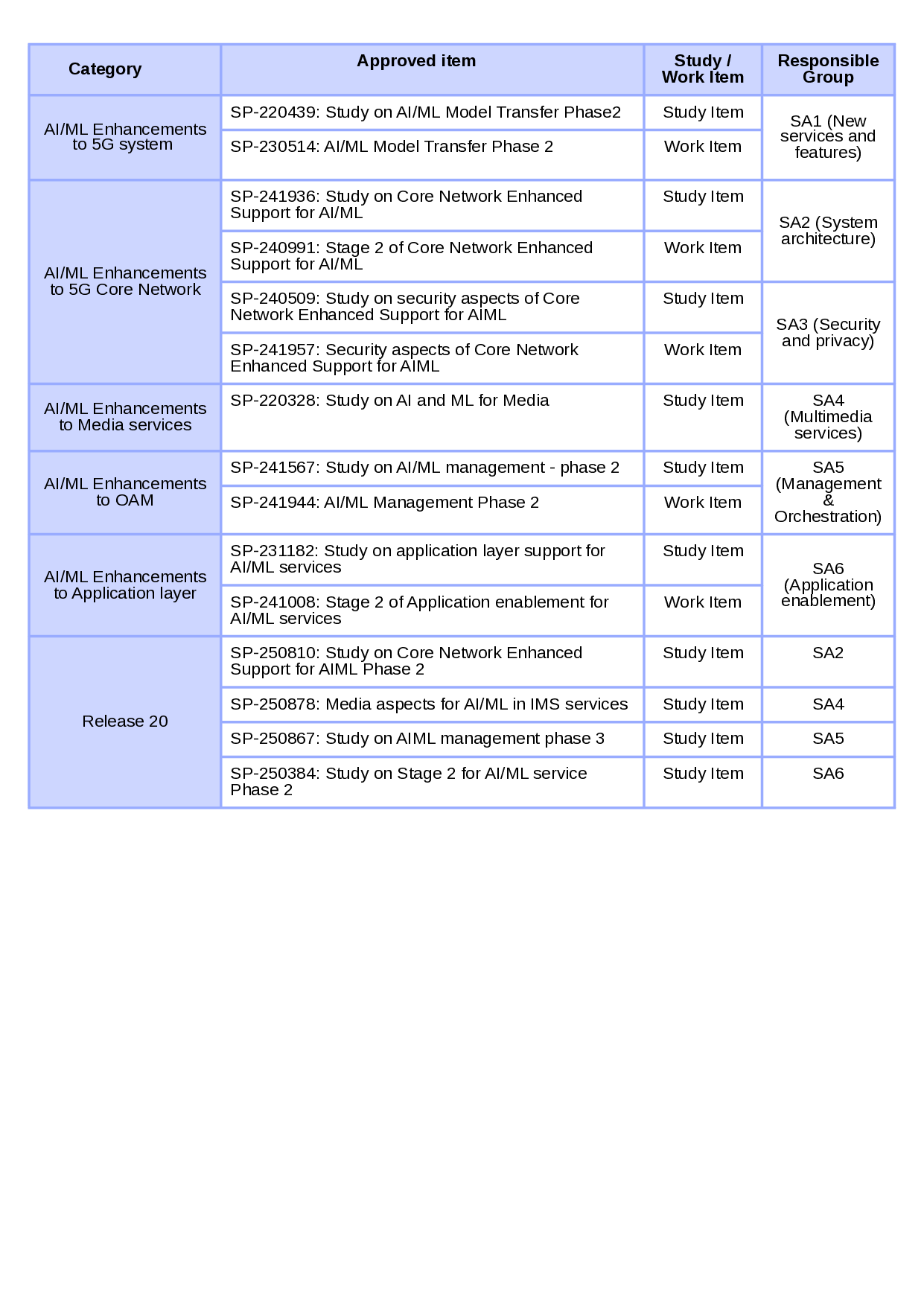
development work is divided across three major groups: Radio
Access Network (RAN), Service and System Aspects (SA),
and Core Network & Terminals (CT). The SA group is re-
sponsible for standardizing Core Network (CN) functionalities,
Security, Operations, Administration and Maintenance (OAM)
functionality and end-to-end application support. The RAN
group develops base station and radio interface standards,
whereas the CT group develops User Equipment (UE) and
CN protocols as well as interworking with external networks.
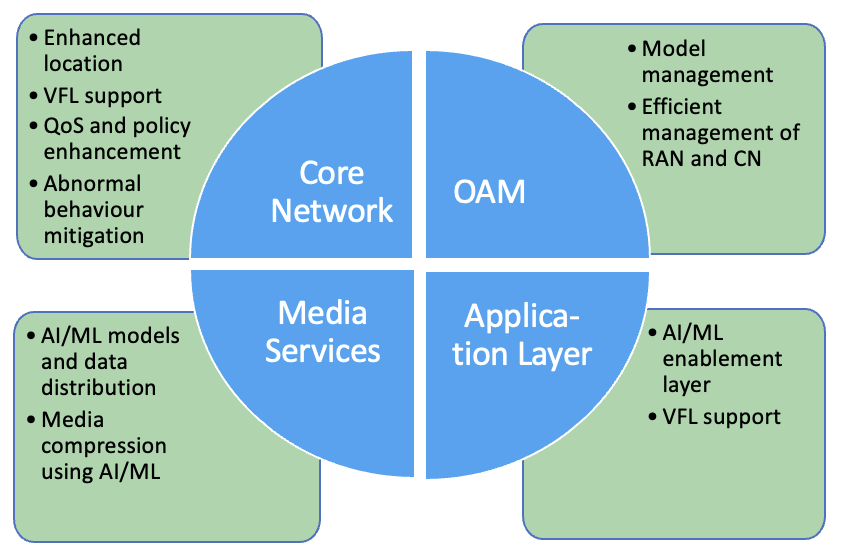
Within 3GPP, AI/ML is being explored across multiple areas,
including RAN intelligence, OAM intelligence, and incorpo-
ration of AI/ML capabilities in 5G Advanced architecture that
began with Release 18.
In 5G and beyond, plans are underway to support AI/ML
related use cases like distributed computing for edge-cloud
collaboration, energy-efficient operation at network as well
as UE, autonomous network management, making mobile
networks more adaptive, scalable, and resilient to changing
demands. These use cases can broadly be divided into:
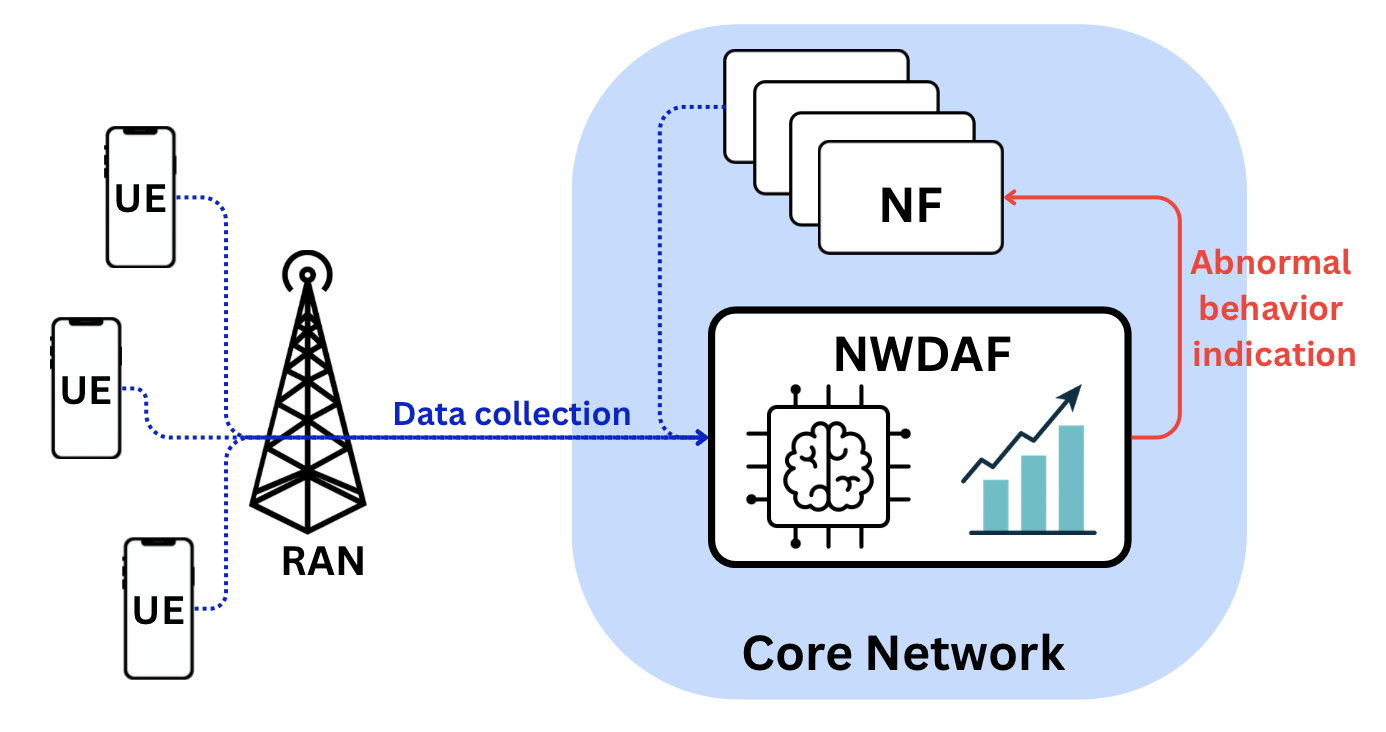
1) AI for Network: It includes the use of AI to optimize
traditional algorithms, network functions, as well as network
operations to improve performance, efficiency, and end-user
experience. For instance, AI/ML can be used to design an
efficient network resource management algorithm.
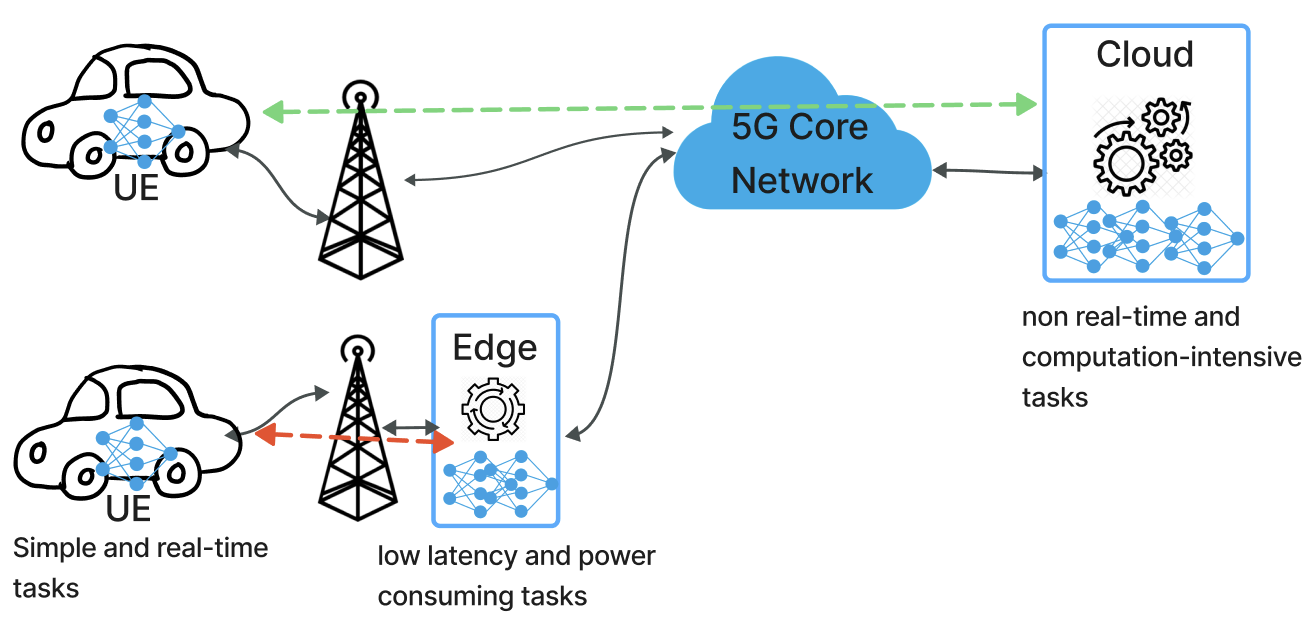
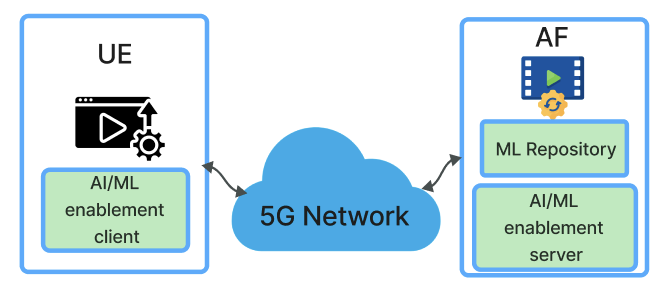
2) Network for AI: Here, the network needs to provide
capabilities like communication with Quality of Service (QoS)
guarantees, computing and storage resources to support AI/ML
applications. For instance, when running an image recognition
AI/ML application on the UE, the low latency connectivity to
the edge or cloud needs to be provided by the network for
additional processing support.
Number of surveys have been published summarizing po-
tential of AI/ML for optimizing mobile networks. A com-
prehensive overview of AI and its role in communications
within the context of 6G networks has been provided in [1],
however, the discussion on standardization aspects of AI/ML
remains at a high level. [2] and [3] discuss AI/ML in network
contexts, particularly related to RAN, but they do not focus on
standardization. [4] primarily focuses on RAN standardization
across various standardization bodies, viz. 3GPP and O-RAN.
Similarly, [5] also emphasizes the RAN perspective but does
not adequately cover the AI/ML activities carried out by
3GPP SA group. [6] provides a comprehensive overview of
AI/ML technologies within the 3GPP RAN scope, including
the proposed framework for applying AI/ML to the New Radio
(NR) air interface. [7] provides an overvie