Towards a fully differentiable digital twin for solar cells
Reading time: 5 minute
...
📝 Original Info
Title: Towards a fully differentiable digital twin for solar cells
ArXiv ID: 2512.02904
Date: 2025-12-02
Authors: Marie Louise Schubert, Houssam Metni, Jan David Fischbach, Benedikt Zerulla, Marjan Krstić, Ulrich W. Paetzold, Seyedamir Orooji, Olivier J. J. Ronsin, Yasin Ameslon, Jens Harting, Thomas Kirchartz, Sandheep Ravishankar, Chris Dreessen, Eunchi Kim, Christian Sprau, Mohamed Hussein, Alexander Colsmann, Karen Forberich, Klaus Jäger, Pascal Friederich, Carsten Rockstuhl
📝 Abstract
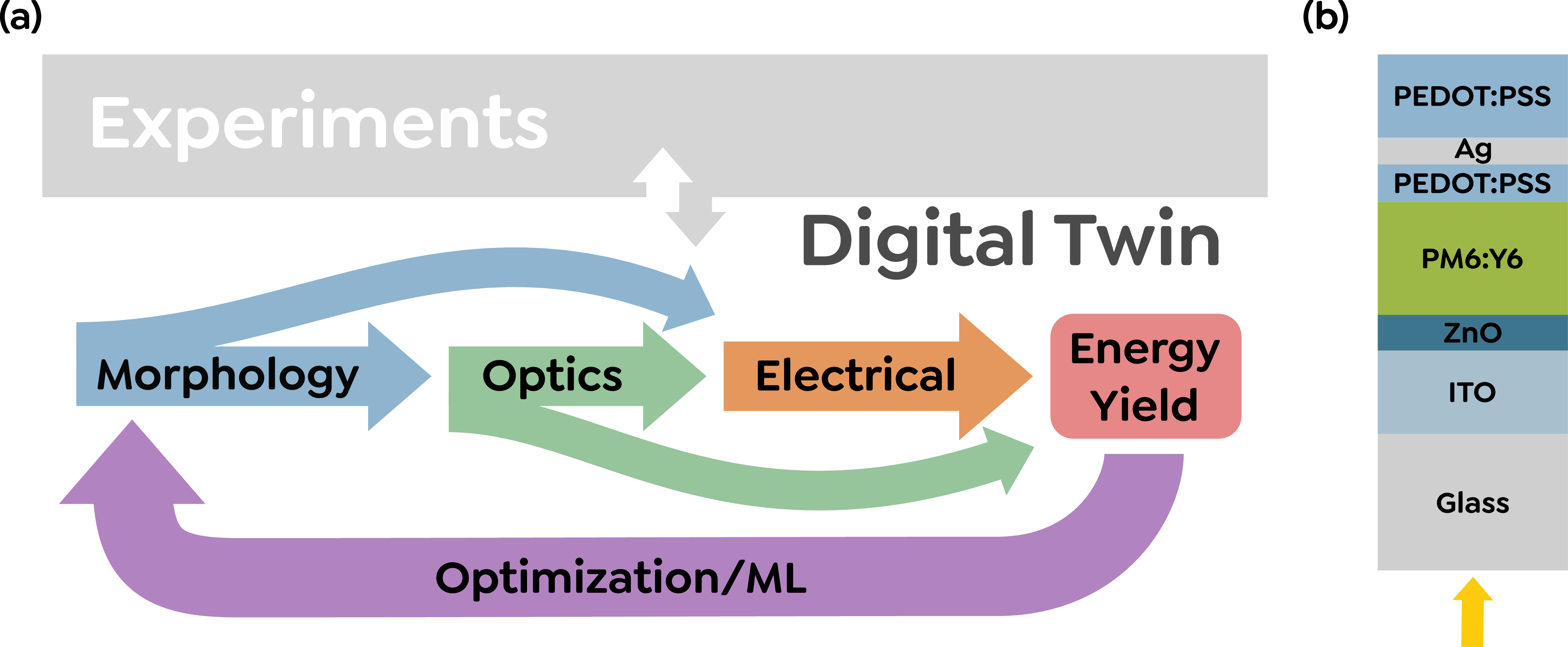
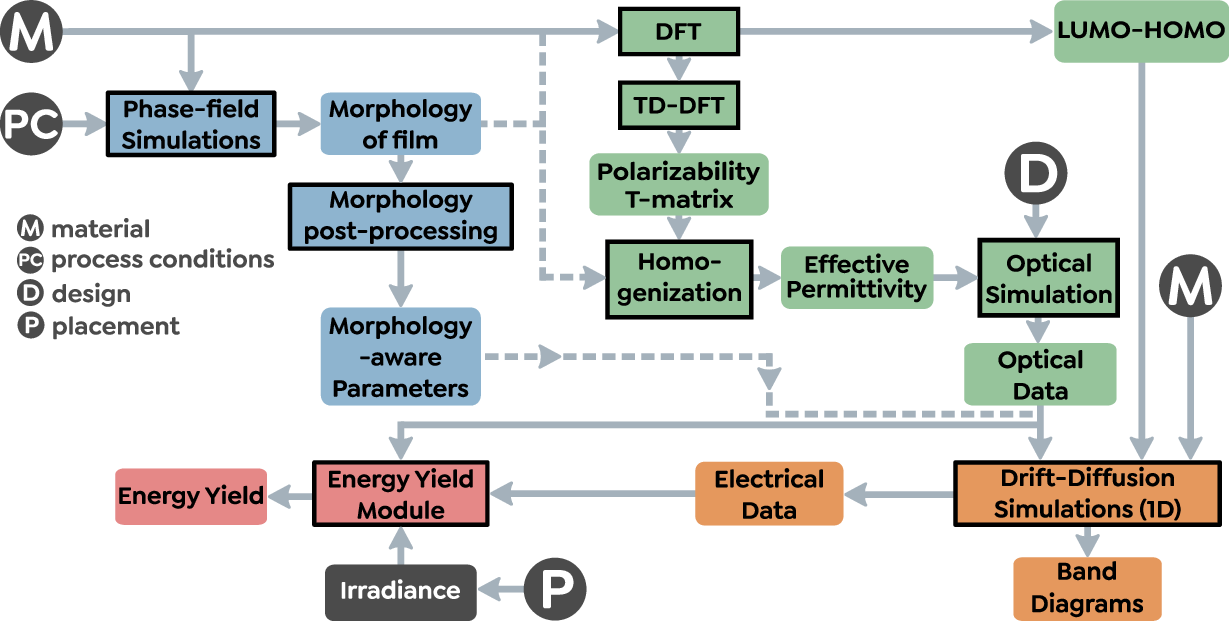
Maximizing energy yield (EY) - the total electric energy generated by a solar cell within a year at a specific location - is crucial in photovoltaics (PV), especially for emerging technologies. Computational methods provide the necessary insights and guidance for future research. However, existing simulations typically focus on only isolated aspects of solar cells. This lack of consistency highlights the need for a framework unifying all computational levels, from material to cell properties, for accurate prediction and optimization of EY prediction. To address this challenge, a differentiable digital twin, Sol(Di)$^2$T, is introduced to enable comprehensive end-to-end optimization of solar cells. The workflow starts with material properties and morphological processing parameters, followed by optical and electrical simulations. Finally, climatic conditions and geographic location are incorporated to predict the EY. Each step is either intrinsically differentiable or replaced with a machine-learned surrogate model, enabling not only accurate EY prediction but also gradient-based optimization with respect to input parameters. Consequently, Sol(Di)$^2$T extends EY predictions to previously unexplored conditions. Demonstrated for an organic solar cell, the proposed framework marks a significant step towards tailoring solar cells for specific applications while ensuring maximal performance.
💡 Deep Analysis
📄 Full Content
Towards a fully differentiable digital twin for solar cells
Marie Louise Schubert1,2,†, Houssam Metni1,2,†, Jan David Fischbach1, Benedikt
Zerulla1, Marjan Krstić14, Ulrich W. Paetzold3,4, Seyedamir Orooji3,4, Olivier J. J.
Ronsin7, Yasin Ameslon7,8, Jens Harting7,8,9, Thomas Kirchartz10,11, Sandheep
Ravishankar10, Chris Dreessen10, Eunchi Kim10, Christian Sprau4,5, Mohamed
Hussein4,6, Alexander Colsmann4,5, Karen Forberich7, Klaus Jäger12,13, Pascal
Friederich1,2,⋆, and Carsten Rockstuhl1,14,⋆
1Institute of Nanotechnology, Karlsruhe Institute of Technology (KIT), Karlsruhe,
Germany
2Institute of Theoretical Informatics, Karlsruhe Institute of Technology (KIT),
Karlsruhe, Germany
3Institute of Microstructure Technology, Karlsruhe Institute of Technology (KIT),
Karlsruhe, Germany
4Light Technology Institute, Karlsruhe Institute of Technology (KIT), Karlsruhe,
Germany
5Material Research Center for Energy Systems, Karlsruhe Institute of Technology
(KIT), Karlsruhe, Germany
6Department of Physics, Faculty of Science, Ain Shams University, Cairo, Egypt
7Helmholtz-Institute Erlangen-Nürnberg for Renewable Energy (IET-2),
Forschungszentrum Jülich, Erlangen, Germany
8Department of Chemical and Biological Engineering,
Friedrich-Alexander-Universität Erlangen-Nürnberg, Erlangen, Germany
9Department of Physics, Friedrich-Alexander-Universität Erlangen-Nürnberg
(FAU), Erlangen, Germany
10IMD-3 Photovoltaik, Forschungszentrum Jülich (FZJ), Jülich, Germany
11Faculty of Electrical Engineering and Information Technology, University of
Duisburg-Essen, Duisburg, Germany
12Department Optics for Solar Energy (SE-AOPT), Helmholtz-Zentrum Berlin für
Materialien und Energie GmbH, Berlin, Germany
13Zuse Institute Berlin, Berlin, Germany
14Institute of Theoretical Solid State Physics, Karlsruhe Institute of Technology
(KIT), Karlsruhe, Germany
†These authors contributed equally; marie.schubert@kit.edu and
houssam.metni@kit.edu
⋆These authors are corresponding authors; pascal.friederich@kit.edu and
carsten.rockstuhl@kit.edu
1
arXiv:2512.02904v1 [physics.comp-ph] 2 Dec 2025
Abstract
Maximizing energy yield (EY) – the total electric energy generated by a solar cell within a
year at a specific location – is crucial in photovoltaics (PV), especially for emerging technolo-
gies. Computational methods provide the necessary insights and guidance for future research.
However, existing simulations typically focus on only isolated aspects of solar cells. This lack
of consistency highlights the need for a framework unifying all computational levels, from ma-
terial to cell properties, for accurate prediction and optimization of EY prediction. To address
this challenge, a differentiable digital twin, Sol(Di)2T, is introduced to enable comprehen-
sive end-to-end optimization of solar cells. The workflow starts with material properties and
morphological processing parameters, followed by optical and electrical simulations. Finally,
climatic conditions and geographic location are incorporated to predict the EY. Each step is
either intrinsically differentiable or replaced with a machine-learned surrogate model, enabling
not only accurate EY prediction but also gradient-based optimization with respect to input
parameters. Consequently, Sol(Di)2T extends EY predictions to previously unexplored con-
ditions. Demonstrated for an organic solar cell, the proposed framework marks a significant
step towards tailoring solar cells for specific applications while ensuring maximal performance.
1
Introduction
Modern photovoltaic applications for building integration or in agricultural settings require solar
cell technologies with customizable properties. Emerging PV technologies offer a promising solution
to this need [1]. Among the many research directions in the context of emerging PV technologies,
organic (OPV) and perovskite solar cells stand out [2]. These PV technologies feature mechanical
flexibility, lightweight design and have the potential for cost-effective production [3, 4, 5, 6]. The
cells can be made transparent and in tunable colors [7], expanding their applicability in design-
sensitive contexts. Furthermore, some of these technologies have demonstrated competitive power
conversion efficiencies (PCE) [8, 9, 10].
In recent years, the energy yield (EY) has become an important technological objective in the PV
research community. The EY encompasses the total electric energy generated by solar cells within
a year in a given location, accounting for external factors such as irradiance and temperature [11].
Computational tools have been developed to better understand PV processes and to predict the EY
for specific solar cell settings [12, 13, 14, 15, 16]. Despite this progress, many existing computational
tools are developed independently and only focus on isolated aspects of solar cells. Therefore, a
comprehensive material-to-application EY simulation framework that targets specific materials,
processes, and device characteristics is highly desirab