Title: Theoretical analysis of beaconless geocast protocols in 1D
ArXiv ID: 2512.02663
Date: 2025-12-02
Authors: ** - Joachim Gudmundsson (University of Sydney) - Irina Kostitsyna (Eindhoven University of Technology) - Maarten Löffler (Universiteit Utrecht) - Tobias Müller (University of Groningen) - Vera Sacristán (Universitat Politècnica de Catalunya) - Rodrigo I. Silveira (Universitat Politècnica de Catalunya) **
📝 Abstract
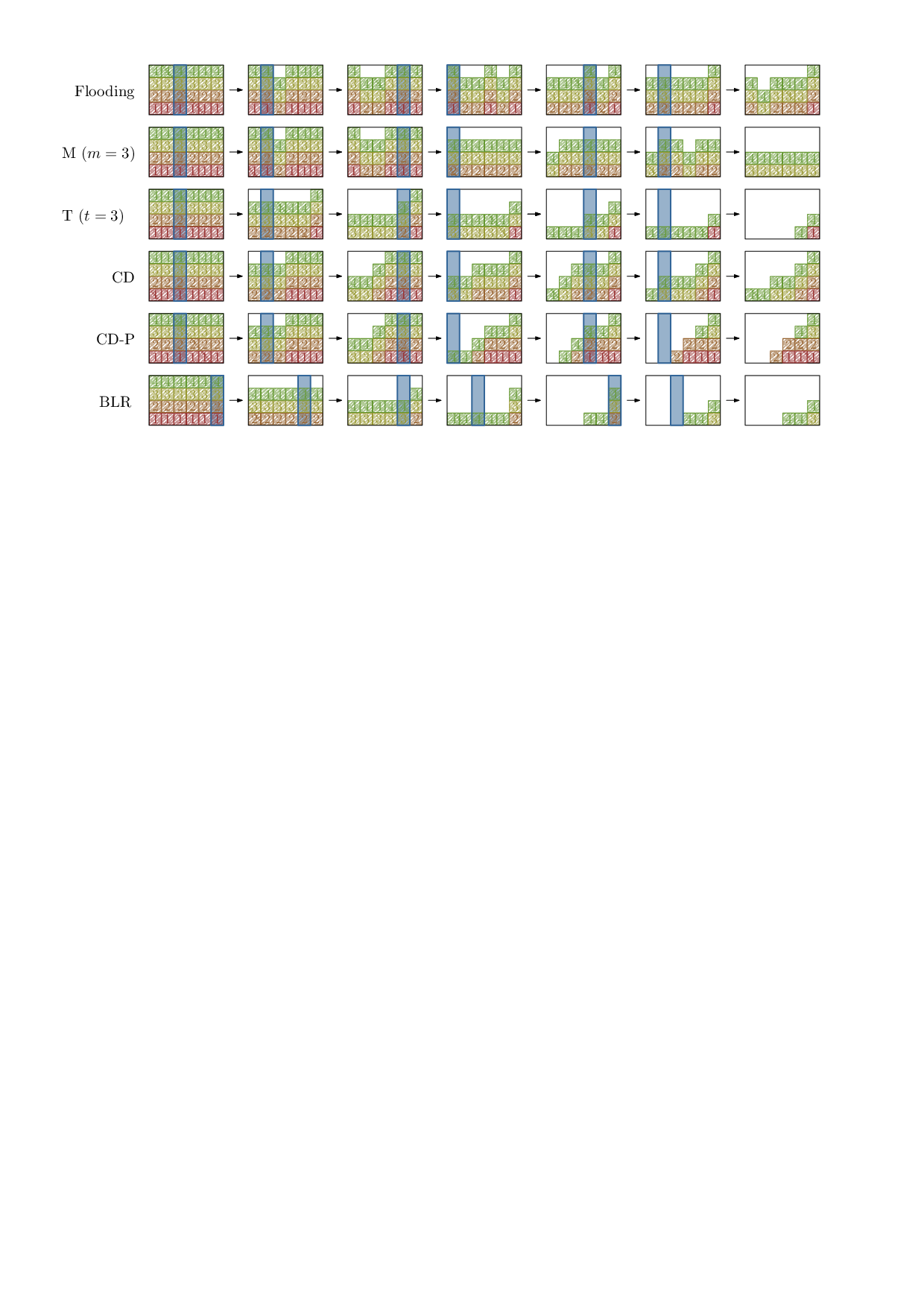
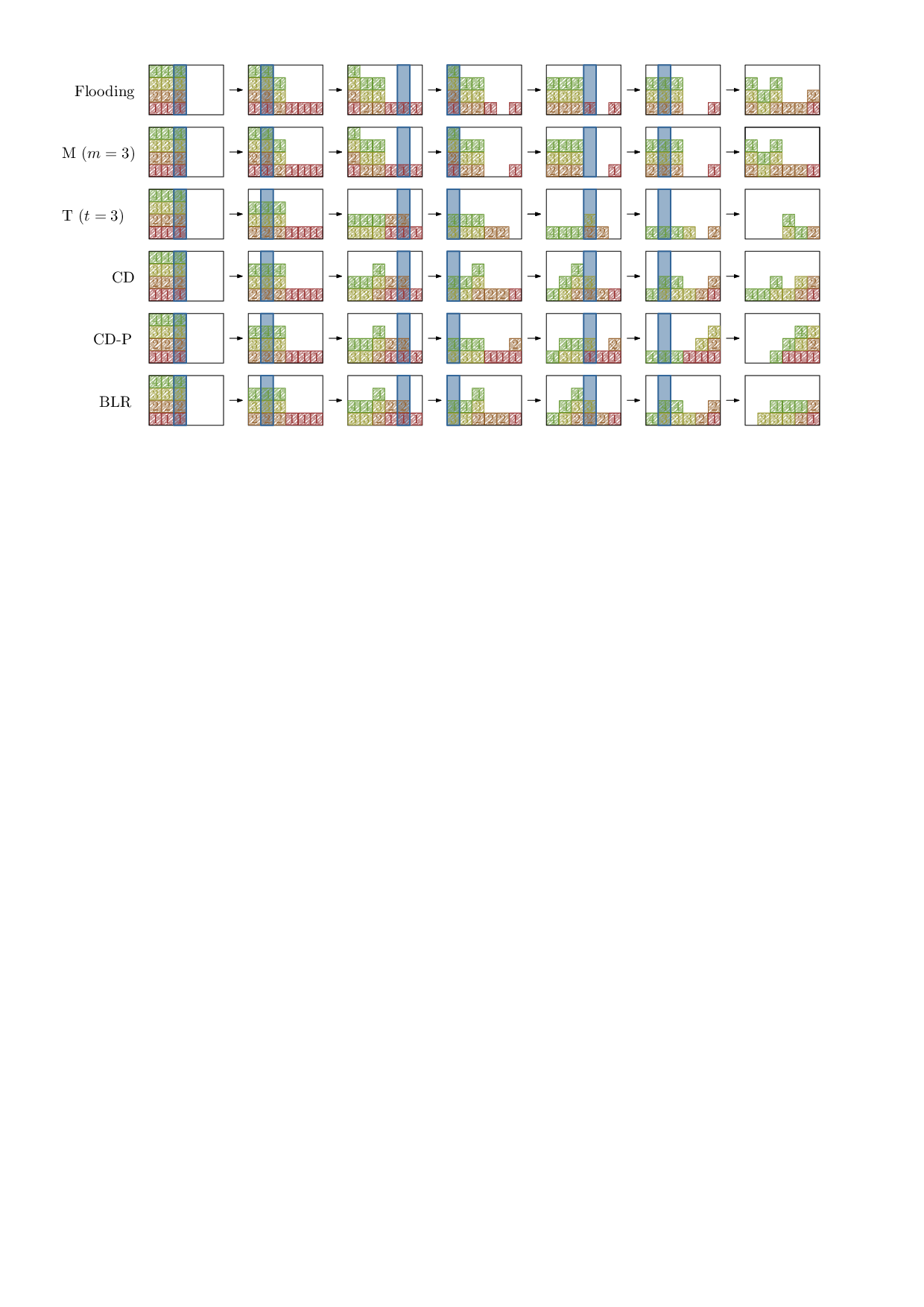
Beaconless geocast protocols are routing protocols used to send messages in mobile ad-hoc wireless networks, in which the only information available to each node is its own location. Messages get routed in a distributed manner: each node uses local decision rules based on the message source and destination, and its own location. In this paper we analyze six different beaconless geocast protocols, focusing on two relevant 1D scenarios. The selection of protocols reflects the most relevant types of protocols proposed in the literature, including those evaluated in previous computer simulations. We present a formal and structured analysis of the maximum number of messages that a node can receive, for each protocol, in each of the two scenarios. This is a measure of the network load incurred by each protocol. Our analysis, that for some of the protocols requires an involved probabilistic analysis, confirms behaviors that had been observed only through simulations before.
💡 Deep Analysis
📄 Full Content
Theoretical analysis of beaconless geocast protocols in 1D∗
Joachim Gudmundsson†
Irina Kostitsyna‡
Maarten Löffler§
Tobias Müller¶
Vera Sacristán‖
Rodrigo I. Silveira‖
Abstract
Beaconless geocast protocols are routing protocols used to send messages in mobile ad-hoc
wireless networks, in which the only information available to each node is its own location.
Messages get routed in a distributed manner: each node uses local decision rules based on
the message source and destination, and its own location. In this paper we analyze six
different beaconless geocast protocols, focusing on two relevant 1D scenarios. The selection
of protocols reflects the most relevant types of protocols proposed in the literature, including
those evaluated in previous computer simulations. We present a formal and structured
analysis of the maximum number of messages that a node can receive, for each protocol, in
each of the two scenarios. This is a measure of the network load incurred by each protocol.
Our analysis, that for some of the protocols requires an involved probabilistic analysis,
confirms behaviors that had been observed only through simulations before.
1
Introduction
In mobile ad-hoc wireless networks there is no fixed infrastructure or global knowledge about
the network topology. Nodes communicate on a peer-to-peer basis, using only local information.
Thus messages between nodes that are not within range of each other must be sent through
other nodes acting as relay stations. An important special case of ad-hoc wireless networks
are wireless sensor networks, in which a (usually large) number of autonomous sensor nodes
collaborate to collectively gather information about a certain area.
Nodes are typically mobile devices whose location and availability may change frequently,
resulting in a highly dynamic environment in which routing must be done on-the-fly. Typically,
messages are not sent to a particular network address, but to some or all nodes within a
geographic region. This is known as geocasting [7]. The main pieces of information used to
send a message are the locations of the source node and the destination region (also referred
to as geocast region), which are usually included in the actual message.1 See Figure 1 for an
illustration.
∗A preliminary version of this work appeared in ANALCO 2018 [1].
†School of Information Technologies, University of Sydney, joachim.gudmundsson@gmail.com
‡Dept. of Mathematics and Computer Science, Eindhoven University of Technology, i.kostitsyna@tue.nl,
supported in part by the Netherlands Organisation for Scientific Research (NWO) under project no. 639.023.208.
§Dept. of Information and Computing Science, Universiteit Utrecht, m.loffler@uu.nl, supported by the
Netherlands Organisation for Scientific Research (NWO) under project no. 639.021.123 and 614.001.504.
¶Bernoulli Institute for Mathematics, Computer Science and Artificial Inteligence, Groningen University,
tobias.muller@rug.nl.
‖Dept. de Matemàtiques, Universitat Politècnica de Catalunya, {vera.sacristan,rodrigo.silveira}@upc.edu,
partially supported by grant PID2023-150725NB-I00 funded by MICIU/AEI/10.13039/501100011033.
1Some works use the term ‘packet’ to denote the indivisible unit of information sent between the nodes. In
this paper we use the term ‘message’ instead, as we are interested in counting the number of transmissions and
not the higher level aspects of protocols.
1
arXiv:2512.02663v1 [cs.CG] 2 Dec 2025
Many geocast protocols have been proposed. In general, existing protocols can be divided into
two groups: those that assume that each node also knows the location of its 1-hop neighbors (i.e.,
all nodes within range) and those that do not make this assumption. In practice, the locations
of neighbors can be obtained by regularly exchanging beacon messages in the neighborhood.
Beacons imply a significant message overhead, which prevents these methods from scaling even
to medium-size networks [4]: the problem is that in dense environments the number of messages
received by each individual node, and thus the workload to decide whether and how to react
to those messages, becomes prohibitive. For this reason, in this paper we are interested in the
second group, the so-called beaconless geocast protocols.
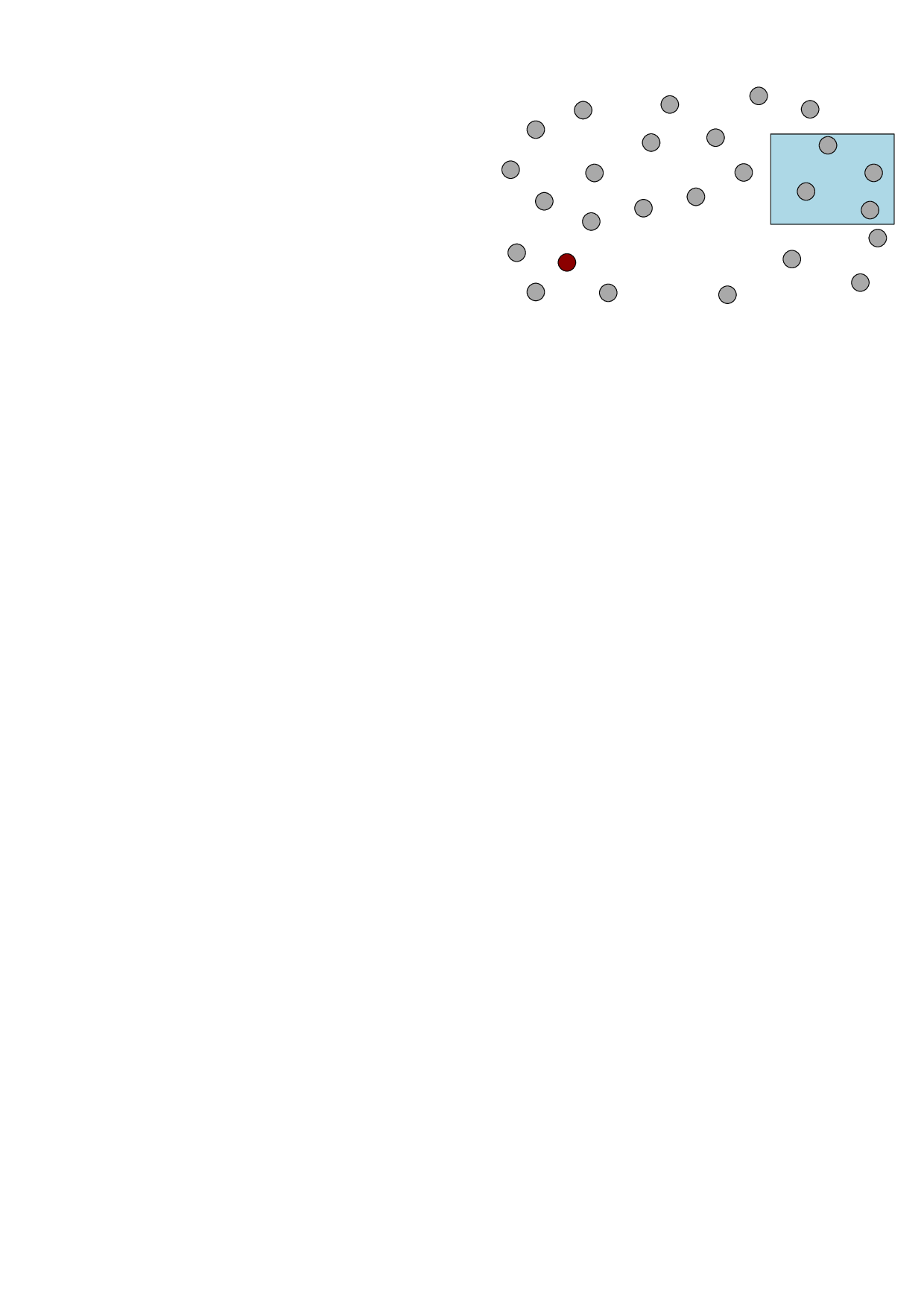
Figure 1: A geocast example in 2D where a message should be sent from the sender (red node) to the
geocast region marked as a blue rectangle.
Probably the most straightforward beaconless geocast protocol is simple flooding: each
message is broadcasted to all neighbors, who in turn broadcast it to all their neighbors, and so
on. Even though it is effective, the resulting message overhead is clearly unaffordable: essentially,
it causes as much overhead as the exchange of beacons, and therefore has the same scaling
problem. From there on, there have been many improvements proposed. The goal is to reduce
the message overhead while still guaranteeing delivery. In the last few decades, many different
geocast protocols