Title: Parallel Multi-Circuit Quantum Feature Fusion in Hybrid Quantum-Classical Convolutional Neural Networks for Breast Tumor Classification
ArXiv ID: 2512.02066
Date: 2025-11-29
Authors: Ece Yurtseven
📝 Abstract
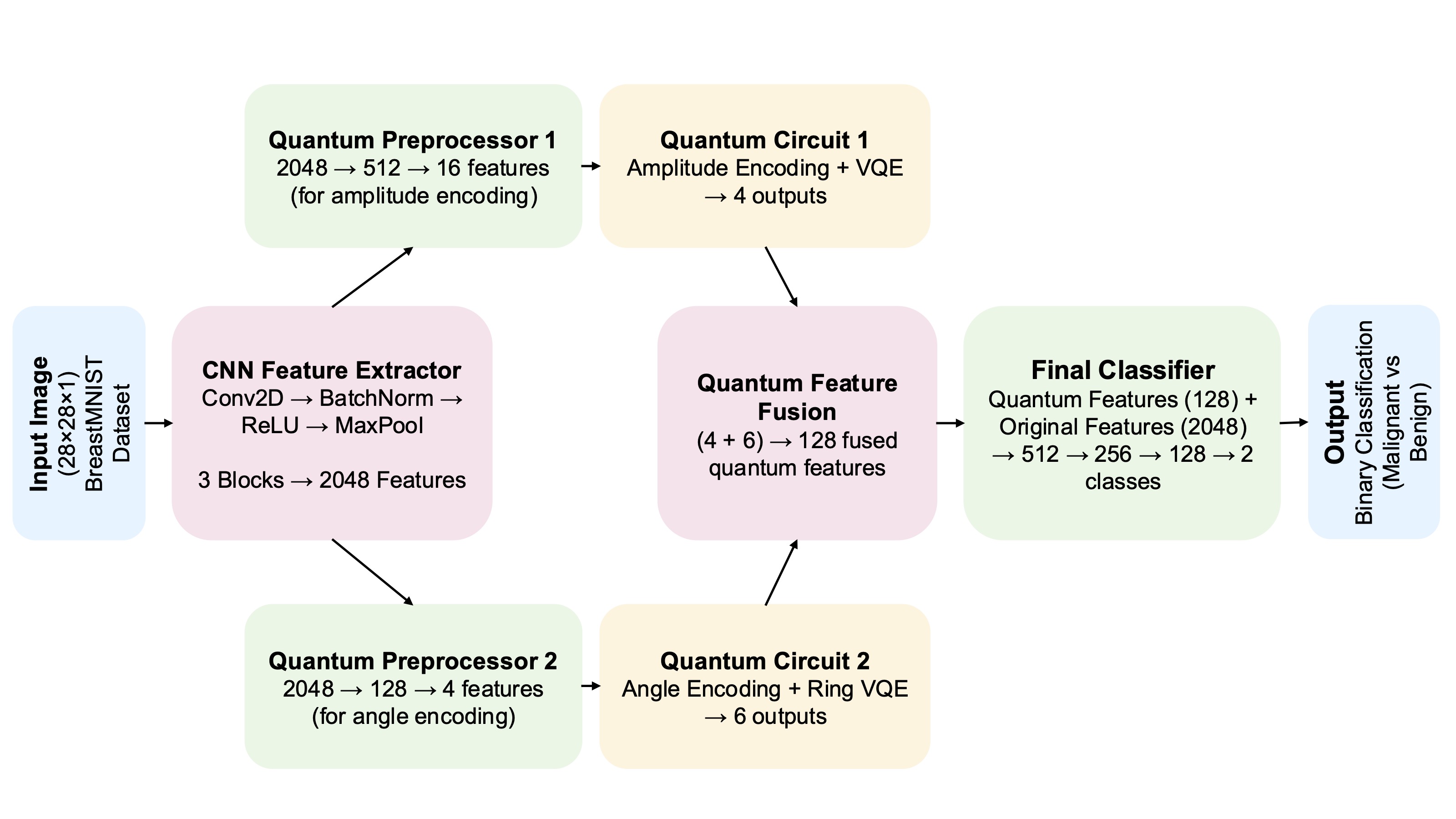
Quantum machine learning has emerged as a promising approach to improve feature extraction and classification tasks in high-dimensional data domains such as medical imaging. In this work, we present a hybrid Quantum-Classical Convolutional Neural Network (QCNN) architecture designed for the binary classification of the BreastMNIST dataset, a standardized benchmark for distinguishing between benign and malignant breast tumors. Our architecture integrates classical convolutional feature extraction with two distinct quantum circuits: an amplitude-encoding variational quantum circuit (VQC) and an angle-encoding VQC circuit with circular entanglement, both implemented on four qubits. These circuits generate quantum feature embeddings that are fused with classical features to form a joint feature space, which is subsequently processed by a fully connected classifier. To ensure fairness, the hybrid QCNN is parameter-matched against a baseline classical CNN, allowing us to isolate the contribution of quantum layers. Both models are trained under identical conditions using the Adam optimizer and binary cross-entropy loss. Experimental evaluation in five independent runs demonstrates that the hybrid QCNN achieves statistically significant improvements in classification accuracy compared to the classical CNN, as validated by a one-sided Wilcoxon signed rank test (p = 0.03125) and supported by large effect size of Cohen's d = 2.14. Our results indicate that hybrid QCNN architectures can leverage entanglement and quantum feature fusion to enhance medical image classification tasks. This work establishes a statistical validation framework for assessing hybrid quantum models in biomedical applications and highlights pathways for scaling to larger datasets and deployment on near-term quantum hardware.
💡 Deep Analysis
📄 Full Content
Parallel Multi-Circuit Quantum Feature Fusion in
Hybrid Quantum-Classical Convolutional Neural
Networks for Breast Tumor Classification
Ece Yurtseven
Robert College of Istanbul
Istanbul, Turkey
yurece.27@robcol.k12.tr
Abstract—Quantum machine learning has emerged as a
promising approach to improve feature extraction and classi-
fication tasks in high-dimensional data domains such as medical
imaging. In this work, we present a hybrid Quantum-Classical
Convolutional Neural Network (QCNN) architecture designed
for the binary classification of the BreastMNIST dataset, a
standardized benchmark for distinguishing between benign and
malignant breast tumors. Our architecture integrates classical
convolutional feature extraction with two distinct quantum cir-
cuits: an amplitude-encoding variational quantum circuit (VQC)
and an angle-encoding VQC circuit with circular entanglement,
both implemented on four qubits. These circuits generate quan-
tum feature embeddings that are fused with classical features
to form a joint feature space, which is subsequently processed
by a fully connected classifier. To ensure fairness, the hybrid
QCNN is parameter-matched against a baseline classical CNN,
allowing us to isolate the contribution of quantum layers. Both
models are trained under identical conditions using the Adam
optimizer and binary cross-entropy loss. Experimental evaluation
in five independent runs demonstrates that the hybrid QCNN
achieves statistically significant improvements in classification
accuracy compared to the classical CNN, as validated by a one-
sided Wilcoxon signed rank test (p = 0.03125) and supported
by large effect size of Cohen’s d = 2.14. Our results indicate
that hybrid QCNN architectures can leverage entanglement and
quantum feature fusion to enhance medical image classification
tasks. This work establishes a statistical validation framework for
assessing hybrid quantum models in biomedical applications and
highlights pathways for scaling to larger datasets and deployment
on near-term quantum hardware.
Index Terms—Quantum Computing, QCNN, Medical Image
Classification, Hybrid Quantum-Classical Models, BreastMNIST
Dataset
I. INTRODUCTION
Breast cancer has emerged as a global health concern,
affecting millions of women worldwide. In 2020, more than
2.3 million women were diagnosed with breast cancer, making
it the most commonly diagnosed cancer globally [1]. Breast
cancer remains a leading cause of cancer-related mortality,
with an estimated 670,000 deaths recorded in 2022 [2].
This burden is projected to continue rising in the following
years. Early mammographic screening has been determined
to play a critical role in lowering breast cancer mortality.
Furthermore, AI-driven diagnostic systems have the potential
to significantly improve the precision and efficiency of the
screening process [3]. However, the classical computational
models that power these AI systems are beginning to encounter
fundamental architectural and practical limitations, particularly
in the demanding domain of medical imaging.
Classical Convolutional Neural Networks (CNNs) remain
pivotal in modern computer vision, especially for biomedical
image analysis, due to their efficacy in automatically extracting
hierarchical features for diagnostic tasks like tumor detection
[4]. However, the ever-increasing complexity and volume of
medical data often strain computational resources, challeng-
ing the scalability of classical deep learning algorithms. To
address these limitations, Quantum Machine Learning (QML)
offers a promising solution, leveraging quantum mechanics
principles like superposition and entanglement for potential
computational acceleration and robust pattern recognition [5].
Quantum computing represents a transformative approach
with the potential to address the computational bottlenecks
faced by classical machine learning [6]. Using quantum
mechanical properties such as superposition and entangle-
ment, quantum computers offer the potential for exponential
speedups in computation [7]. This makes them suitable for
complex computational tasks. Quantum algorithms can lead
to several benefits over classical counterparts, offering expo-
nential computational boosts and the ability to simultaneously
process more inputs with fewer operations. In machine learn-
ing, quantum algorithms provide significant speedups in data
handling by efficiently managing high-dimensional vectors [8].
Building on these concepts, variational quantum cir-
cuits (VQCs) have become a widely used framework for
near-term quantum machine learning. VQCs employ pa-
rameterized quantum circuits optimized through a hybrid
quantum–classical loop, allowing models to access high-
dimensional quantum representations while relying on clas-
sical algorithms for training [9]. This approach has supported
applications such as quantum feature mapping, classification,
and generative modeling, where VQCs can express complex
transformations with relatively minimal cir