We study on-device time-series analysis for gait detection in Parkinson's disease (PD) from short windows of triaxial acceleration, targeting resource-constrained wearables and edge nodes. We compare magnitude thresholding to three 1D CNNs for time-series analysis: a literature baseline (separable convolutions) and two ultra-light models - one purely separable and one with residual connections. Using the BioStampRC21 dataset, 2 s windows at 30 Hz, and subject-independent leave-one-subject-out (LOSO) validation on 16 PwPD with chest-worn IMUs, our residual separable model (Model 2, 533 params) attains PR-AUC = 94.5%, F1 = 91.2%, MCC = 89.4%, matching or surpassing the baseline (5,552 params; PR-AUC = 93.7%, F1 = 90.5%, MCC = 88.5%) with approximately 10x fewer parameters. The smallest model (Model 1, 305 params) reaches PR-AUC = 94.0%, F1 = 91.0%, MCC = 89.1%. Thresholding obtains high recall (89.0%) but low precision (76.5%), yielding many false positives and high inter-subject variance. Sensor-position analysis (train-on-all) shows chest and thighs are most reliable; forearms degrade precision/recall due to non-gait arm motion; naive fusion of all sites does not outperform the best single site. Both compact CNNs execute within tight memory/latency budgets on STM32-class MCUs (sub-10 ms on low-power boards), enabling on-sensor gating of transmission/storage. Overall, ultra-light separable CNNs provide a superior accuracy-efficiency-generalization trade-off to fixed thresholds for wearable PD gait detection and underscore the value of tailored time-series models for edge deployment.
Parkinson's disease (PD) is now one of the fastest-growing neurodegenerative disorders in the world (Chaudhuri et al. 2024). Despite optimal treatment, the progression of the disease leads to a gradual deterioration in motor and cognitive disorders, with inevitable compromise in patients' quality of life. Several works in the literature have studied gait disabilities using wearable, small, and non-invasive sensors. To design personalized interventions and overcome the limitations related to self-reported questionnaires and diaries, the focus is to improve clinical and home care through the additional information on daily life performance provided by Inertial Measurement Units (IMUs) (Corrà et al. 2021). It is essential to develop algorithms for rapid and precise detection of motor activity in subjects with Parkinson's disease to intervene promptly in the detection of anomalies to safeguard the subject's health. To carry out continuous and constant monitoring of PD subjects, particularly in a domestic and unsupervised environment, the first fundamental step is the detection of the activities carried out by the subject (Muthukrishnan, Abbas, and Krishnamurthi 2020;Corrà et al. 2021). In particular, gait activities are of interest due to the fact that PD severely affects the gait cycle and, therefore, gait cycle impairments should be monitored and detected promptly. Following gait detection, it is advisable to perform gait analysis to detect all possible anomalies such as fluctuations, dyskinesias, etc. (Sigcha et al. 2020;Mancini et al. 2021). The main studies either process the signal offline or use Cloud-based services. Cloud-based architectures need data to be moved to data centers, and are typically employed to support long-term data analyses. However, this scenario is contrary to IoT application requirements, such as limiting costs, memory footprint, processing, and communication resources (Kianoush et al. 2023). In recent years, there has been a shift towards edge computing, which means processing data on devices closer to the data sources, rather than relying on cloud-based services to reduce the amount of data to be sent to the cloud by the IoT devices (Fathalla et al. 2022). This shift has also been enabled by advances in embedded systems, as well as tools and accelerators that make it possible to run machine learning and artificial intelligence algorithms on low-power devices (Dini et al. 2024).
In this paper, an in-depth investigation of gait recognition techniques is conducted as a first step towards developing a decentralized architecture for Parkinson’s disease monitoring where distributed processing happens across wearable devices, edge nodes, and the cloud. The proposed gait recognition algorithm aims to reduce data transmission through local data processing, optimizing the system’s energy efficiency and improving the quality of stored data by eliminating redundant or irrelevant data samples. Compared to previous works, we provide a comprehensive evaluation that compares simple threshold-based methods to separable CNNs-based frameworks, including a Residual Network structure. Our evaluation covers multiple sensor positions and combinations, assesses the methods’ performance across different patients (Leave-One-Subject-Out validation), and examines computational complexity and inference time on a target MCU.
In this work, we make the following contributions:
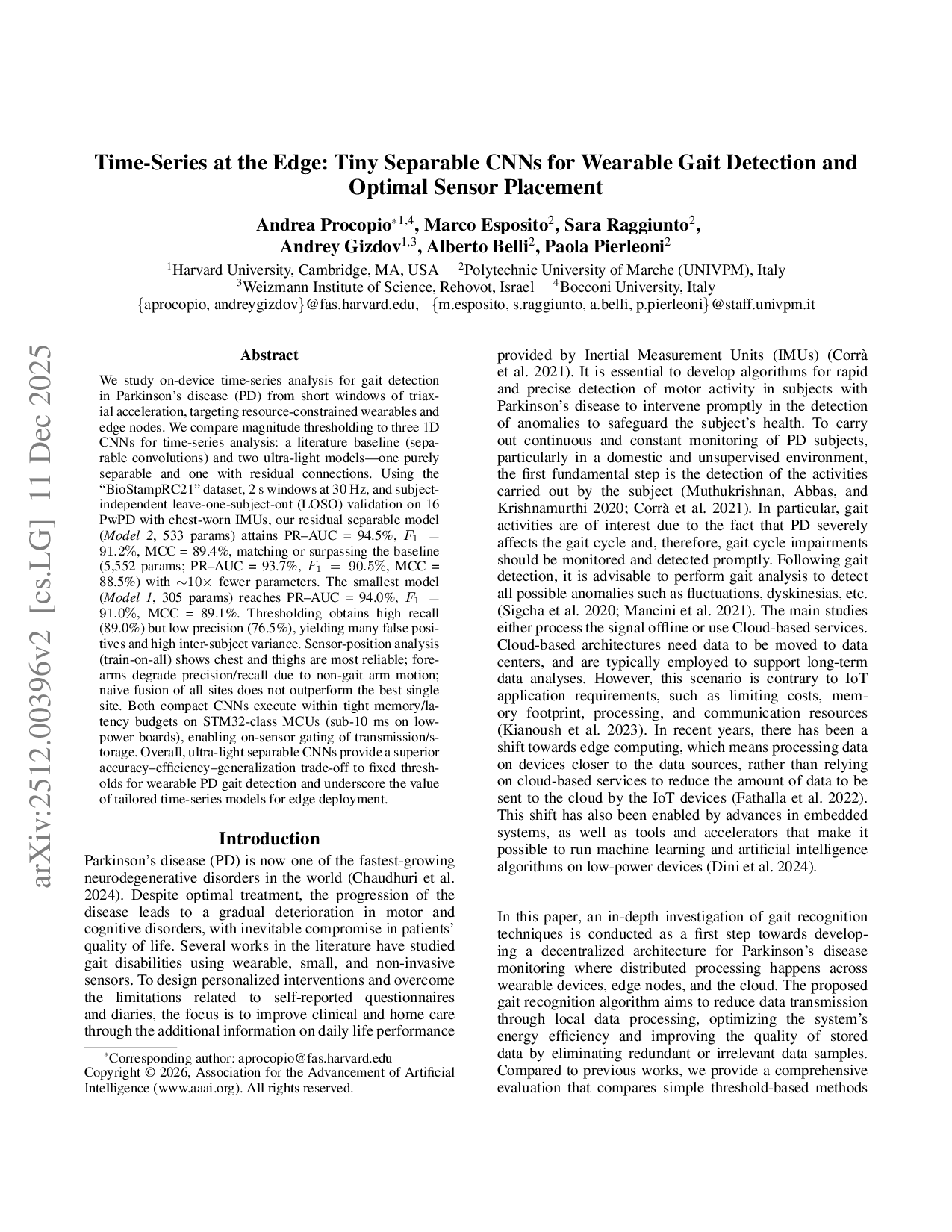
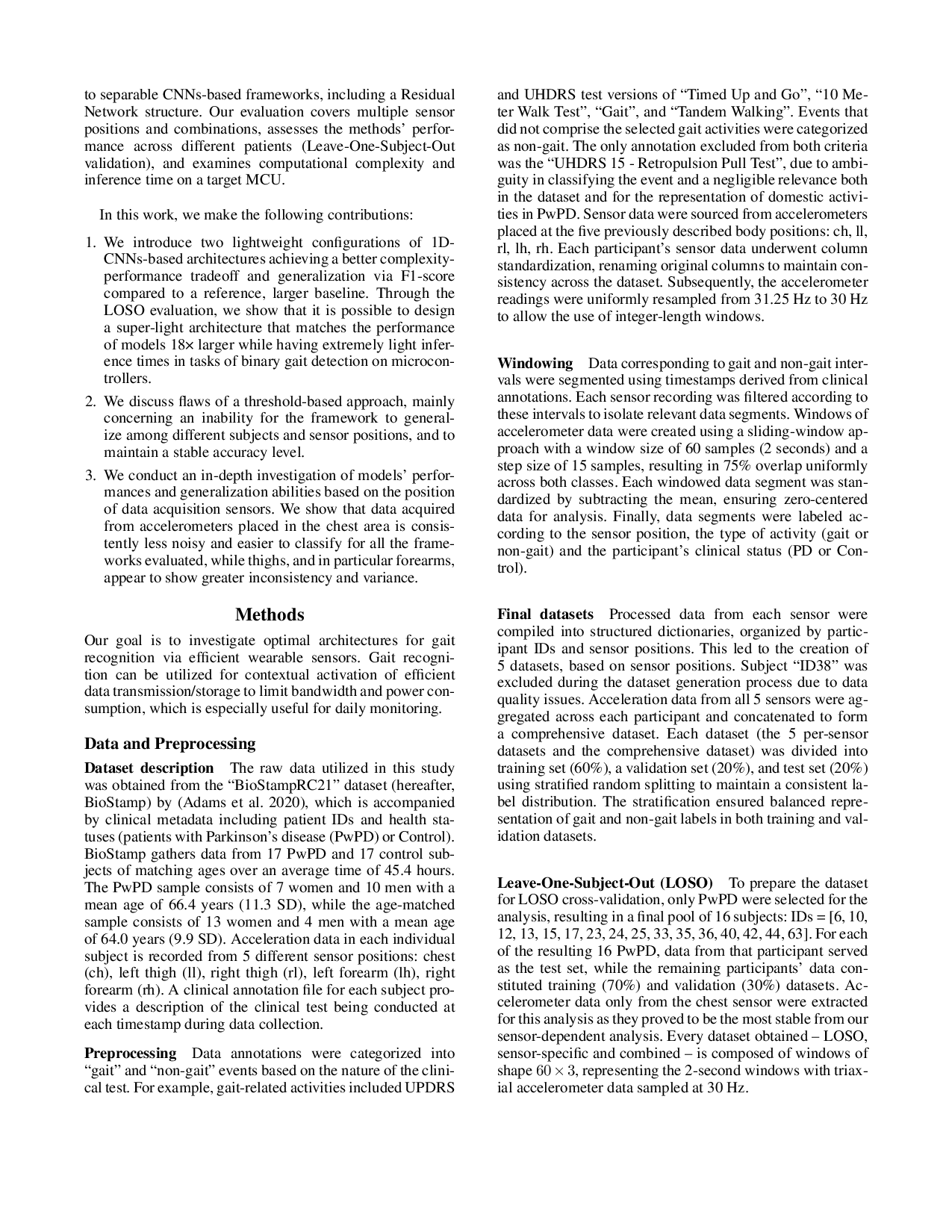
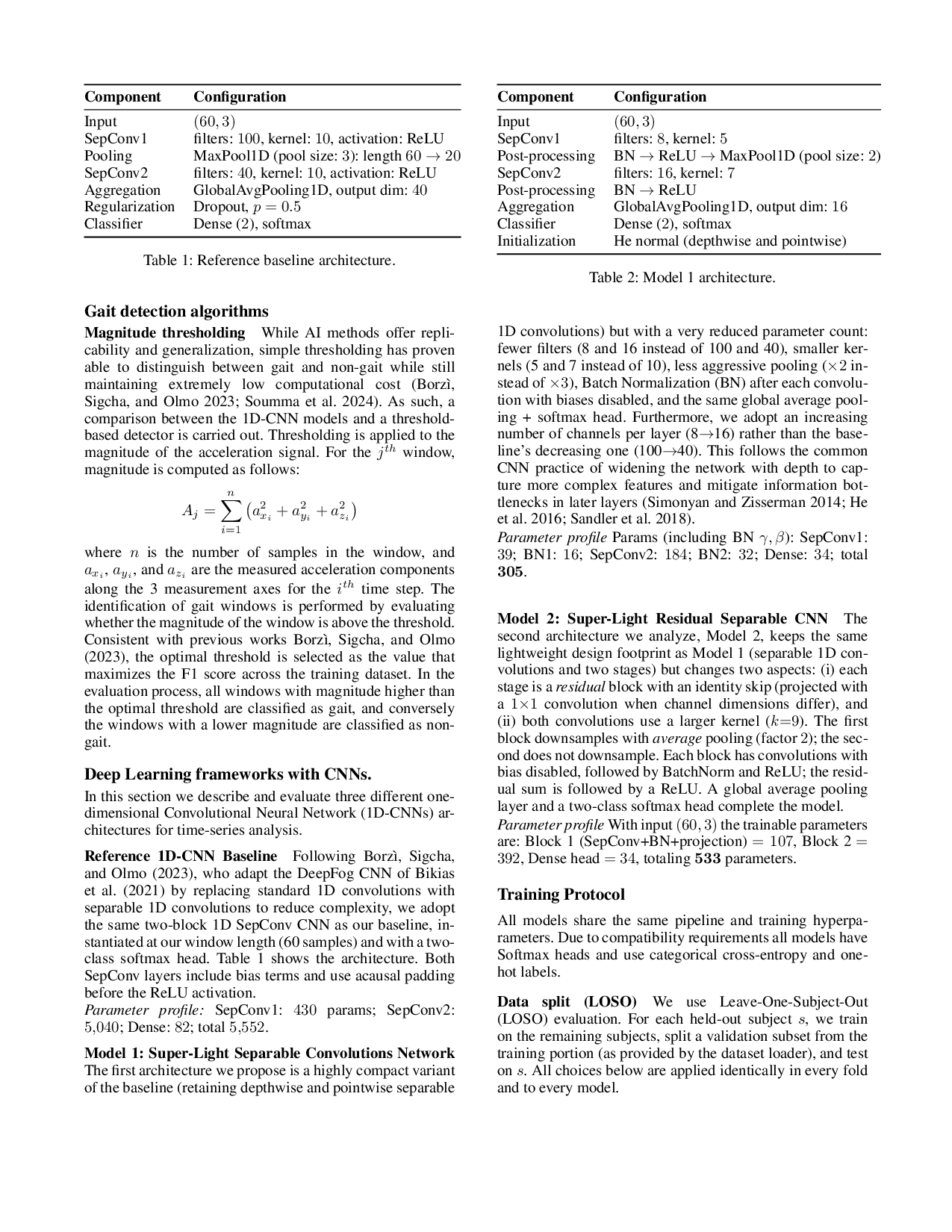
- We introduce two lightweight configurations of 1D-CNNs-based architectures achieving a better complexityperformance tradeoff and generalization via F1-score compared to a reference, larger baseline. Through the LOSO evaluation, we show that it is possible to design a super-light architecture that matches the performance of models 18× larger while having extremely light inference times in tasks of binary gait detection on microcontrollers. 2. We discuss flaws of a threshold-based approach, mainly concerning an inability for the framework to generalize among different subjects and sensor positions, and to maintain a stable accuracy level. 3. We conduct an in-depth investigation of models’ performances and generalization abilities based on the position of data acquisition sensors. We show that data acquired from accelerometers placed in the chest area is consistently less noisy and easier to classify for all the frameworks evaluated, while thighs, and in particular forearms, appear to show greater inconsistency and variance.
Our goal is to investigate optimal architectures for gait recognition via efficient wearable sensors. Gait recognition can be utilized for contextual activation of efficient data transmission/storage to limit bandwidth and power consumption, which is especially useful for daily monitoring.
Dataset description The raw data utilized in this study was obtained from the “BioStampRC21” dataset (hereafter, BioStamp) by (Adams et al. 2020) Preprocessing Data annotations were categorized into “gait” and “non-gait” events b
This content is AI-processed based on open access ArXiv data.