Title: ByteStorm: a multi-step data-driven approach for Tropical Cyclones detection and tracking
ArXiv ID: 2512.07885
Date: 2025-11-28
Authors: ** - Davide Donno¹² - Donatello Elia¹ - Gabriele Accarino¹³ - Marco De Carlo¹ - Enrico Scoccimarro¹ - Silvio Gualdi¹ ¹ CMCC Foundation – Euro‑Mediterranean Center on Climate Change, Lecce, Italy ² University of Salento, Department of Engineering for Innovation, Lecce, Italy ³ Department of Earth and Environmental Engineering, Columbia University, New York, USA — **
📝 Abstract
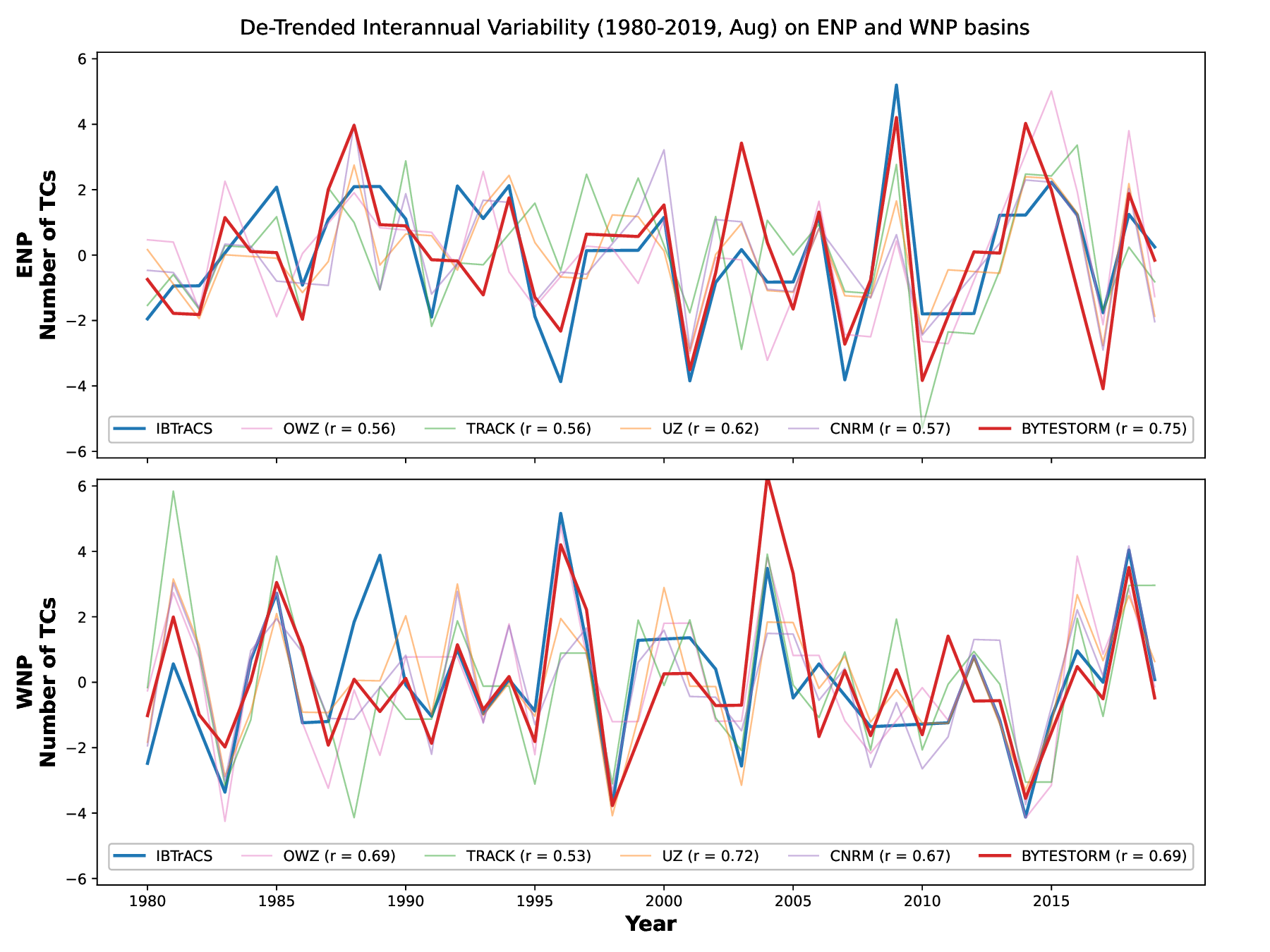
Accurate tropical cyclones (TCs) tracking represents a critical challenge in the context of weather and climate science. Traditional tracking schemes mainly rely on subjective thresholds, which may introduce biases in their skills on the geographical region of application. We present ByteStorm, an efficient data-driven framework for reconstructing TC tracks without threshold tuning. It leverages deep learning networks to detect TC centers (via classification and localization), using only relative vorticity (850 mb) and mean sea-level pressure. Then, detected centers are linked into TC tracks through the BYTE algorithm. ByteStorm is evaluated against state-of-the-art deterministic trackers in the East-and West-North Pacific basins (ENP and WNP). The proposed framework achieves superior performance in terms of Probability of Detection (85.05% ENP, 79.48% WNP), False Alarm Rate (23.26% ENP, 16.14% WNP), and high Inter-Annual Variability correlations (0.75 ENP and 0.69 WNP). These results highlight the potential of integrating deep learning and computer vision for fast and accurate TC tracking, offering a robust alternative to traditional approaches.
💡 Deep Analysis
📄 Full Content
BYTESTORM: A MULTI-STEP DATA-DRIVEN APPROACH FOR
TROPICAL CYCLONES DETECTION AND TRACKING
A PREPRINT
Davide Donno1,2
Donatello Elia1
Gabriele Accarino1,3
Marco De Carlo1
Enrico Scoccimarro1
Silvio Gualdi1
1 CMCC Foundation - Euro-Mediterranean Center on Climate Change, Via Marco Biagi, 5, Lecce, Italy
2 University of Salento, Department of Engineering for Innovation, Via per Monteroni, Lecce, Italy
3 Department of Earth and Environmental Engineering, Columbia University, New York, NY, USA
ABSTRACT
Accurate tropical cyclones (TCs) tracking represents a critical challenge in the context of weather
and climate science. Traditional tracking schemes mainly rely on subjective thresholds, which may
introduce biases in their skills on the geographical region of application. We present ByteStorm, an
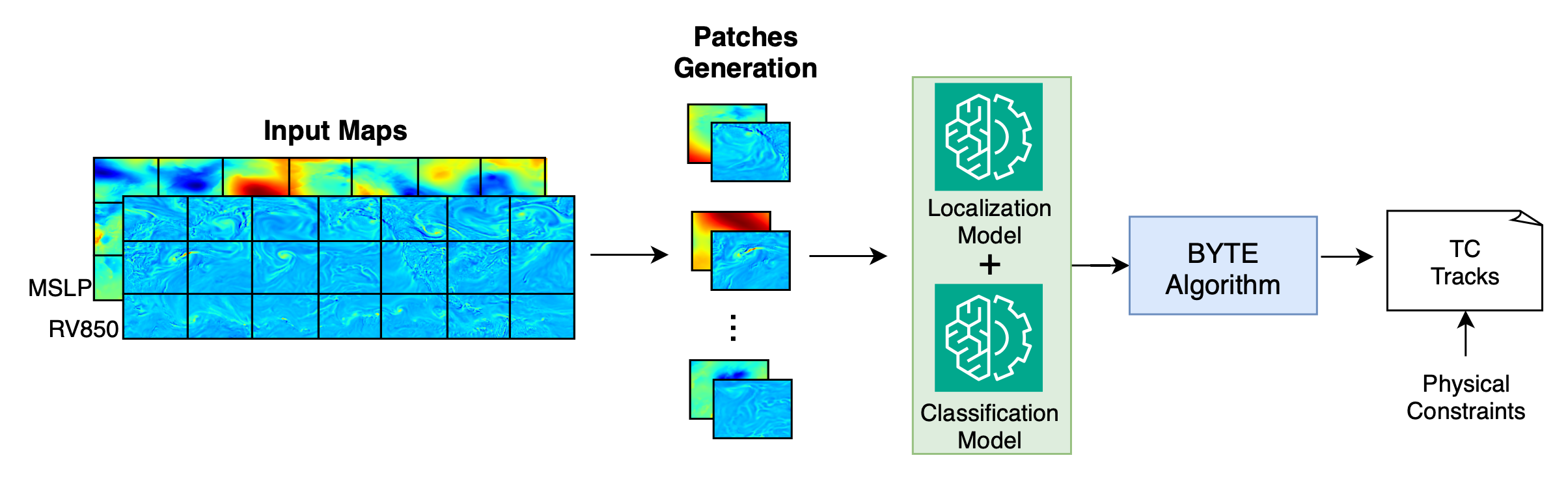
efficient data-driven framework for reconstructing TC tracks without threshold tuning. It leverages
deep learning networks to detect TC centers (via classification and localization), using only relative
vorticity (850 mb) and mean sea-level pressure. Then, detected centers are linked into TC tracks
through the BYTE algorithm. ByteStorm is evaluated against state-of-the-art deterministic trackers in
the East- and West-North Pacific basins (ENP and WNP). The proposed framework achieves superior
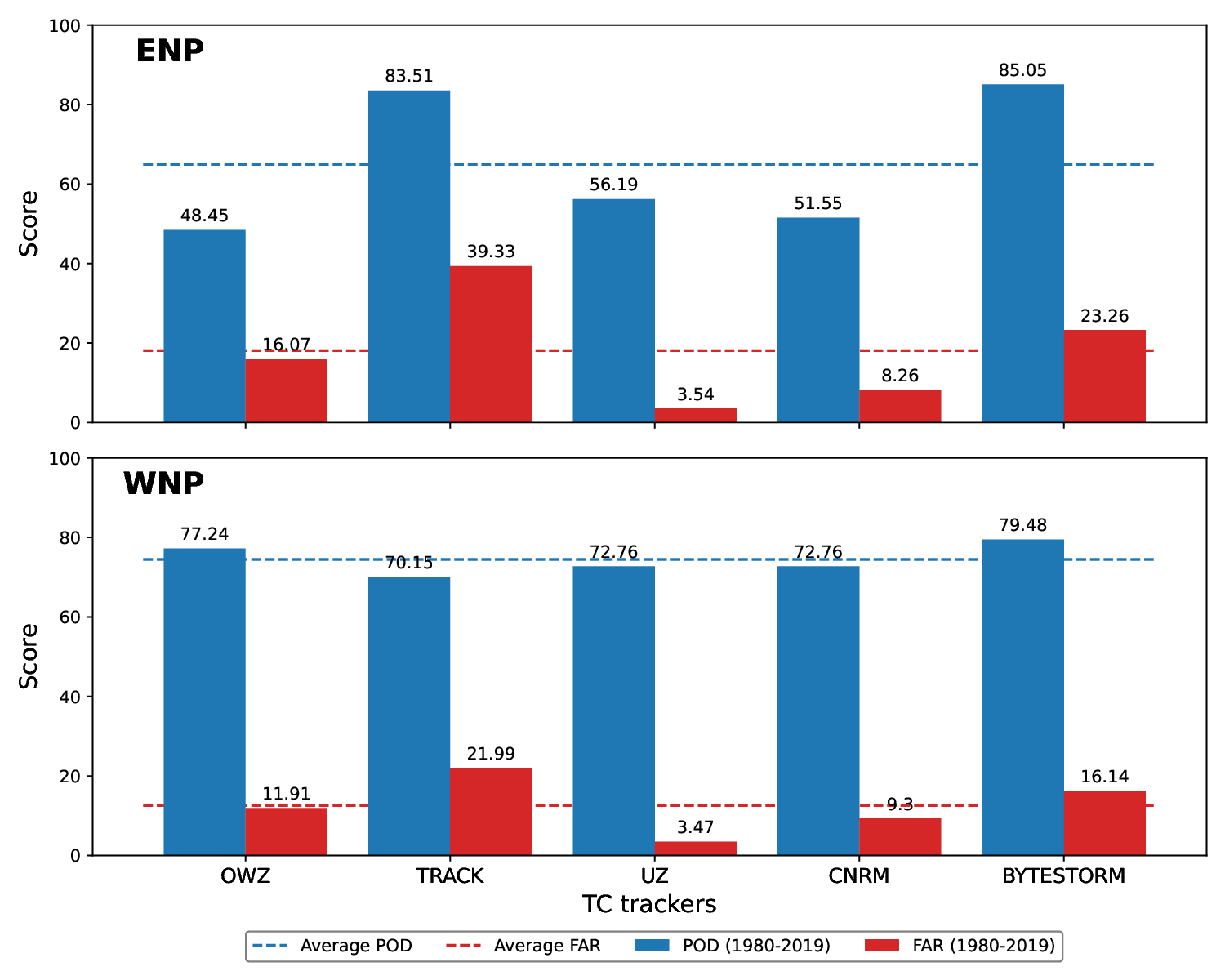
performance in terms of Probability of Detection (85.05% ENP, 79.48% WNP), False Alarm Rate
(23.26% ENP, 16.14% WNP), and high Inter-Annual Variability correlations (0.75 ENP and 0.69
WNP). These results highlight the potential of integrating deep learning and computer vision for fast
and accurate TC tracking, offering a robust alternative to traditional approaches.
Keywords Tropical Cyclones Tracking · Deep Learning · Computer Vision · Atmospheric Science · Machine Learning ·
Multi-Object Tracking
1
Introduction
Tropical Cyclones (TCs) are among the most destructive natural phenomena (Emanuel, 2003), causing widespread
damage and disruption globally. Their formation and development result from complex interactions between the ocean
and atmosphere, modulated by large-scale circulation patterns. For the development of a TC, several conditions must
meet (Gray, 1975; Weaver and Garner, 2023): warm sea surface temperatures from which the TC draws energy due to
the evaporation, the influence of the Coriolis force along with low wind shear and ample humidity and a pre-existing
low-pressure disturbance. Every year, an average of 90 TCs occur worldwide (Emanuel and Nolan, 2004), and climate
change is making them stronger and more destructive (Elsner et al., 2008; Mendelsohn et al., 2012; Sun et al., 2017).
Owing to their significant socio-economic impacts (World Meteorological Organization, 2023) and strong sensitivity to
climate variability (Mueller et al., 2024), the accurate monitoring and prediction of TCs remains a critical challenge in
both weather and climate science.
The accurate detection and tracking of these phenomena in large climate datasets is an active area of research for the
climate community (Scoccimarro et al., 2014; Dabhade et al., 2021; Garner et al., 2021; Chand et al., 2022). The
identification of TCs in such datasets is traditionally performed using deterministic tracking algorithms, or TC trackers
(Horn et al., 2014), which detect TC structures within gridded climate fields, locate their centers, and link them across
time, resulting in TC tracks (Bourdin et al., 2022). Specifically, TC tracking schemes comprise two consecutive
sub-tasks: detection and linking. The detection task aims to localize TC occurrences across space and time, and is
arXiv:2512.07885v1 [cs.LG] 28 Nov 2025
ByteStorm: a multi-step data-driven approach for Tropical Cyclones detection and tracking
PREPRINT
typically highly permissive, as it detects a wide number of false positives and small disturbances. Then, the linking task
joins previously detected TC occurrences across time based on some physical constraints (e.g., TC eye located in the
local minima of mean sea level pressure, maximum TC distance after 6 hours etc.), further removing most of these
unwanted detections.
Traditional tracking schemes are generally classified into physics-based (Camargo and Zebiak, 2002; Chauvin et al.,
2006a; Zhao et al., 2009; Horn et al., 2014; Murakami, 2014; Zarzycki and Ullrich, 2017) and dynamics-based (Hodges
et al., 2017a; Strachan et al., 2013; Tory et al., 2013a). Physics-based trackers rely on thermodynamic variables,
typically identifying local minima in the sea level pressure and confirming the presence of a warm-core using surface
temperature anomalies or geopotential thickness. They often apply an additional intensity-based criterion applied on
surface wind speed or vorticity to validate detections. In contrast, dynamics-based trackers focus on vorticity fields and
the velocity derivatives to detect the TC centers (Bourdin et al., 2022).
The aforementioned methods typically rely on threshold-based criteria, which makes them sensitive to expert’s