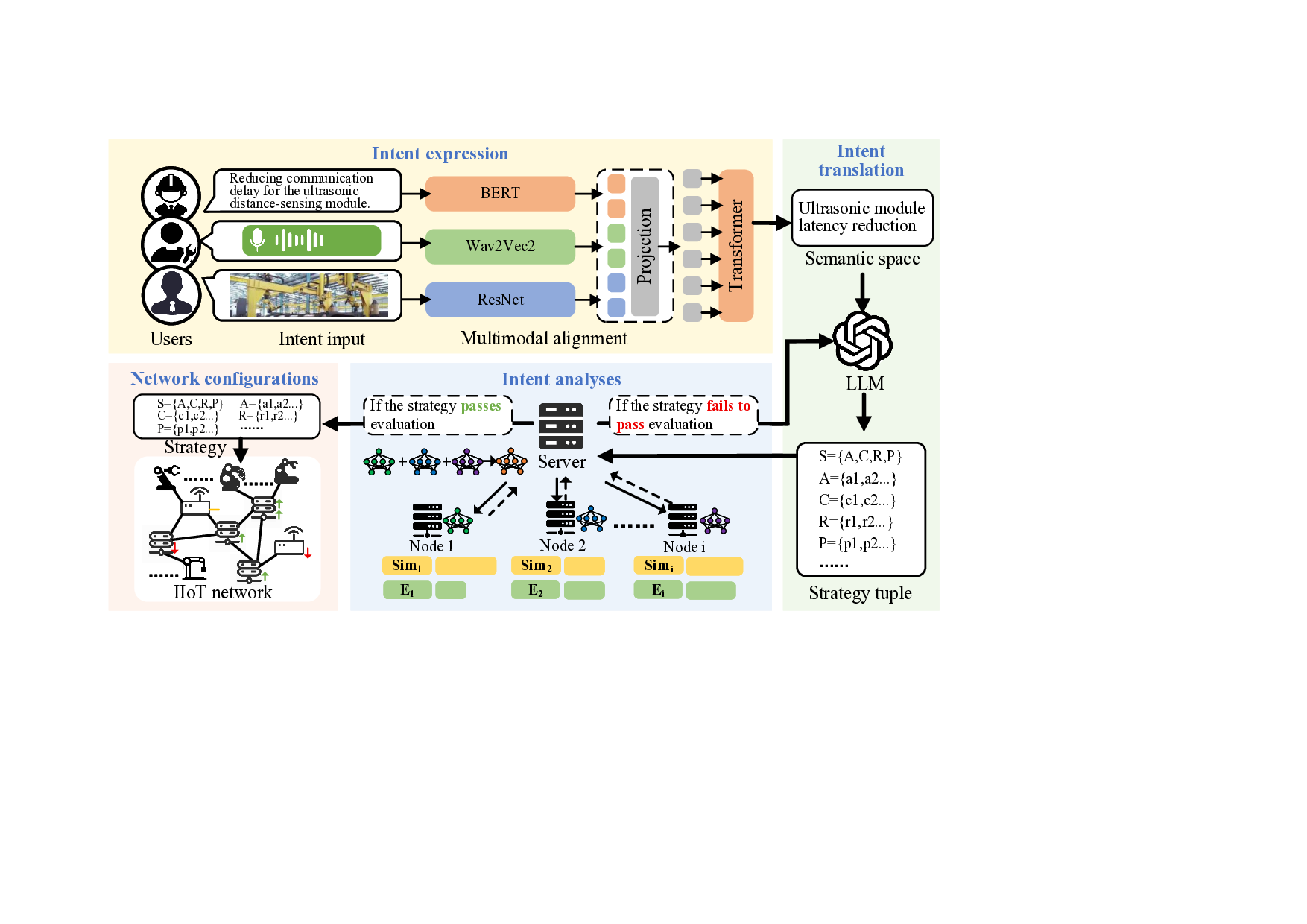
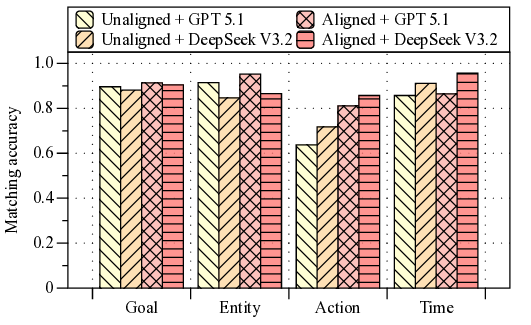
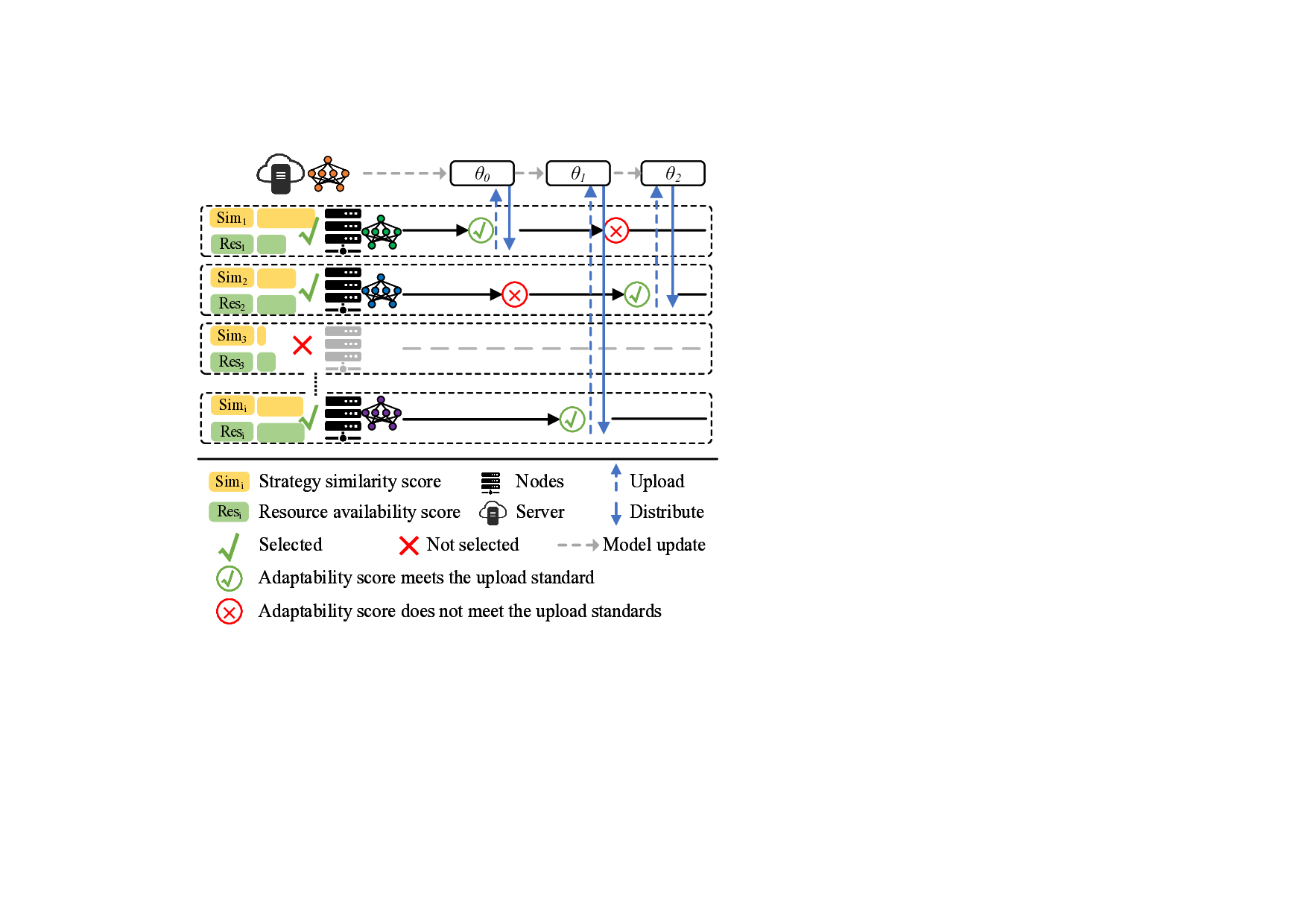
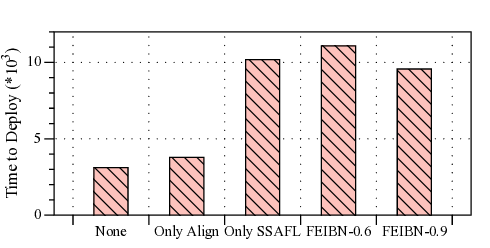
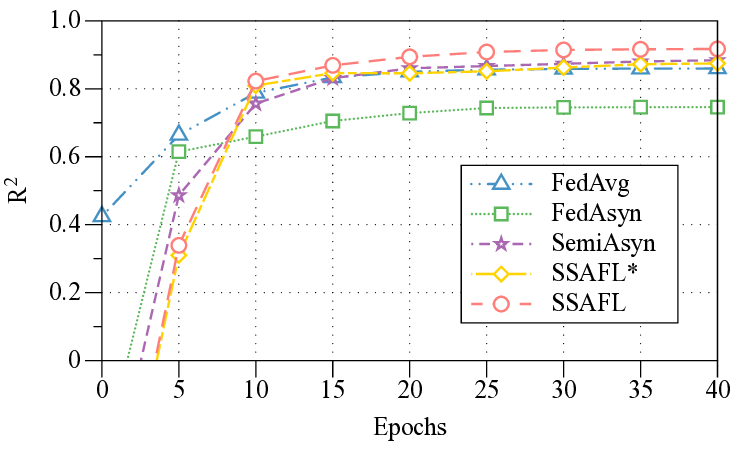
Intent-Based Networking (IBN) offers a promising paradigm for intelligent and automated network control in Industrial Internet of Things (IIoT) environments by translating high-level user intents into executable network strategies. However, frequent strategy deployment and rollback are impractical in real-world IIoT systems due to tightly coupled workflows and high downtime costs, while the heterogeneity and privacy constraints of IIoT nodes further complicate centralized policy verification. To address these challenges, we propose FEIBN, a Federated Evaluation Enhanced Intent-Based Networking framework. FEIBN leverages large language models (LLMs) to align multimodal user intents into structured strategy tuples and employs federated learning to perform distributed policy verification across IIoT nodes without exposing raw data. To improve training efficiency and reduce communication overhead, we design SSAFL, a Strategy Similarity Aware Federated Learning mechanism that selects task-relevant nodes based on strategy similarity and resource status, and triggers asynchronous model uploads only when updates are significant. Experiments demonstrate that SSAFL can improve model accuracy, accelerate model convergence, and reduce the cost by 27.8% compared with SemiAsyn.
a core enabling technology for modern industrial systems [1], [2]. Intent-Based Networking (IBN) provides a promising paradigm for intelligent operation in IIoT by allowing users to express desired outcomes through human-readable intents, which are automatically translated into executable policies for deployment and enforcement [3], [4]. However, IIoT intents often involve task execution goals, device coordination rules, safety constraints, and temporal requirements, rather than simple network configuration updates [5]. For example, in a sensing-driven environment equipped with temperature, humidity, water-level, and ultrasonic modules, an engineer may express intentions such as "increase the sampling priority of the ultrasonic sensing module" or "allocate more processing resources to the water-level monitoring zone." Ensuring that such high-level instructions are correctly interpreted and mapped to actionable IIoT strategies is crucial for safe and efficient system operation [6], [7]. Traditional intent analysis methods, which rely on rule-based or shallow semantic models [8], suffer from limited generalization and adaptability in complex industrial scenarios. Large Language Models (LLMs) [9], with their powerful semantic understanding and crossmodal reasoning capabilities, can integrate intents expressed across different modalities into a unified semantic representation, thereby significantly enhancing the intent recognition capability of IBN systems [10].
However, accurate intent recognition alone is insufficient to ensure reliable policy execution. Unlike traditional network management intents that primarily involve routing or configuration updates, IIoT intents directly drive physical actions, making incorrect interpretations or unsafe deployments potentially lead to costly downtime or even physical hazards [11], [12]. This necessitates thorough policy verification prior to deployment to prevent costly failures or interruptions [4]. Existing AI-based methods to verify network policies before actual deployment, which requires uploading operational and environmental data from multiple devices to a centralized server for model training and performance evaluation. Nevertheless, IIoT nodes are typically distributed and heterogeneous, and the data held by each node often involves sensitive information such as device parameters and operational status [13], rendering centralized evaluation and prediction model training infeasible. Federated Learning (FL) [14], [15], as a distributed collaborative learning framework, enables crossnode policy verification without requiring raw data to leave local devices [16]. FL can be categorized into synchronous FL and asynchronous FL. In synchronous FL, the server must wait for all clients to upload their updates, causing faster clients to idle until the slowest ones finish. This straggler effect slows down training and leads to inefficient resource utilization, resulting in prolonged aggregation time and delayed convergence [17], [18]. Asynchronous FL addresses the previously mentioned challenges by allowing the server to aggregate and update models promptly upon receiving a single client model [19]. This method significantly reduces the waiting times for faster clients and expedites the training process of the global model. Although integrating asynchronous FL with industrial intent-based networking effectively enhances distributed policy verification, it also brings the following new issues.
i. There is a lack of a complete framework that connects multimodal intent fusion, semantic translation, policy generation, and distributed verification into a unified process. Although several recent studies have introduced LLMs into IBN, existing LLMs can only process unstructured textual descriptions, which do not fully meet the requirements of multimodal inputs [20], [21]. Moreover, current IBN approaches for IIoT largely focus on intent interpretation while seldom integrating verification and feedback mechanisms into the overall workflow, making it difficult to form a closed-loop system in which intents can be accurately interpreted, reliably executed, and continuously optimized. ii. Because different strategies often correspond to distinct execution conditions and action sets [22], IBN policy verification tasks exhibit strong task-specific characteristics. However, existing methods usually neglect the relevance between nodes and strategies, with node evaluation metrics only focusing on capability, which can result in inefficient or low-value training. iii. IBN policy verification tasks impose strict requirements on communication efficiency and response time, since frequent uploads of minor updates may lead to resource waste and delay timely strategy deployment due to prolonged training [23]. Although asynchronous FL accelerates global model updates, it often results in redundant communication and unstable convergence due to uneven resource availability and unbalanced node part
This content is AI-processed based on open access ArXiv data.