UV unwrapping flattens 3D surfaces to 2D with minimal distortion, often requiring the complex surface to be decomposed into multiple charts. Although extensively studied, existing UV unwrapping methods frequently struggle with AI-generated meshes, which are typically noisy, bumpy, and poorly conditioned. These methods often produce highly fragmented charts and suboptimal boundaries, introducing artifacts and hindering downstream tasks. We introduce PartUV, a part-based UV unwrapping pipeline that generates significantly fewer, part-aligned charts while maintaining low distortion. Built on top of a recent learning-based part decomposition method PartField, PartUV combines high-level semantic part decomposition with novel geometric heuristics in a top-down recursive framework. It ensures each chart's distortion remains below a user-specified threshold while minimizing the total number of charts. The pipeline integrates and extends parameterization and packing algorithms, incorporates dedicated handling of non-manifold and degenerate meshes, and is extensively parallelized for efficiency. Evaluated across four diverse datasets, including man-made, CAD, AI-generated, and Common Shapes, PartUV outperforms existing tools and recent neural methods in chart count and seam length, achieves comparable distortion, exhibits high success rates on challenging meshes, and enables new applications like part-specific multi-tiles packing. Our project page is at https://www.zhaoningwang.com/PartUV.
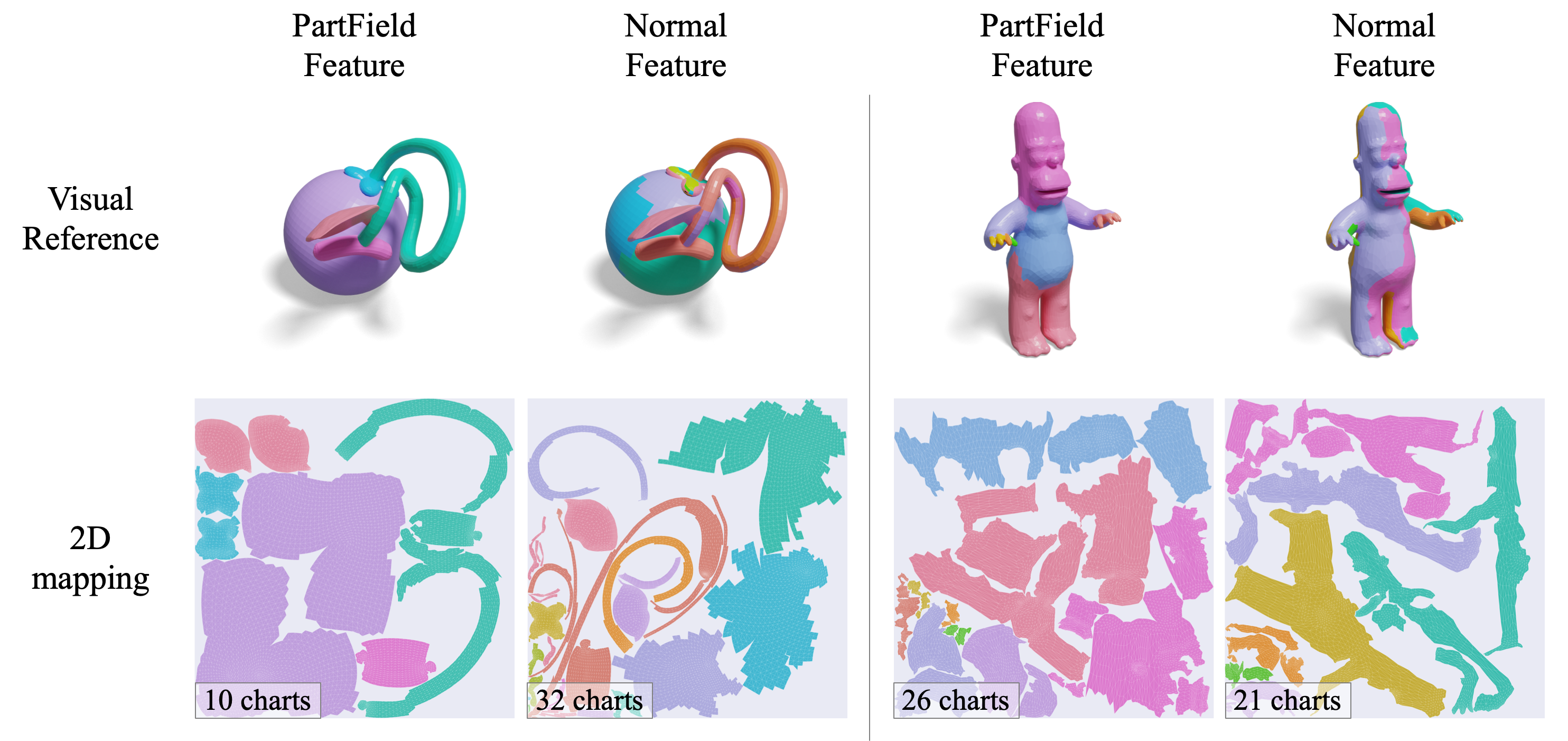
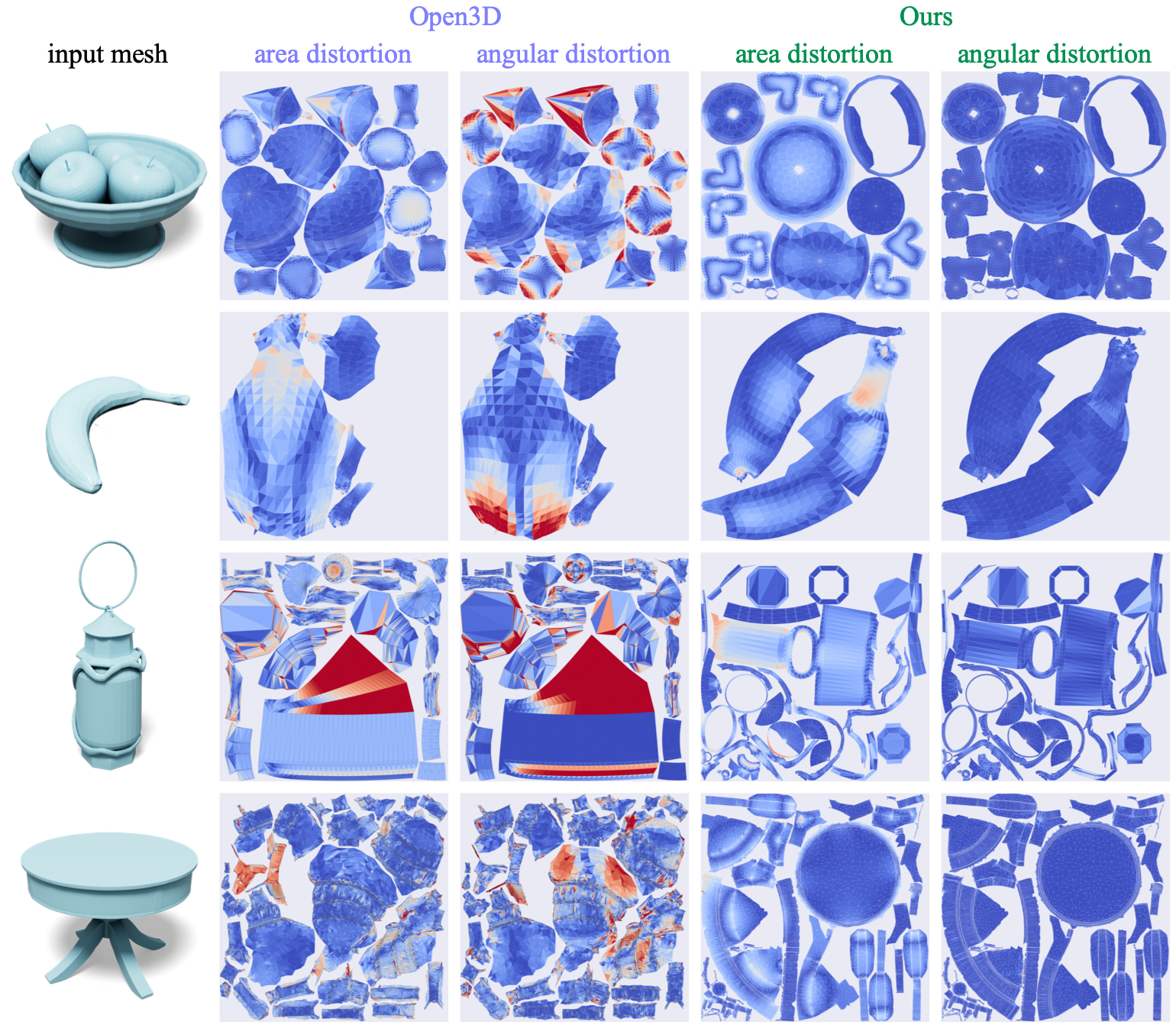
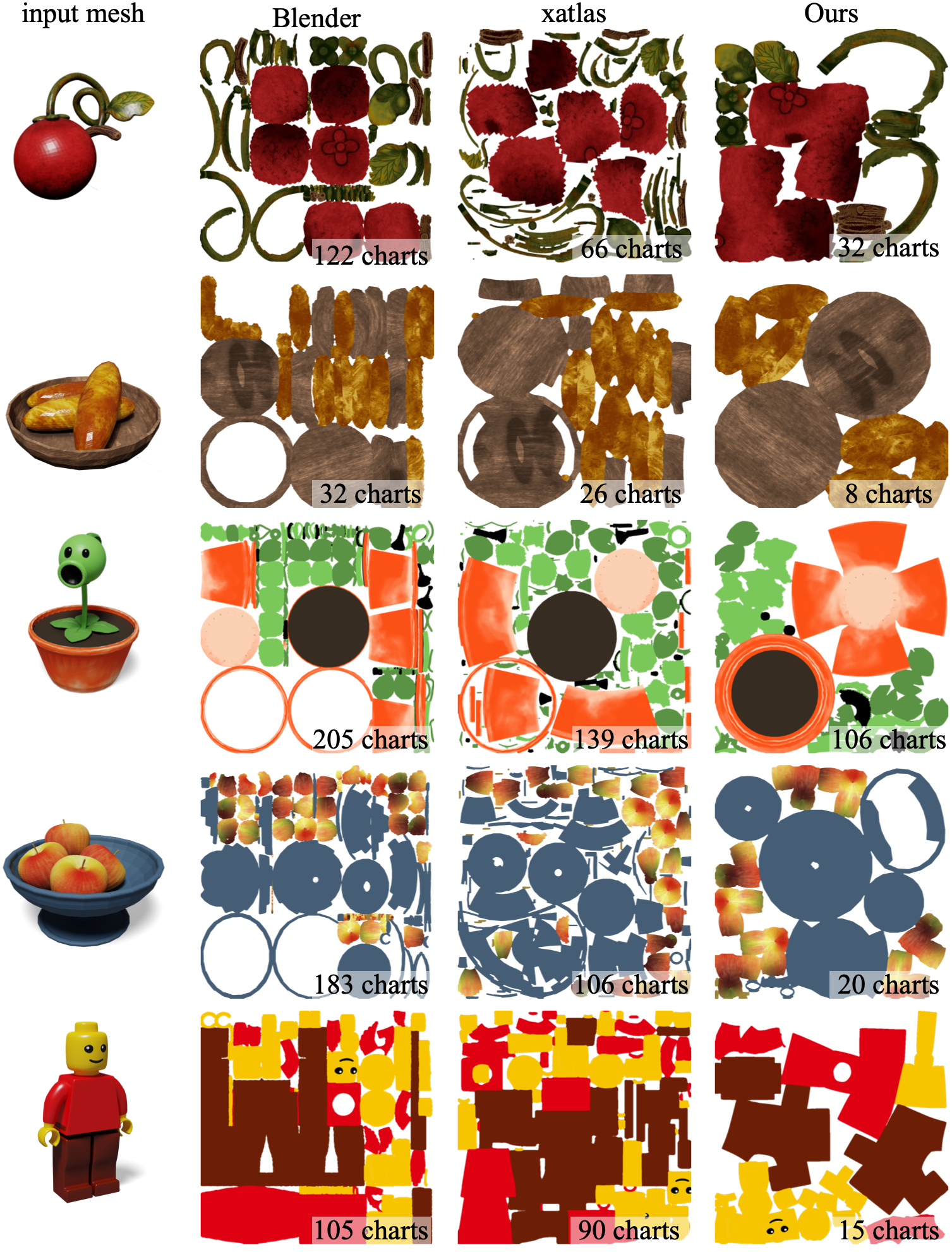
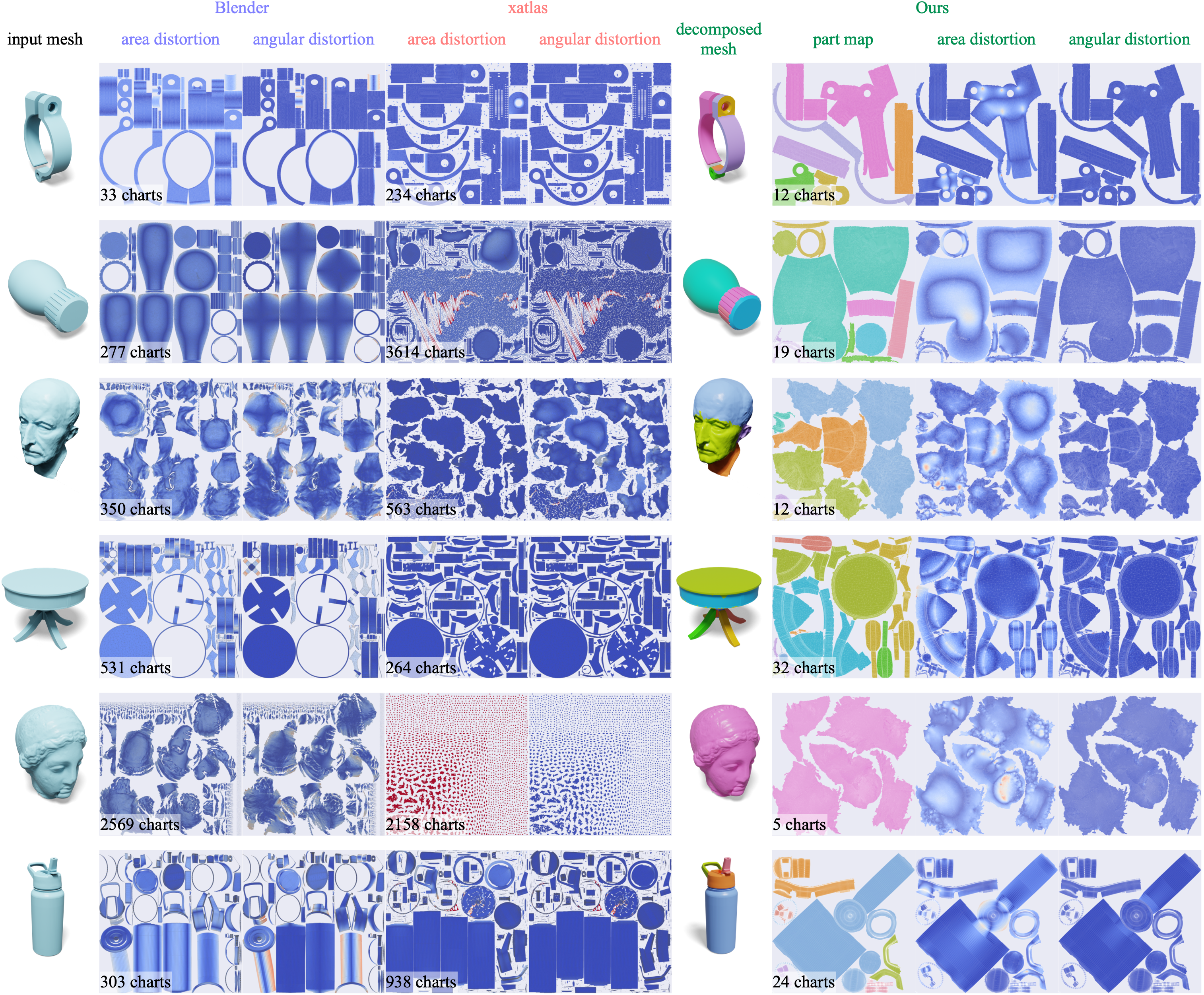
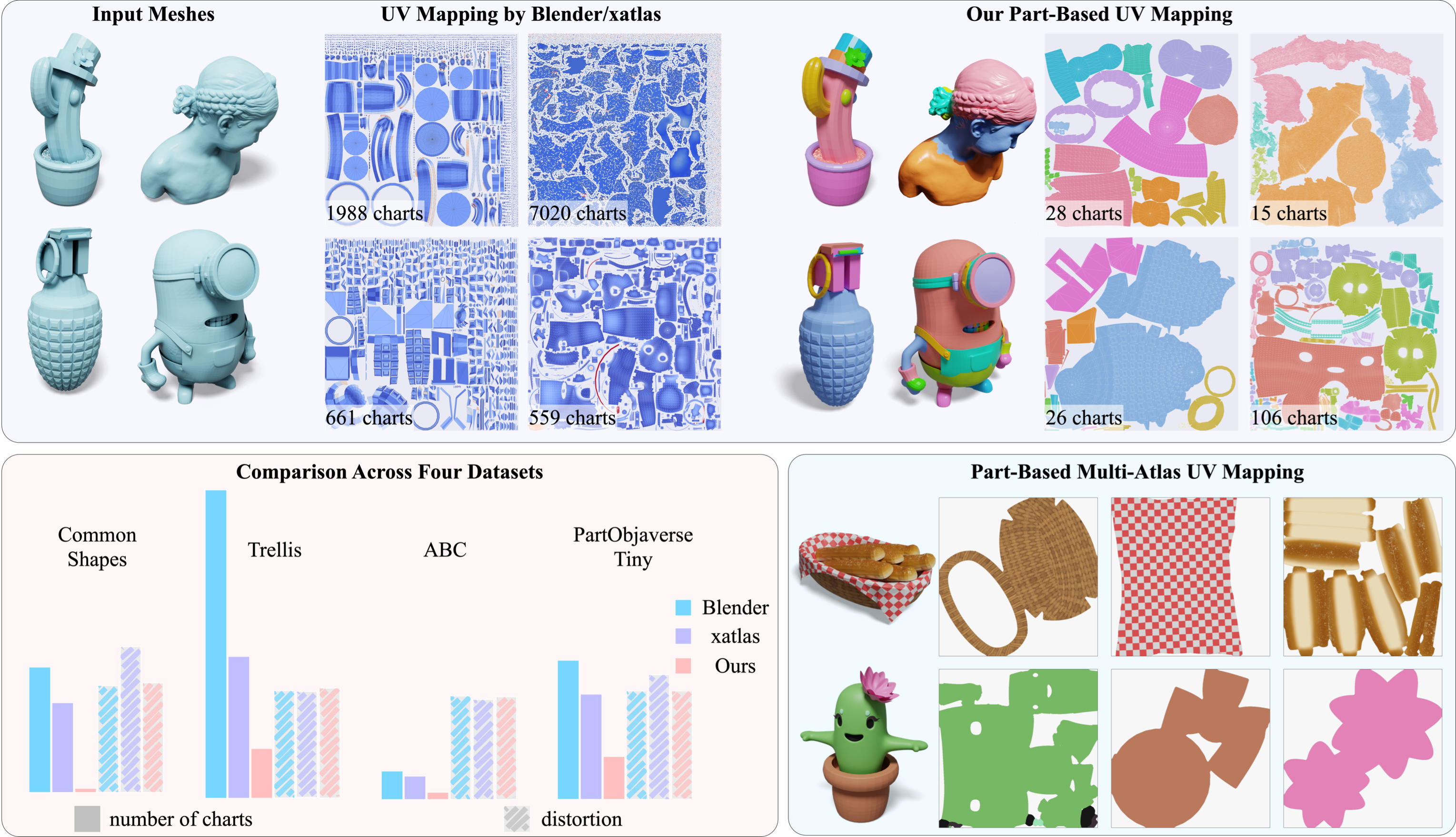
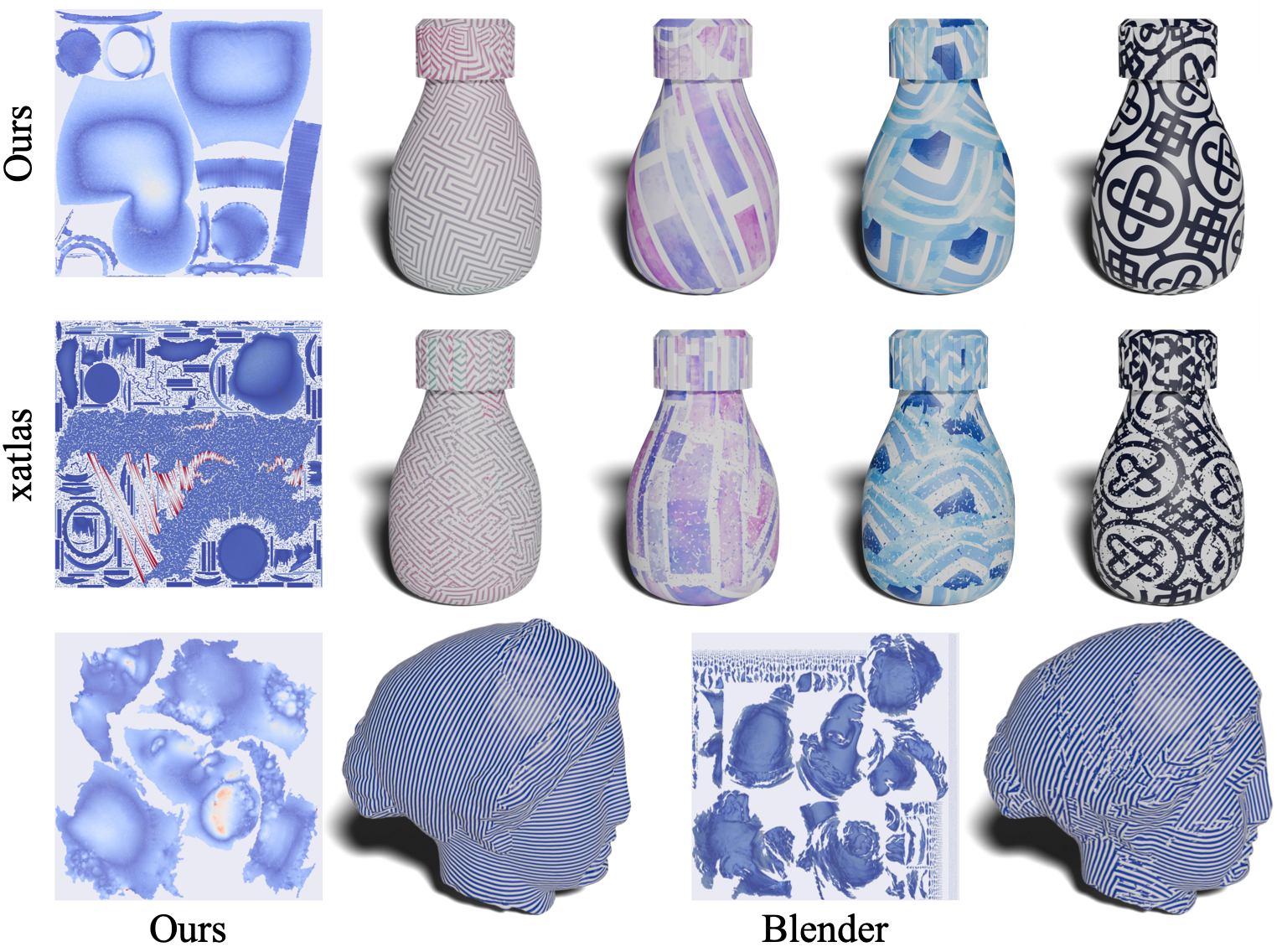
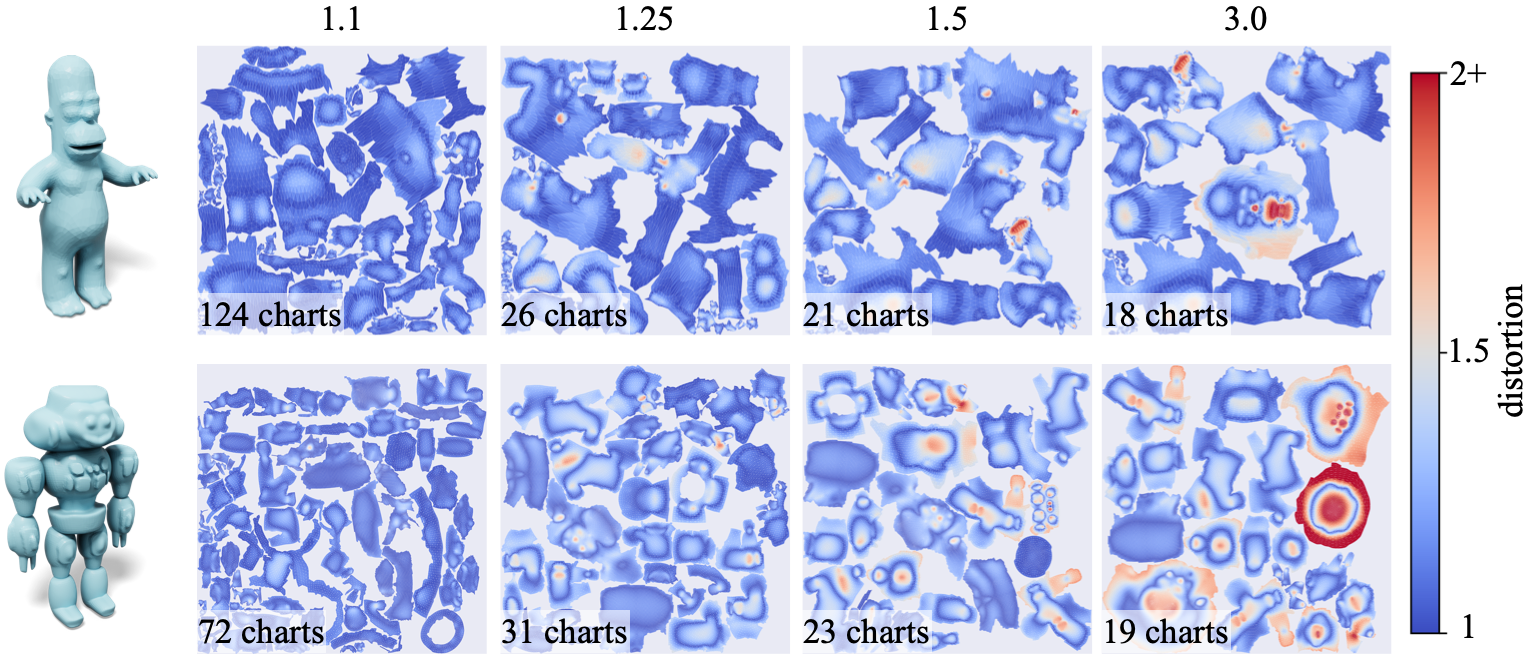
Fig. 1. We propose PartUV, a novel part-based UV unwrapping method for 3D meshes. Unlike traditional approaches that rely solely on local geometric priors and often produce over-fragmented charts, PartUV combines learned part priors with geometric cues to generate a small number of part-aligned charts. We evaluate our method on four diverse datasets-PartObjaverseTiny (man-made) [Yang et al. 2024], Trellis (AI-generated) [Xiang et al. 2024], ABC (CAD) [Koch et al. 2019], and Common Shapes [Jacobson and contributors 2023]-and show that it produces significantly less fragmented UV mappings while maintaining low distortion on par with baseline methods. Leveraging part-aware charts also enables applications such as generating one atlas per part.
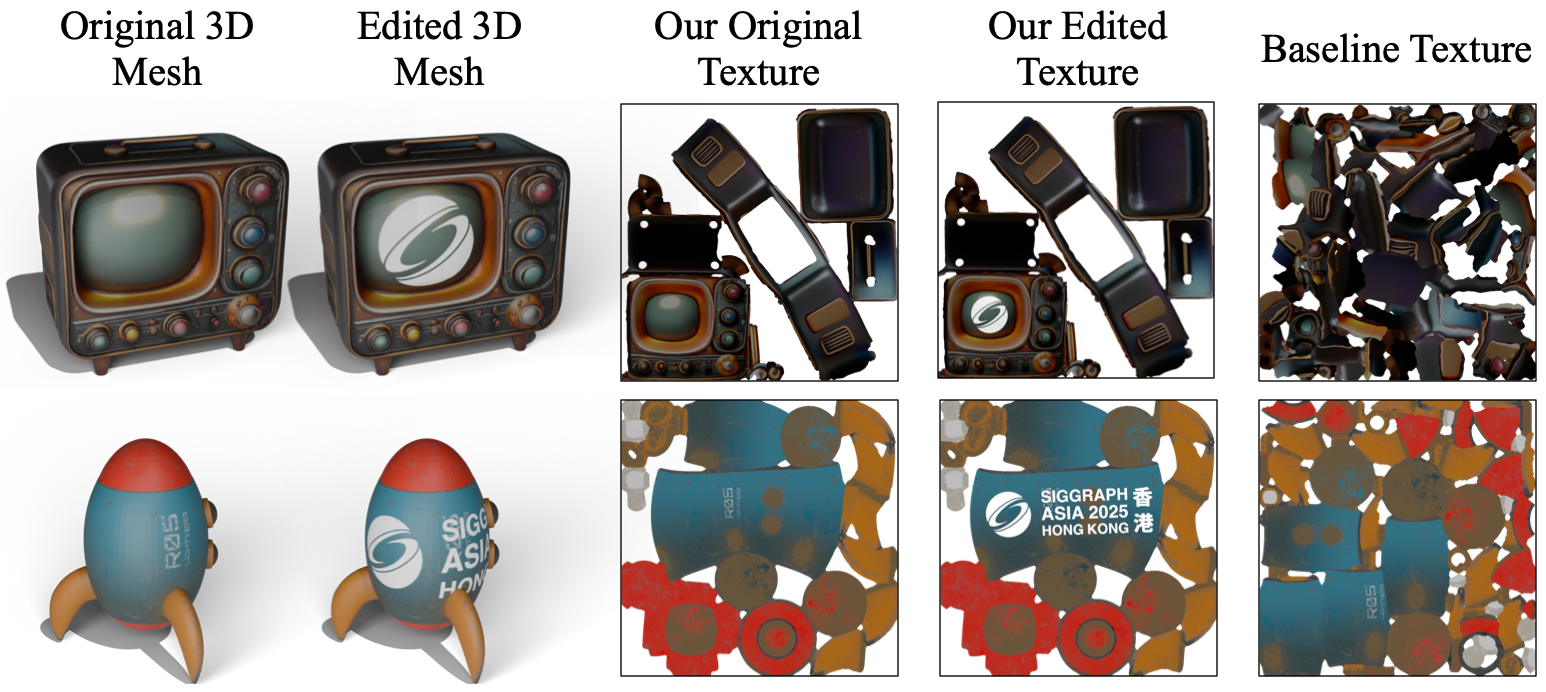
UV unwrapping projects the 3D surface of a mesh onto a 2D plane, assigning every 3D surface point a corresponding 2D UV coordinate. This step is fundamental in 3D-content-creation pipelines because it enables detailed surface information-such as material properties (e.g., base-color, roughness, normal maps), along with auxiliary maps like ambient occlusion and displacement-to be efficiently stored and manipulated in 2D space.
A principal component of UV unwrapping is surface parameterization, which flattens the 3D surface while trying to preserve geometric properties such as angles and areas. For meshes with complex geometry, flattening the entire surface into a single 2D chart introduces large distortion. Consequently, chart segmentation (or seam cutting) is typically used to divide the mesh into multiple charts along strategically placed seams, allowing each chart to be flattened with reduced distortion. Finally, UV packing arranges the resulting charts within the unit square (the UV atlas) to maximize texture-space use.
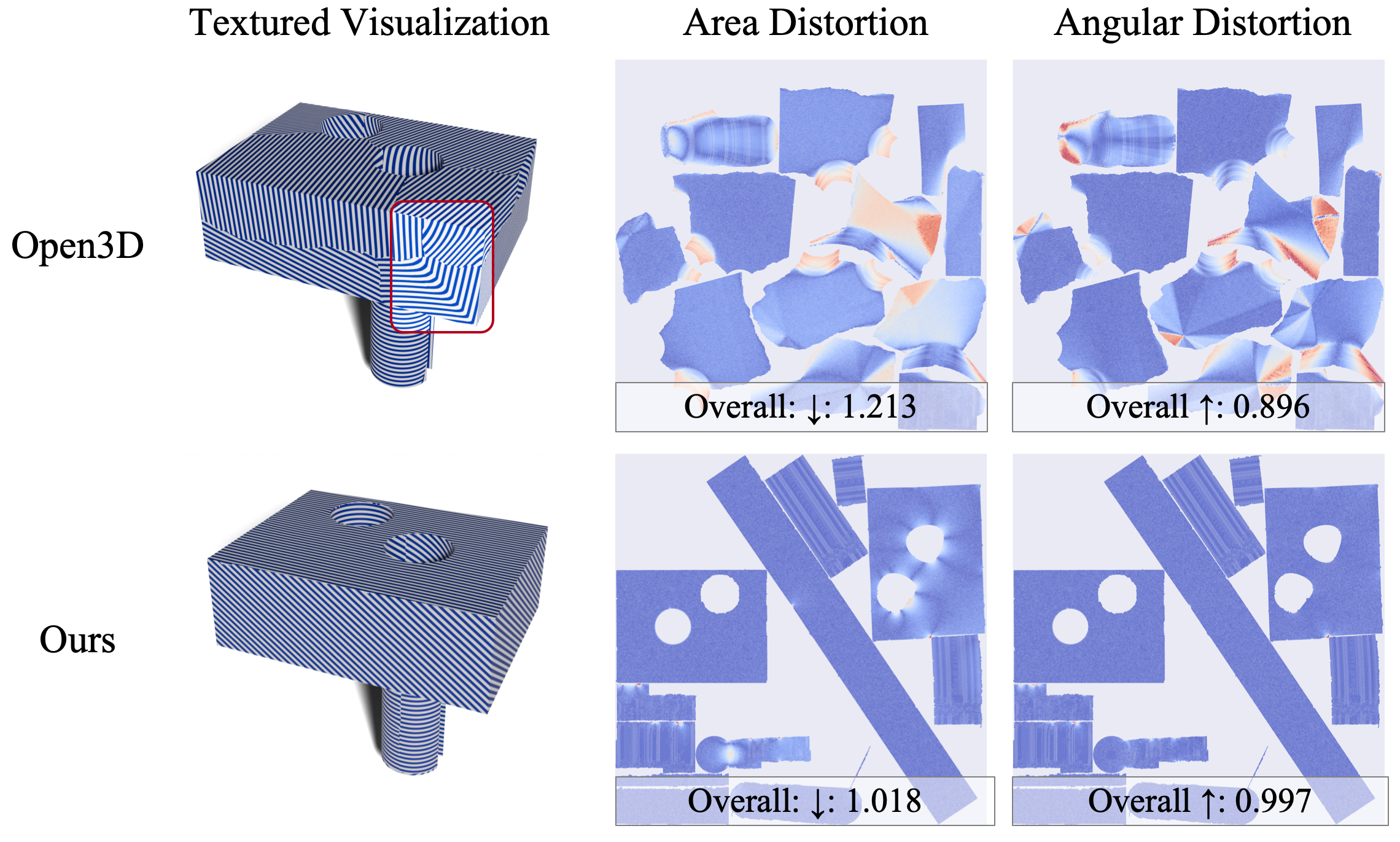
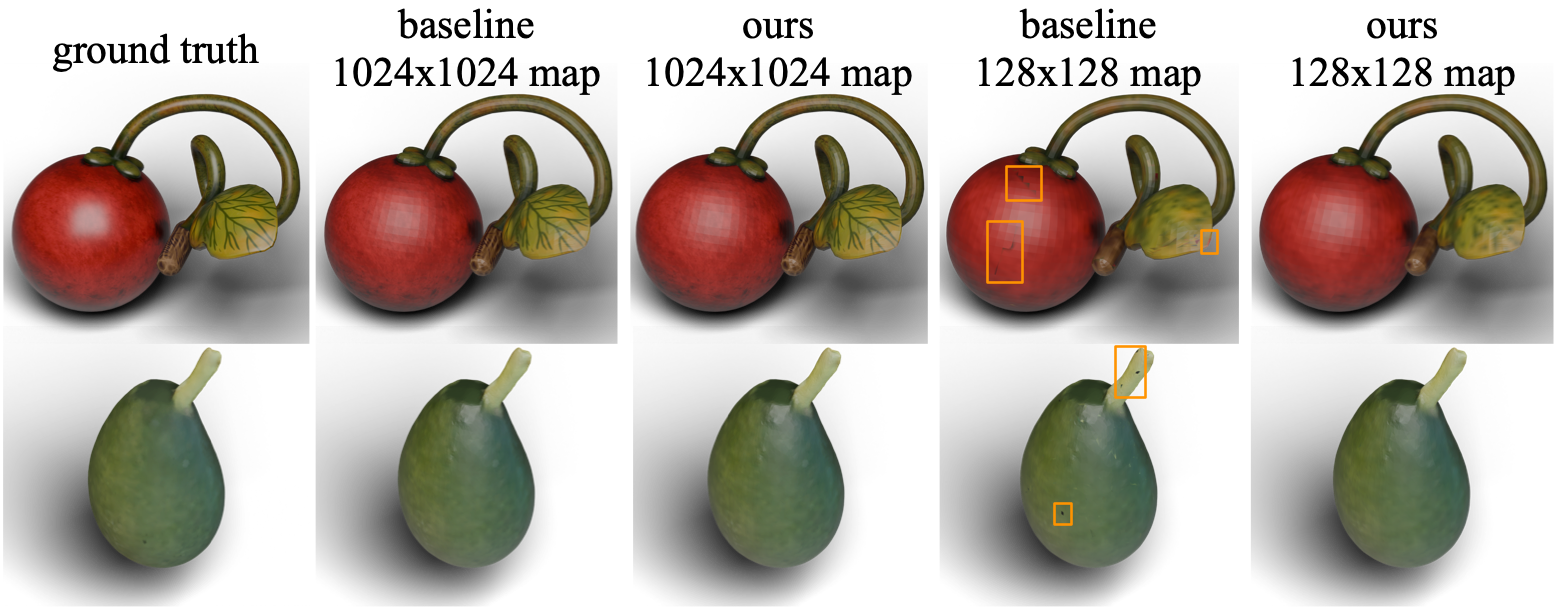
Although UV unwrapping has been studied extensively, existing methods are typically tuned for well-behaved meshes, such as those created by professional 3D artists. They often fail on more complex, AI-generated meshes. Such meshes, typically extracted from neural-field isosurfaces (e.g., via marching cubes [Lorensen and Cline 1998]), tend to have bumpy surfaces, many small triangles, and poor geometric quality (e.g., disconnected components or holes). On such data, existing methods may time-out or return extremely fragmented atlases in which a single chart holds only one or a handful of triangles. This extreme fragmentation hampers texture painting and editing, introduces texture-bleed and baking or rendering artifacts at chart boundaries, and burdens downstream applications with an unwieldy number of charts.
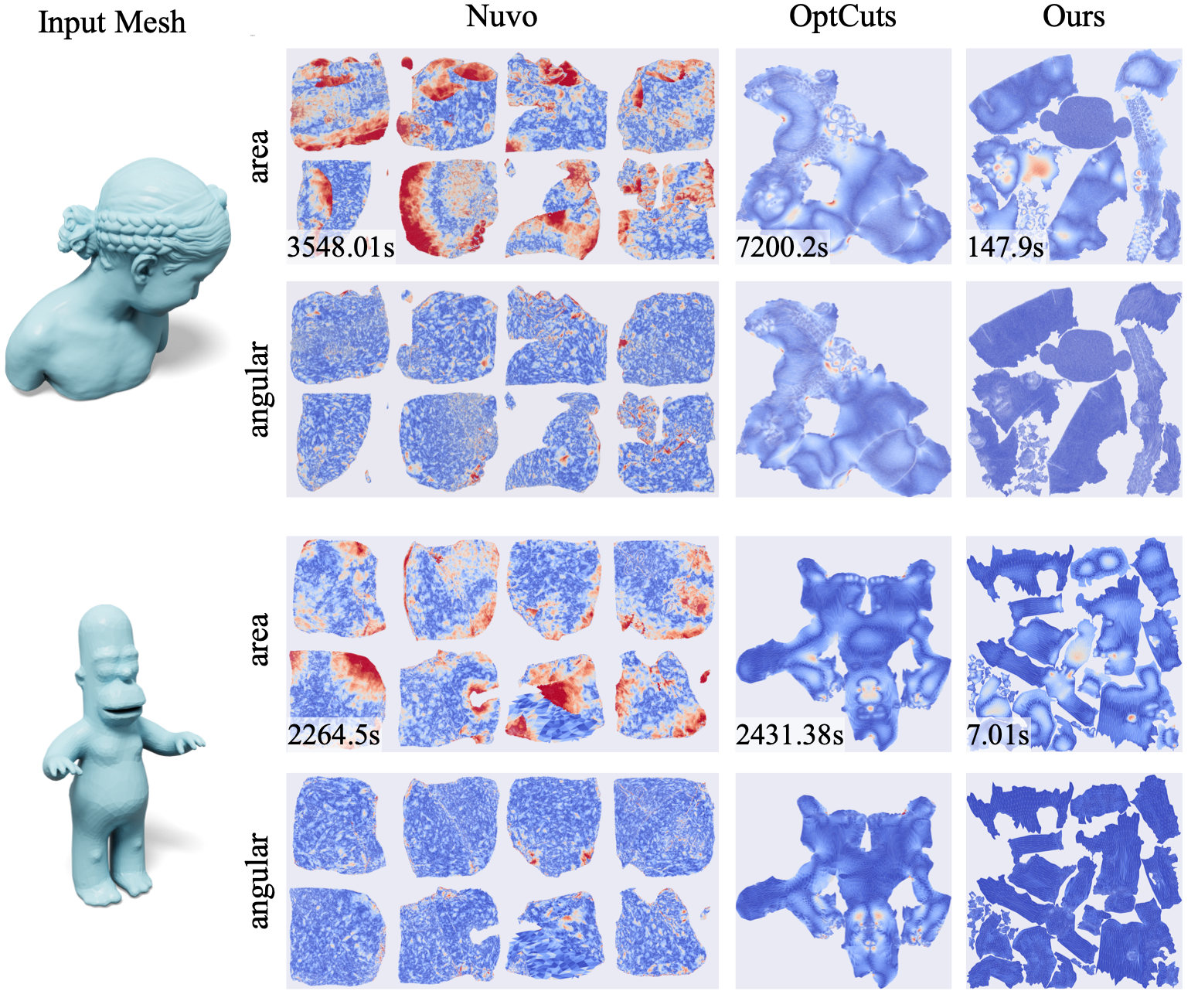
Some recent approaches mitigate fragmentation [Srinivasan et al. 2024;Zhang et al. 2024;Zhao et al. 2025] by representing the UV mapping using a neural field and optimizing such a field for each 3D shape from scratch. While these methods can effectively control the number of charts generated, they typically run for more than thirty minutes and still exhibit noticeable distortion. Other methods [Li et al. 2018;Poranne et al. 2017] jointly optimize seam length and distortion but are likewise computationally expensive. Moreover, some existing approaches like [Lévy et al. 2002;Sorkine et al. 2002;Zhou et al. 2004] segment charts or identify seams using heuristics based on local geometric properties, rather than leveraging the concept of geometric or semantic parts. This can lead to unintuitive or suboptimal chart boundaries that split semantically coherent regions across multiple charts, further complicating downstream tasks such as texture authoring, part-based editing, and semanticaware rendering.
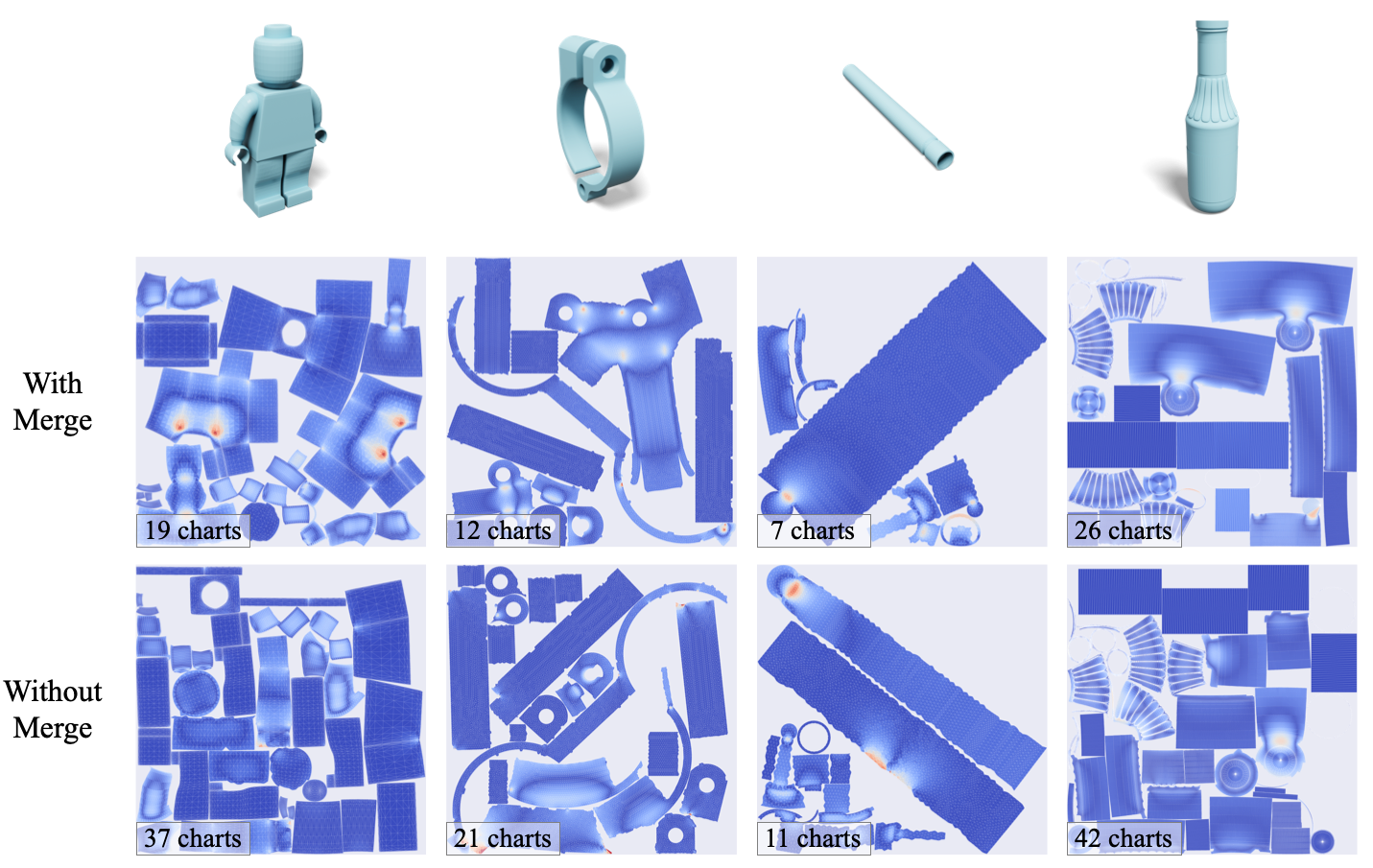
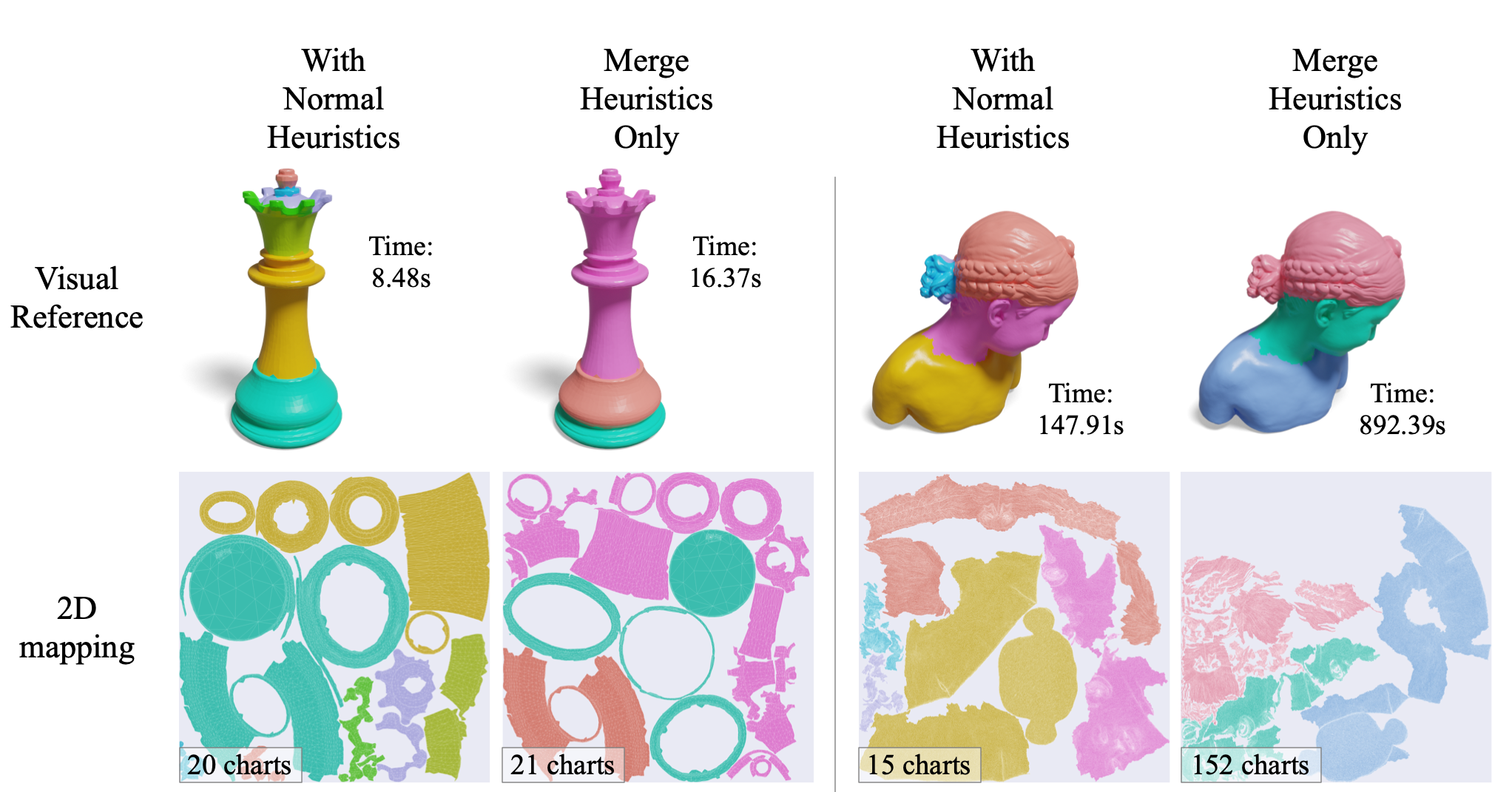
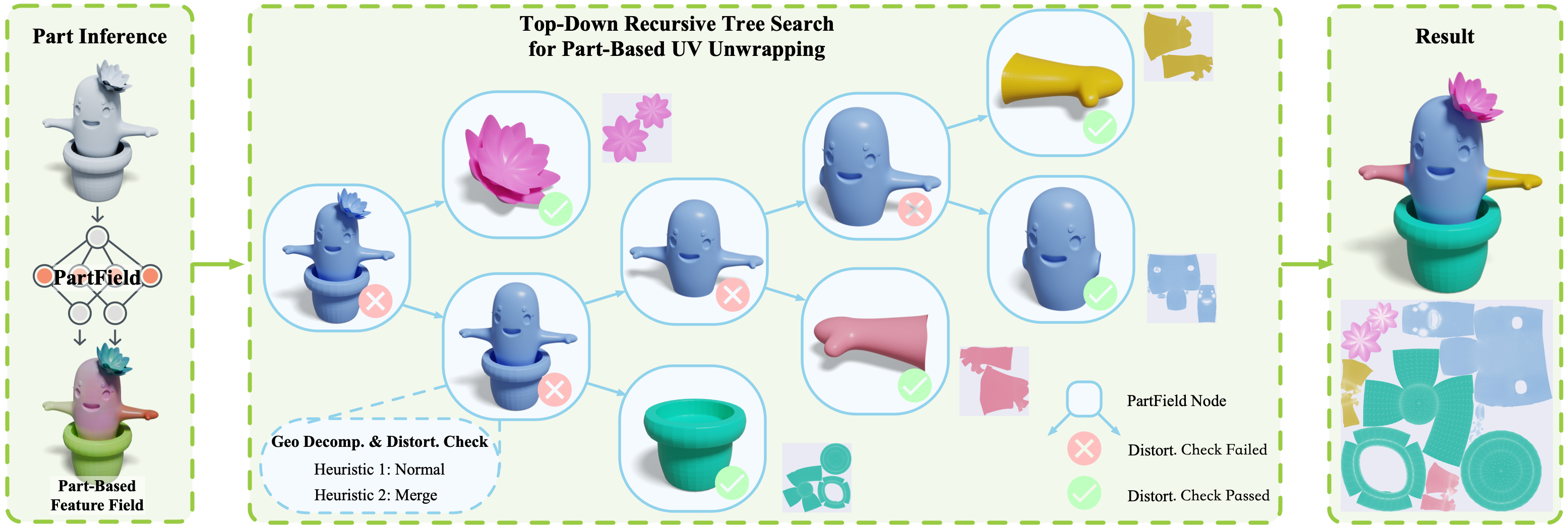
In this paper, we introduce PartUV, a part-based UV unwrapping pipeline for 3D meshes that generates UV mappings with a small number of part-aligned charts while maintaining low distortion, as well as robust and efficient processing-typically completed within a few to several tens of seconds. PartUV builds on a recent learning-based method, PartField [Liu et al. 2025], which produces a hierarchical part tree for the input mesh. PartUV also proposes several novel geometric heuristics that further decompose simple local parts into charts that can be flattened with minimal distortion. Combining high-level semantic decomposition from PartField with fine-grained geometric cuts, PartUV employs a top-down recursive search that minimizes chart count while keeping each chart’s distortion below a user-specified threshold. PartUV uses established surface parameterization algorithms (e.g., ABF++ [Sheffer et al. 2005]) for chart flattening and proven packing algorithms for optimal atlas layout. To ensure high speed and robustness, the pipeline incorporates extensive parallelization and acceleration strategies, as well as dedicated handling of non-manifold and degenerate cases.
By explicitly incorporating semantic priors, our approach yields several key benefits. First, semantics improve decomposition by reducing excessive reliance on local geometry, which often c
This content is AI-processed based on open access ArXiv data.