A Lightweight DL Model for Smart Grid Power Forecasting with Feature and Resolution Mismatch
📝 Original Info
- Title: A Lightweight DL Model for Smart Grid Power Forecasting with Feature and Resolution Mismatch
- ArXiv ID: 2510.16911
- Date: 2025-10-19
- Authors: Sarah Al-Shareeda, Gulcihan Ozdemir, Heung Seok Jeon, Khaleel Ahmad
📝 Abstract
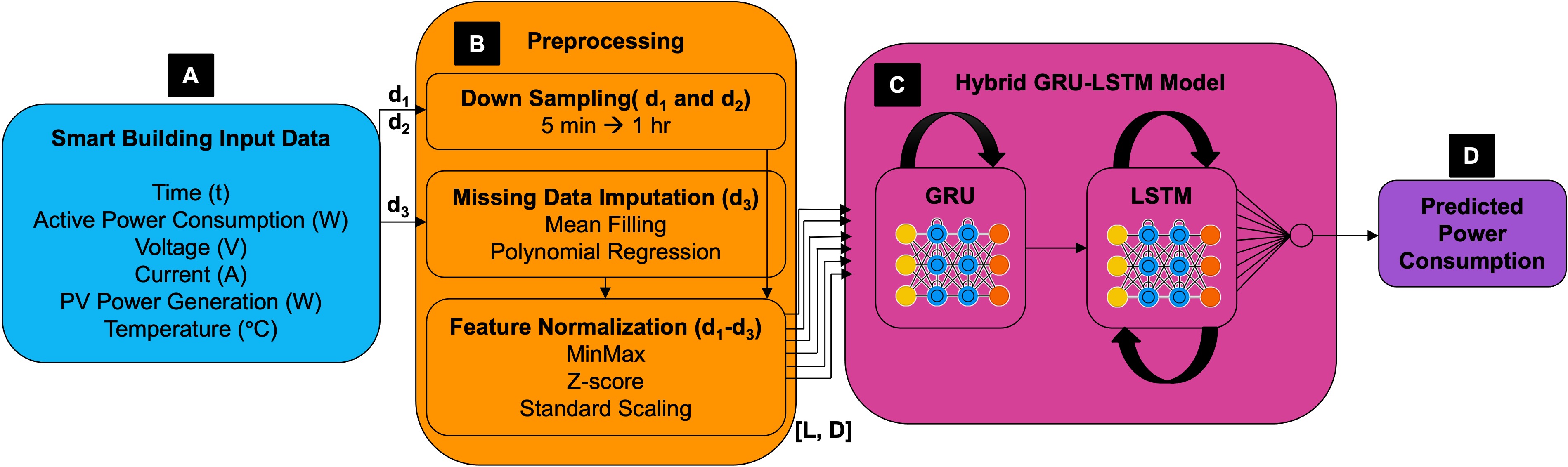
How can short-term energy consumption be accurately forecasted when sensor data is noisy, incomplete, and lacks contextual richness? This question guided our participation in the \textit{2025 Competition on Electric Energy Consumption Forecast Adopting Multi-criteria Performance Metrics}, which challenged teams to predict next-day power demand using real-world high-frequency data. We proposed a robust yet lightweight Deep Learning (DL) pipeline combining hourly downsizing, dual-mode imputation (mean and polynomial regression), and comprehensive normalization, ultimately selecting Standard Scaling for optimal balance. The lightweight GRU-LSTM sequence-to-one model achieves an average RMSE of 601.9~W, MAE of 468.9~W, and 84.36\% accuracy. Despite asymmetric inputs and imputed gaps, it generalized well, captured nonlinear demand patterns, and maintained low inference latency. Notably, spatiotemporal heatmap analysis reveals a strong alignment between temperature trends and predicted consumption, further reinforcing the model's reliability. These results demonstrate that targeted preprocessing paired with compact recurrent architectures can still enable fast, accurate, and deployment-ready energy forecasting in real-world conditions.💡 Deep Analysis
This research explores the key findings and methodology presented in the paper: A Lightweight DL Model for Smart Grid Power Forecasting with Feature and Resolution Mismatch.How can short-term energy consumption be accurately forecasted when sensor data is noisy, incomplete, and lacks contextual richness? This question guided our participation in the \textit{2025 Competition on Electric Energy Consumption Forecast Adopting Multi-criteria Performance Metrics}, which challenged teams to predict next-day power demand using real-world high-frequency data. We proposed a robust yet lightweight Deep Learning (DL) pipeline combining hourly downsizing, dual-mode imputation (mean and polynomial regression), and comprehensive normalization, ultimately selecting Standard Scaling for optimal balance. The lightweight GRU-LSTM sequence-to-one model achieves an average RMSE of 601.9W, MAE of 468.9W, and 84.36% accuracy. Despite asymmetric inputs and imputed gaps, it generalized well, captured nonlinear demand patterns, and maintained low inference latency. Notably, spatiotemporal heatmap analysis reveals a strong alignment between temperature trends and predicted consu
📄 Full Content
📸 Image Gallery