CARE: Contrastive Alignment for ADL Recognition from Event-Triggered Sensor Streams
📝 Original Info
- Title: CARE: Contrastive Alignment for ADL Recognition from Event-Triggered Sensor Streams
- ArXiv ID: 2510.16988
- Date: 2025-10-19
- Authors: Junhao Zhao, Zishuai Liu, Ruili Fang, Jin Lu, Linghan Zhang, Fei Dou
📝 Abstract
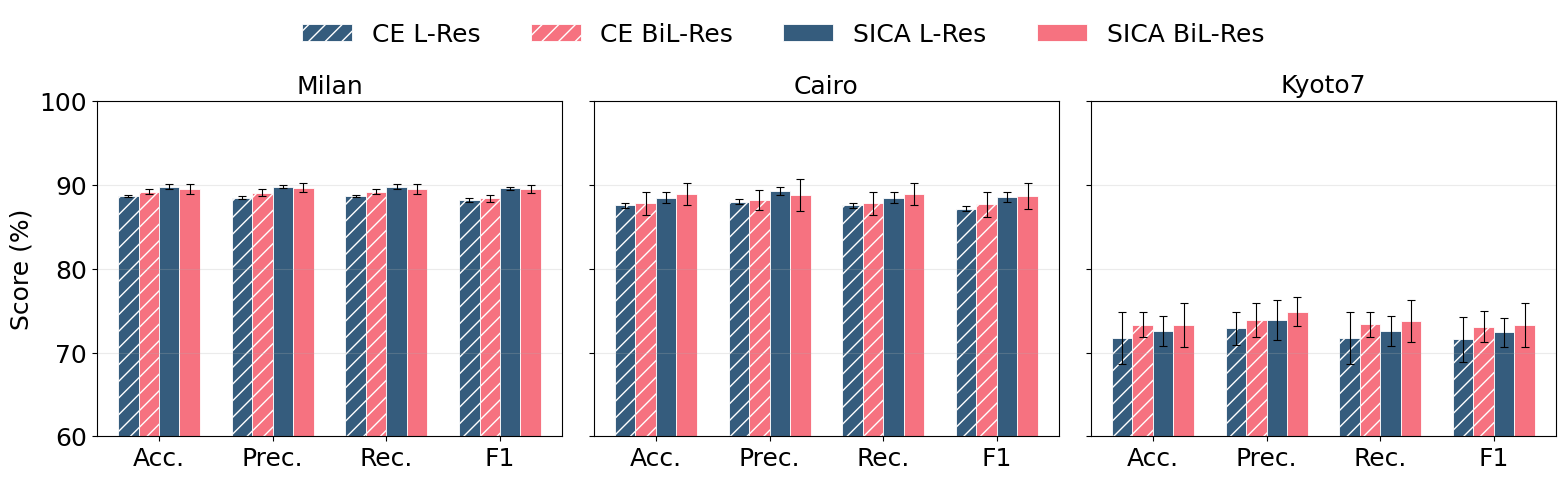
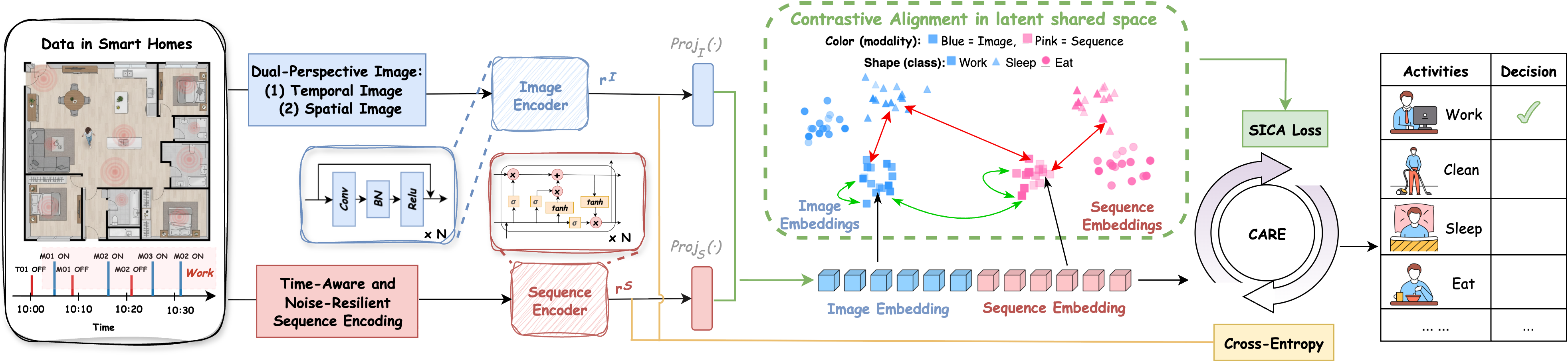
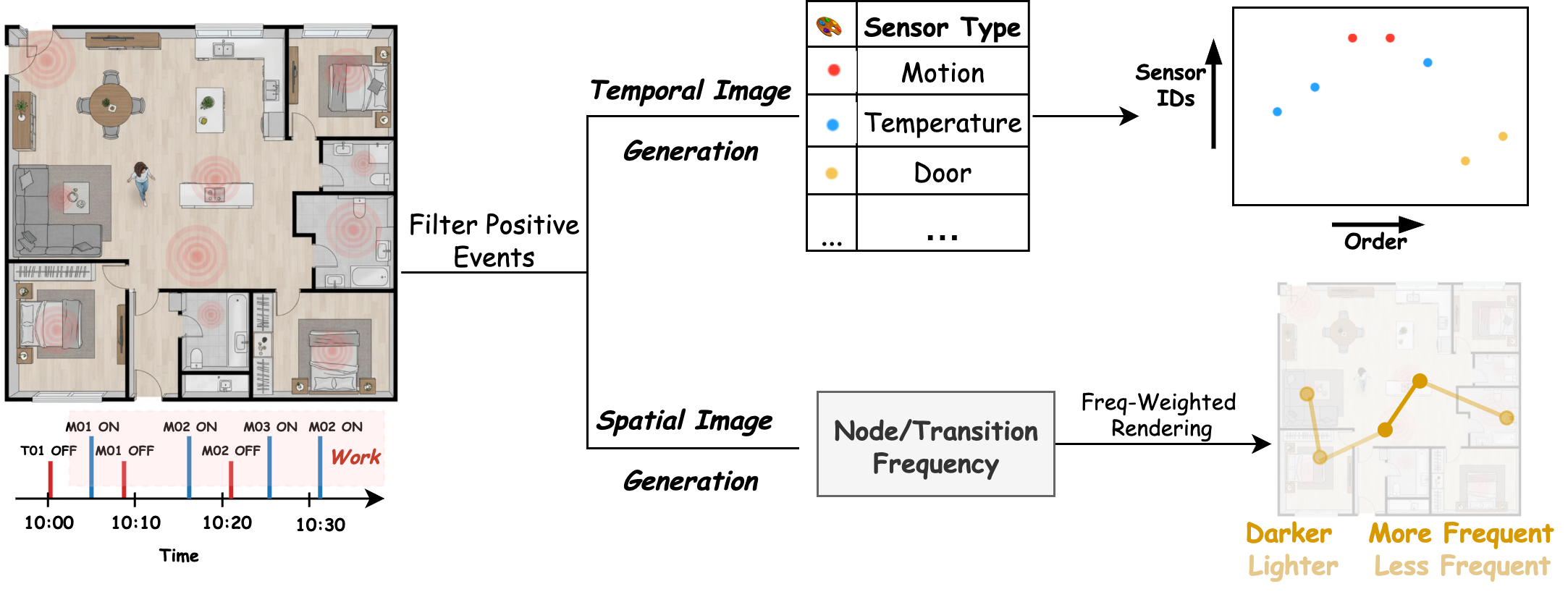
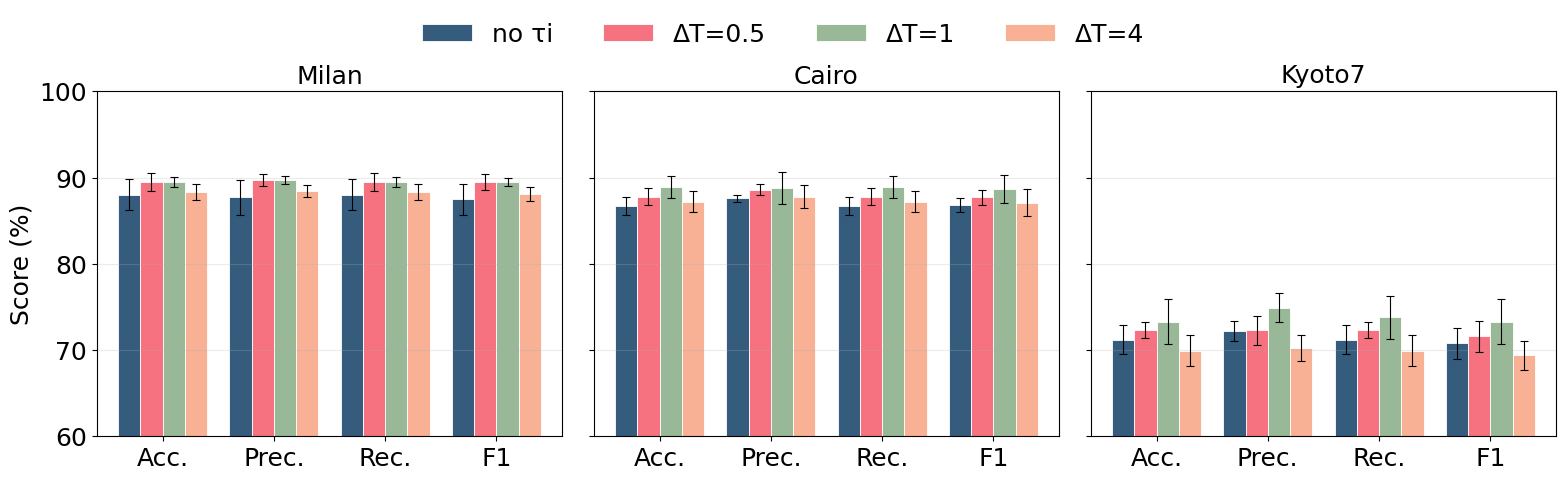
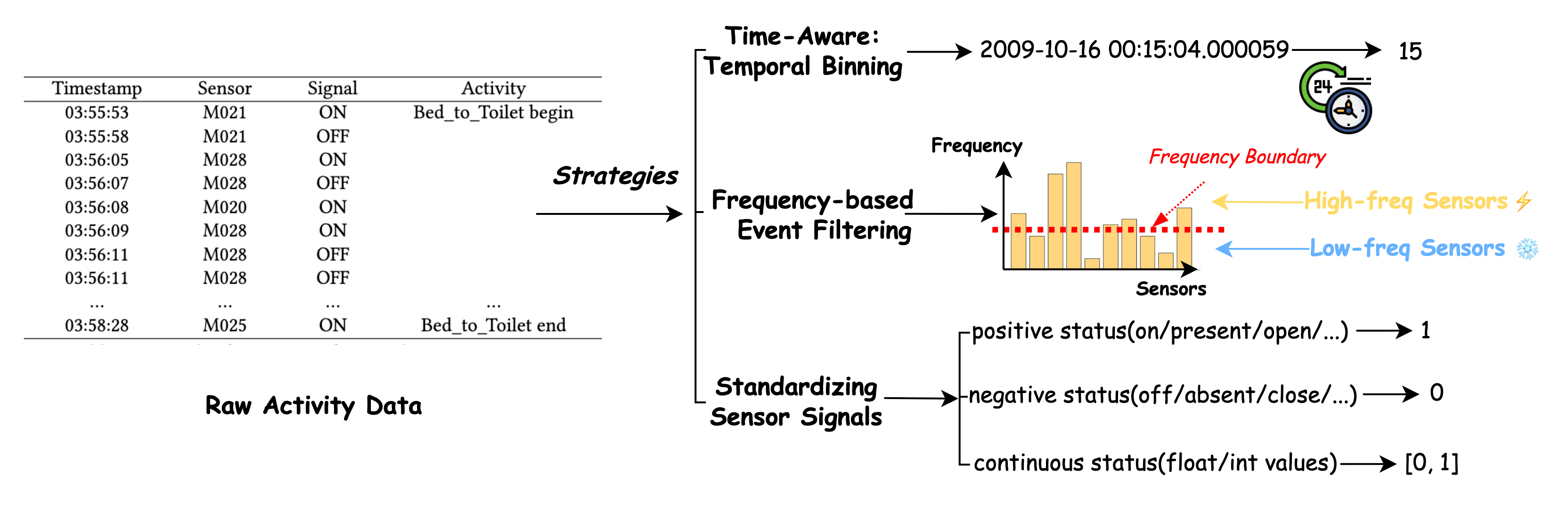
The recognition of Activities of Daily Living (ADLs) from event-triggered ambient sensors is an essential task in Ambient Assisted Living, yet existing methods remain constrained by representation-level limitations. Sequence-based approaches preserve temporal order of sensor activations but are sensitive to noise and lack spatial awareness, while image-based approaches capture global patterns and implicit spatial correlations but compress fine-grained temporal dynamics and distort sensor layouts. Naive fusion (e.g., feature concatenation) fail to enforce alignment between sequence- and image-based representation views, underutilizing their complementary strengths. We propose Contrastive Alignment for ADL Recognition from Event-Triggered Sensor Streams (CARE), an end-to-end framework that jointly optimizes representation learning via Sequence-Image Contrastive Alignment (SICA) and classification via cross-entropy, ensuring both cross-representation alignment and task-specific discriminability. CARE integrates (i) time-aware, noise-resilient sequence encoding with (ii) spatially-informed and frequency-sensitive image representations, and employs (iii) a joint contrastive-classification objective for end-to-end learning of aligned and discriminative embeddings. Evaluated on three CASAS datasets, CARE achieves state-of-the-art performance (89.8% on Milan, 88.9% on Cairo, and 73.3% on Kyoto7) and demonstrates robustness to sensor malfunctions and layout variability, highlighting its potential for reliable ADL recognition in smart homes.💡 Deep Analysis
This research explores the key findings and methodology presented in the paper: CARE: Contrastive Alignment for ADL Recognition from Event-Triggered Sensor Streams.The recognition of Activities of Daily Living (ADLs) from event-triggered ambient sensors is an essential task in Ambient Assisted Living, yet existing methods remain constrained by representation-level limitations. Sequence-based approaches preserve temporal order of sensor activations but are sensitive to noise and lack spatial awareness, while image-based approaches capture global patterns and implicit spatial correlations but compress fine-grained temporal dynamics and distort sensor layouts. Naive fusion (e.g., feature concatenation) fail to enforce alignment between sequence- and image-based representation views, underutilizing their complementary strengths. We propose Contrastive Alignment for ADL Recognition from Event-Triggered Sensor Streams (CARE), an end-to-end framework that jointly optimizes representation learning via Sequence-Image Contrastive Alignment (SICA) and classification via cross-entropy, ensuring both cross-representation alignment and task-specific discrimina
📄 Full Content
📸 Image Gallery