AndesVL Technical Report: An Efficient Mobile-side Multimodal Large Language Model
📝 Original Info
- Title: AndesVL Technical Report: An Efficient Mobile-side Multimodal Large Language Model
- ArXiv ID: 2510.11496
- Date: 2025-10-13
- Authors: Zhiwei Jin, Xiaohui Song, Nan Wang, Yafei Liu, Chao Li, Xin Li, Ruichen Wang, Zhihao Li, Qi Qi, Long Cheng, Dongze Hao, Quanlong Zheng, Yanhao Zhang, Haobo Ji, Jian Ma, Zhitong Zheng, Zhenyi Lin, Haolin Deng, Xin Zou, Xiaojie Yin, Ruilin Wang, Liankai Cai, Haijing Liu, Yuqing Qiu, Ke Chen, Zixian Li, Chi Xie, Huafei Li, Chenxing Li, Chuangchuang Wang, Kai Tang, Zhiguang Zhu, Kai Tang, Wenmei Gao, Rui Wang, Jun Wu, Chao Liu, Qin Xie, Chen Chen, Haonan Lu
📝 Abstract
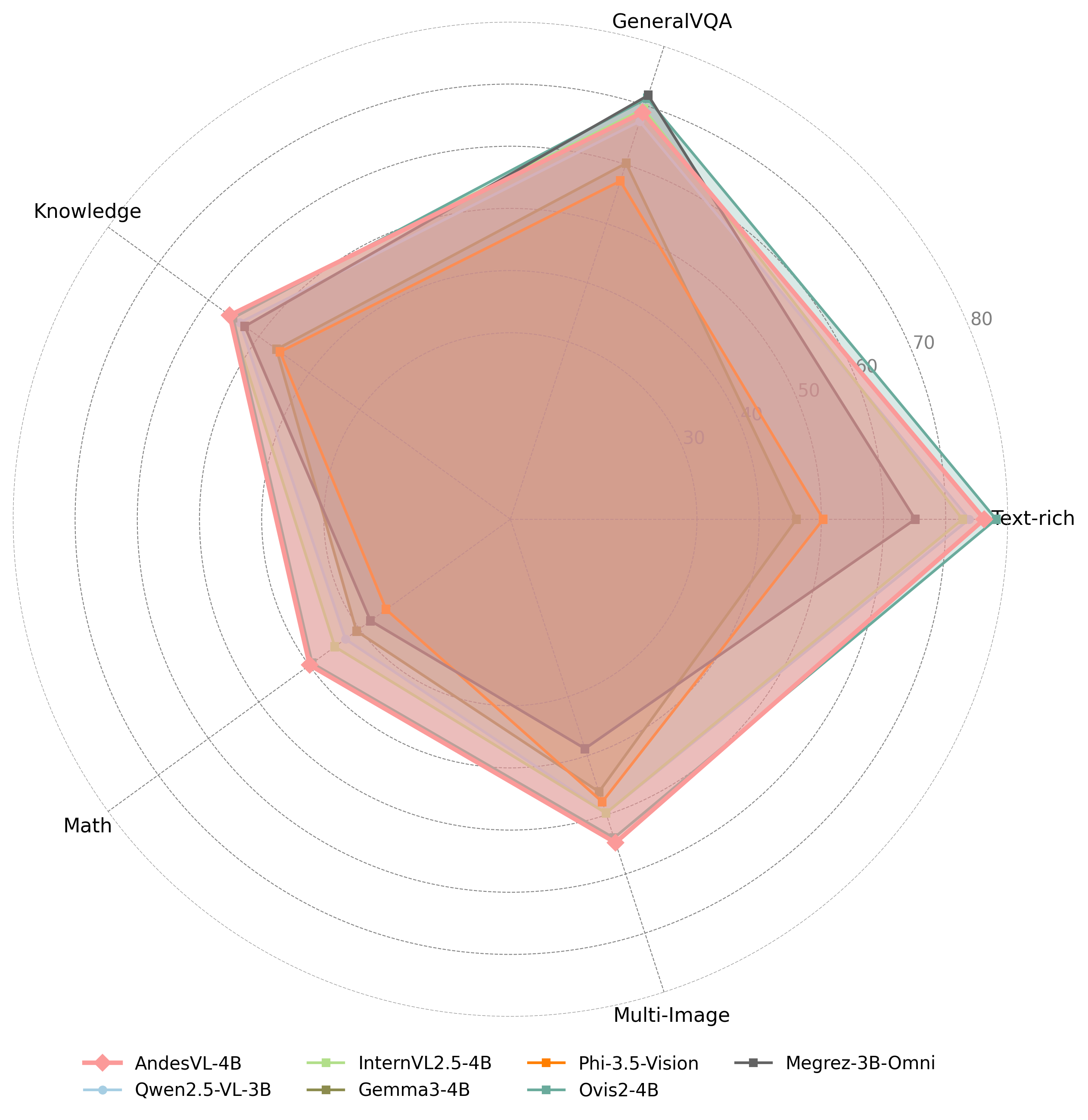
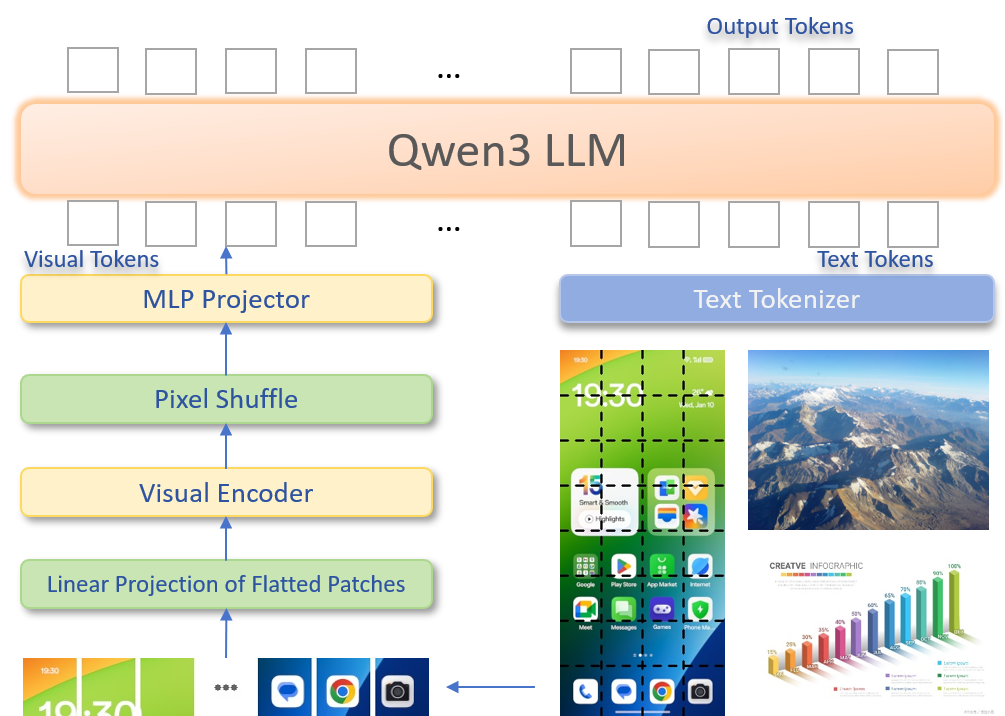
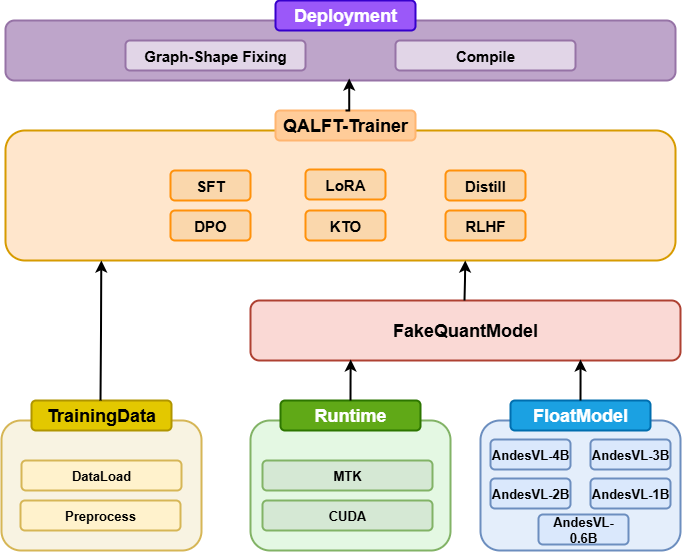
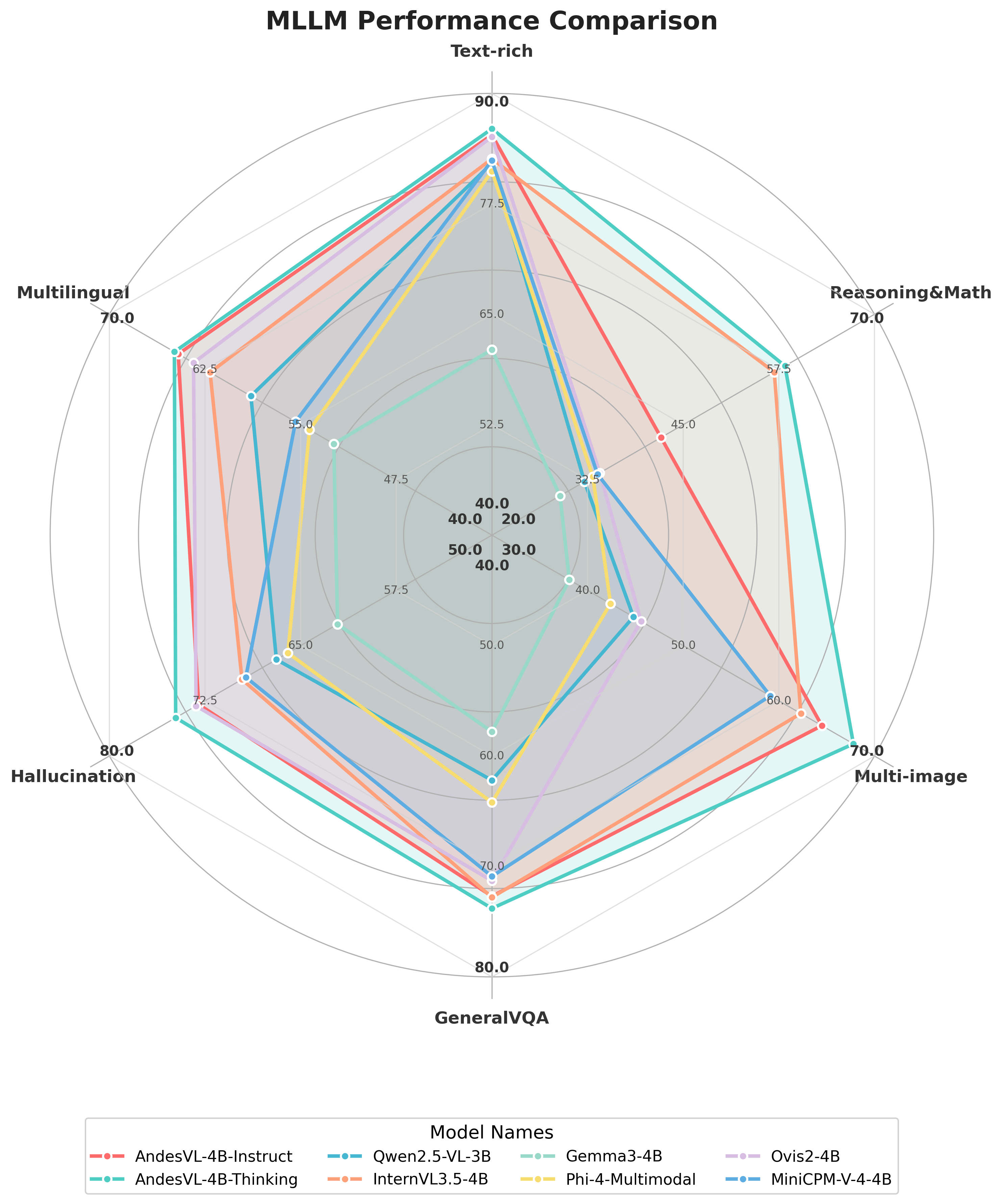
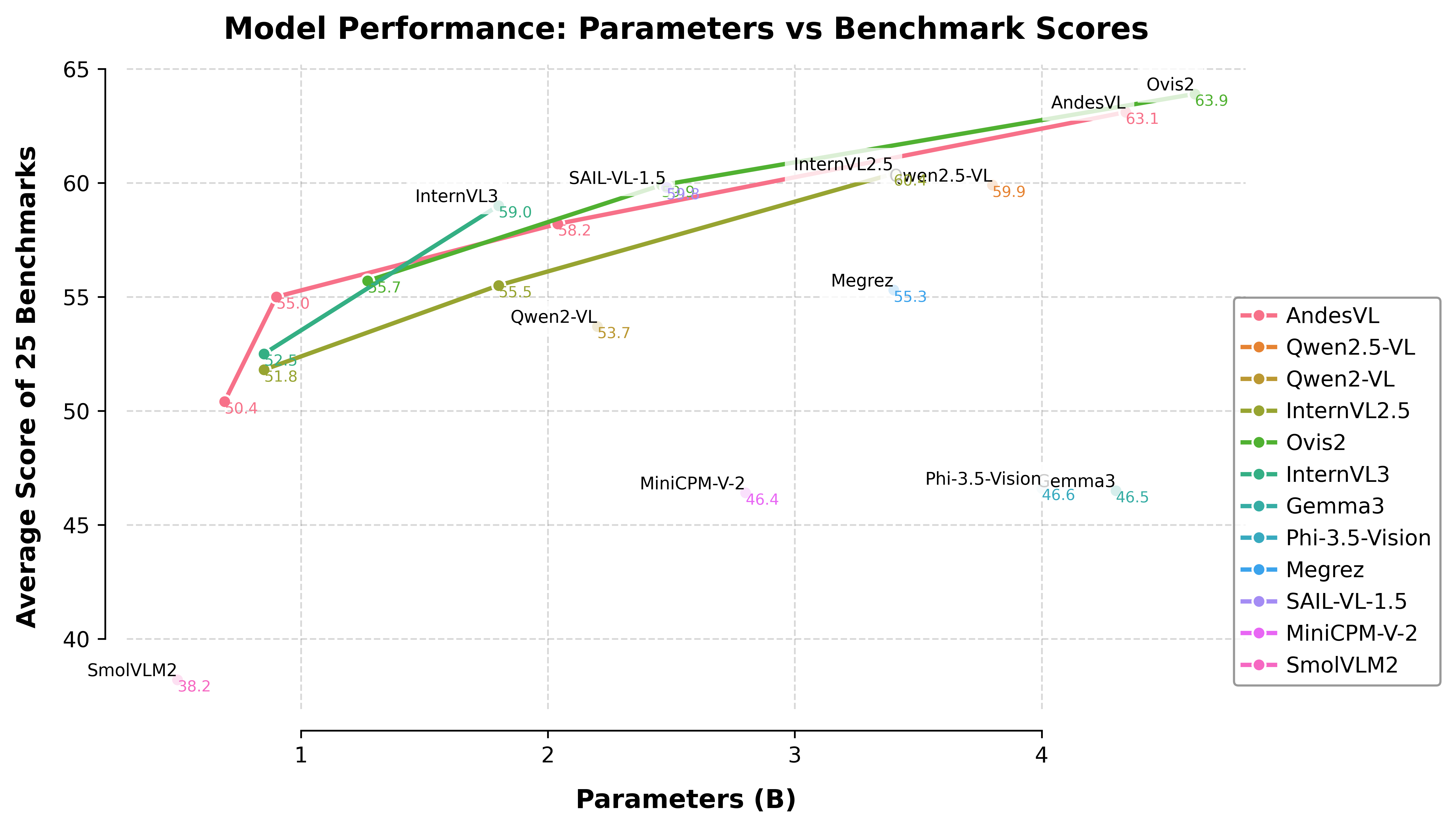
In recent years, while cloud-based MLLMs such as QwenVL, InternVL, GPT-4o, Gemini, and Claude Sonnet have demonstrated outstanding performance with enormous model sizes reaching hundreds of billions of parameters, they significantly surpass the limitations in memory, power consumption, and computing capacity of edge devices such as mobile phones. This paper introduces AndesVL, a suite of mobile-side MLLMs with 0.6B to 4B parameters based on Qwen3's LLM and various visual encoders. We comprehensively outline the model architectures, training pipeline, and training data of AndesVL, which achieves first-tier performance across a wide range of open-source benchmarks, including fields such as text-rich image understanding, reasoning and math, multi-image comprehension, general VQA, hallucination mitigation, multilingual understanding, and GUI-related tasks when compared with state-of-the-art models of a similar scale. Furthermore, we introduce a 1+N LoRA architecture alongside a Quantization-Aware LoRA Fine-Tuning (QALFT) framework to facilitate efficient task adaptation and model compression during mobile-side deployment of AndesVL. Moreover, utilizing our cache eviction algorithm -- OKV -- along with customized speculative decoding and compression strategies, we achieve a 6.7x peak decoding speedup ratio, up to 30.9% memory reduction, and 1.8 bits-per-weight when deploying AndesVL-4B on MediaTek Dimensity 9500 chips. We release all models on https://huggingface.co/OPPOer.💡 Deep Analysis
This research explores the key findings and methodology presented in the paper: AndesVL Technical Report: An Efficient Mobile-side Multimodal Large Language Model.In recent years, while cloud-based MLLMs such as QwenVL, InternVL, GPT-4o, Gemini, and Claude Sonnet have demonstrated outstanding performance with enormous model sizes reaching hundreds of billions of parameters, they significantly surpass the limitations in memory, power consumption, and computing capacity of edge devices such as mobile phones. This paper introduces AndesVL, a suite of mobile-side MLLMs with 0.6B to 4B parameters based on Qwen3’s LLM and various visual encoders. We comprehensively outline the model architectures, training pipeline, and training data of AndesVL, which achieves first-tier performance across a wide range of open-source benchmarks, including fields such as text-rich image understanding, reasoning and math, multi-image comprehension, general VQA, hallucination mitigation, multilingual understanding, and GUI-related tasks when compared with state-of-the-art models of a similar scale. Furthermore, we introduce a 1+N LoRA architecture alongside a Quantizatio
📄 Full Content
📸 Image Gallery