Accelerating Triangle Counting with Real Processing-in-Memory Systems
📝 Original Info
- Title: Accelerating Triangle Counting with Real Processing-in-Memory Systems
- ArXiv ID: 2505.04269
- Date: 2025-05-07
- Authors: Researchers mentioned in the ArXiv original paper
📝 Abstract
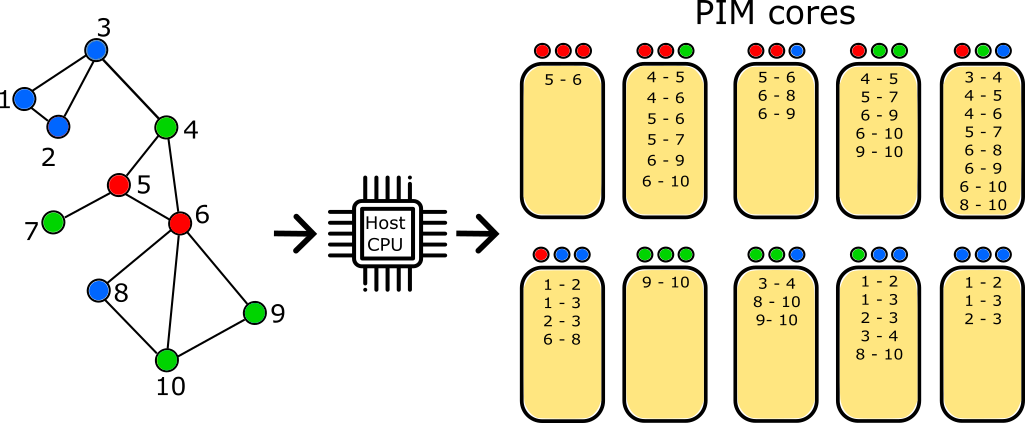
Triangle Counting (TC) is a procedure that involves enumerating the number of triangles within a graph. It has important applications in numerous fields, such as social or biological network analysis and network security. TC is a memory-bound workload that does not scale efficiently in conventional processor-centric systems due to several memory accesses across large memory regions and low data reuse. However, recent Processing-in-Memory (PIM) architectures present a promising solution to alleviate these bottlenecks. Our work presents the first TC algorithm that leverages the capabilities of the UPMEM system, the first commercially available PIM architecture, while at the same time addressing its limitations. We use a vertex coloring technique to avoid expensive communication between PIM cores and employ reservoir sampling to address the limited amount of memory available in the PIM cores' DRAM banks. In addition, our work makes use of the Misra-Gries summary to speed up counting triangles on graphs with high-degree nodes and uniform sampling of the graph edges for quicker approximate results. Our PIM implementation surpasses state-of-the-art CPU-based TC implementations when processing dynamic graphs in Coordinate List format, showcasing the effectiveness of the UPMEM architecture in addressing TC's memory-bound challenges.💡 Deep Analysis
This research explores the key findings and methodology presented in the paper: Accelerating Triangle Counting with Real Processing-in-Memory Systems.Triangle Counting (TC) is a procedure that involves enumerating the number of triangles within a graph. It has important applications in numerous fields, such as social or biological network analysis and network security. TC is a memory-bound workload that does not scale efficiently in conventional processor-centric systems due to several memory accesses across large memory regions and low data reuse. However, recent Processing-in-Memory (PIM) architectures present a promising solution to alleviate these bottlenecks. Our work presents the first TC algorithm that leverages the capabilities of the UPMEM system, the first commercially available PIM architecture, while at the same time addressing its limitations. We use a vertex coloring technique to avoid expensive communication between PIM cores and employ reservoir sampling to address the limited amount of memory available in the PIM cores’ DRAM banks. In addition, our work makes use of the Misra-Gries summary to speed up counting trian
📄 Full Content
📸 Image Gallery