A Bio-inspired Asymmetric Double-Gate Ferroelectric FET for Emulating Astrocyte and Dendrite Dynamics in Neuromorphic Systems
📝 Original Info
- Title: A Bio-inspired Asymmetric Double-Gate Ferroelectric FET for Emulating Astrocyte and Dendrite Dynamics in Neuromorphic Systems
- ArXiv ID: 2504.14466
- Date: 2025-04-20
- Authors: ** 논문에 명시된 저자 정보가 제공되지 않았습니다. (정보 없음) **
📝 Abstract
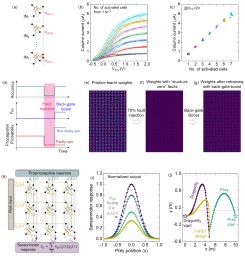
Neuromorphic systems seek to replicate the functionalities of biological neural networks to attain significant improvements in performance and efficiency of AI computing platforms. However, these systems have generally remained limited to emulation of simple neurons and synapses; and ignored higher order functionalities enabled by other components of the brain like astrocytes and dendrites. In this work, drawing inspiration from biology, we introduce a compact Double-Gate Ferroelectric Field Effect Transistor (DG-FeFET) cell that can emulate the dynamics of both astrocytes and dendrites within neuromorphic architectures. We demonstrate that with a ferroelectric top gate for synaptic weight programming as in conventional synapses and a non-ferroelectric back gate, the DG-FeFET realizes a synapse with a dynamic gain modulation mechanism. This can be leveraged as an analog for a compact astrocyte-tripartite synapse, as well as enabling dendrite-like gain modulation operations. By employing a fully-depleted silicon-on-insulator (FDSOI) FeFET as our double-gate device, we validate the linear control of the synaptic weight via the back gate terminal (i.e., the gate underneath the buried oxide (BOX) layer) through comprehensive theoretical and experimental studies. We showcase the promise such a tripartite synaptic device holds for numerous important neuromorphic applications, including autonomous self-repair of faulty neuromorphic hardware mediated by astrocytic functionality. Coordinate transformations based on dragonfly prey-interception circuitry models are also demonstrated based on dendritic function emulation by the device. This work paves the way forward for developing truly "brain-like" neuromorphic hardware that go beyond the current dogma focusing only on neurons and synapses.💡 Deep Analysis

📄 Full Content
📸 Image Gallery




Reference
This content is AI-processed based on open access ArXiv data.