Using the Inverse Scattering Method with a nonvanishing boundary condition, we obtain the square k^2 of a focusing modified Korteweg-de Vries (mKdV) breather solution with non zero vacuum parameter b^2 . We are able to factorize and simplify it in order to get explicitly the associated mKdV breather solution k with non zero vacuum parameter b. Moreover, taking the limiting case of zero frequency, we obtain a generalization of the Double Pole solution introduced by M.Wadati et al.
The focusing modified Korteweg-de Vries equation (mKdV for short) ∂k ∂t + ∂k ∂s 3 + 6k 2 ∂k ∂s = 0, (s, t) ∈ R × R.
(
appears to be relevant in a number of different physical systems (e.g. phonons in anharmonic lattices, models of traffic congestion, curve motion and fluid mechanics between others). Indeed, it can also be considered as a canonical equation, as KdV, sine-Gordon and non linear Schrödinger equations.
Breather solutions of mKdV (1.1) in the line were found by M.Wadati [13] (see also G.Lamb [10]). They were rediscovered by C.Kenig, G.Ponce and L.Vega in the proof of the discontinuity of the flowmaps associated to mKdV equation in the Sobolev spaces H σ , constituted by functions with σ derivatives in L 2 (R) (see [9]). Those breather solutions are defined in all the real line, vanish exponentially at infinity and, in a qualitative point of view, describe traveling wave packets.
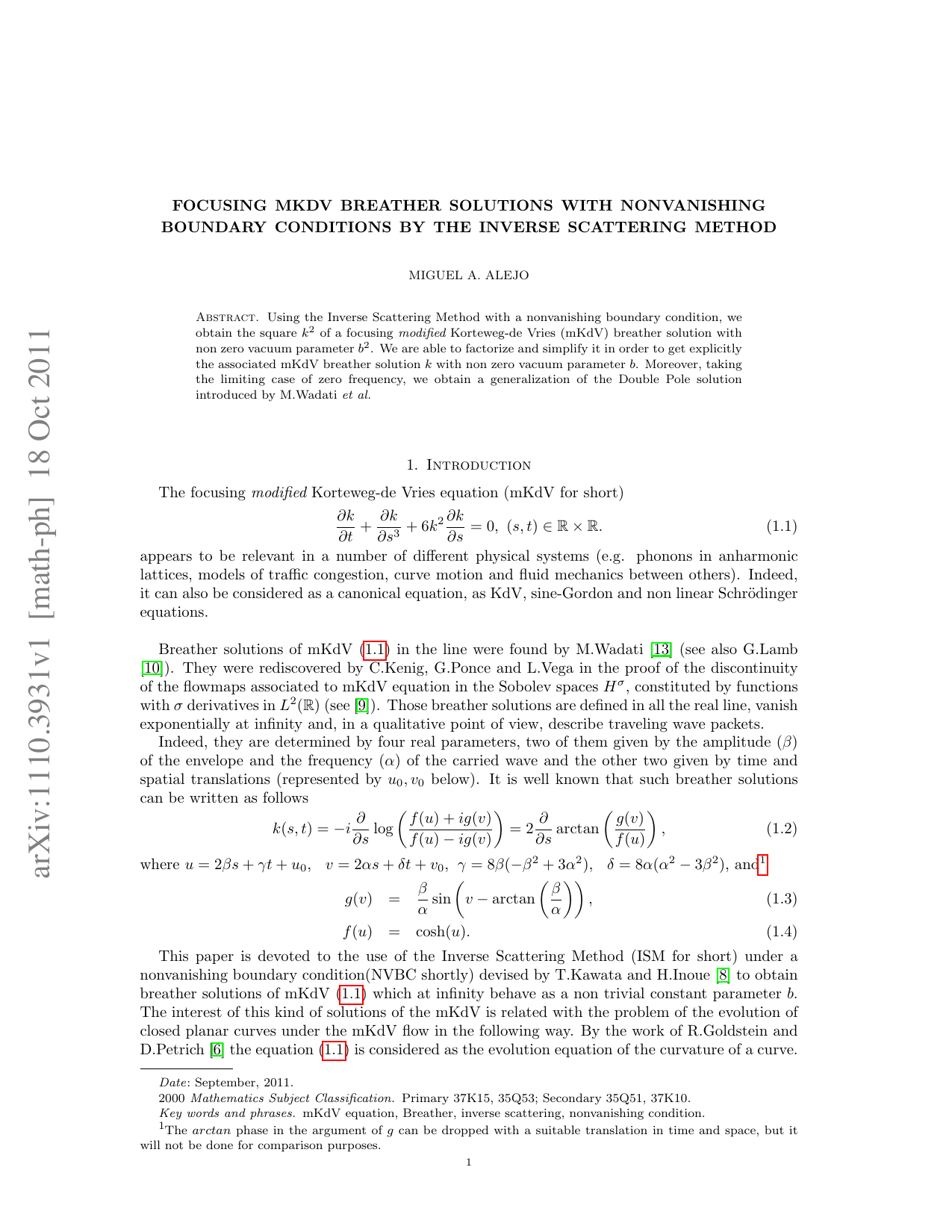
Indeed, they are determined by four real parameters, two of them given by the amplitude (β) of the envelope and the frequency (α) of the carried wave and the other two given by time and spatial translations (represented by u 0 , v 0 below). It is well known that such breather solutions can be written as follows
where u = 2βs + γt + u 0 , v = 2αs + δt + v 0 , γ = 8β(-β 2 + 3α 2 ), δ = 8α(α 2 -3β 2 ), and
f (u) = cosh(u). (1.4) This paper is devoted to the use of the Inverse Scattering Method (ISM for short) under a nonvanishing boundary condition(NVBC shortly) devised by T.Kawata and H.Inoue [8] to obtain breather solutions of mKdV (1.1) which at infinity behave as a non trivial constant parameter b. The interest of this kind of solutions of the mKdV is related with the problem of the evolution of closed planar curves under the mKdV flow in the following way. By the work of R.Goldstein and D.Petrich [6] the equation (1.1) is considered as the evolution equation of the curvature of a curve. By this work, closed curves can be considered as those whose associated curvature satisfies that its mean is non-zero. Moreover, those curvatures can be obtained from a solution of the focusing mKdV constructed by the (nonlinear) superposition of a constant (e.g. constant b) plus a traveling wave. In fact, it is posible to find some special breather solutions associated to simple closed curves that, when evolving under the mKdV flow, they create and annihilate self-intersections (see [2] for more information).
Although in the literature some kind of breather solutions of the Gardner equation(also known as the extended KdV equation) have been obtained before [7,12], they do not contain details on derivations of these breather solutions from the ISM scheme. Even despite the close relation between Gardner and mKdV equations (solutions of the mKdV equation with NVBC are also solutions of the Gardner equation with zero boundary condition), breathers obtained in these references [7,12] are far to be easily compared with the breather of M.Wadati [13] they generalize. These two aspects are attained too in the present paper(for further details see section 2.2 and (2.47)). Finally note that the mKdV breather solutions mentioned above can be obtained alternatively using the Hirota method with a suitable selection of the wavenumbers (see the work of K.Chow and D.Lai [5]).
In this section we obtain breathers of the focusing mKdV (1.1) with nonvanishing boundary conditions by using the ISM for potentials that are not trivial at infinity, introduced by T.Kawata and H.Inoue in [8]. We also recall the work of T.Au-Yeung et al. [4], in which the same approach was used to obtain one and two soliton solutions with non trivial values at infinity. First, we summarize some basic results from [8] and [4], necessary for our research.
2.1. Basic results of T.Kawata and H.Inoue for the mKdV. T.Kawata and H.Inoue considered in [1] a generalized AKNS eigenvalue problem for nonvanishing potentials, which consist in the following spatial and time evolution equations1 :
where
Matrices D(λ) and F (λ) satisfy the well known integrable condition associated to equations (2.1) and (2.2) (i.e ∂ t (2.1)= ∂ s (2.2)):
They seek a real potential solution q(s, t) under the following boundary condition:
requiring that q(s, t) is sufficiently smooth and all the s derivatives of q tend to zero as s → ±∞. For this purpose, they consider potentials q(s, t) and r(s, t) with the following nonvanishing conditions:
q(s, t)(or r(s, t)) → q ± (or r ± ) as s → ±∞,
where q ± , r ± and λ 2 0 are constants. Then, the spatial evolution matrix D(λ; s, t) can be written as follows:
and the characteristic roots of D ± (λ) are ±iζ, with ζ = λ 2 -λ 2 0 . Now, they define
where
and q 1 , r 1 are suitable smooth and satisfy that q 1 (s)r 1 (s) = λ 2 0 for all s ∈ R. The matrices D ± (λ) can be diagonalized by T ± (λ, ζ) as
(2.9) Using (2.9), they can define Jost matrices Φ ± as the solutions of (2.1) under conditions
(2.10) where J(ζs) = e -iζs 0 0 e iζs . Then, a scattering matrix
This content is AI-processed based on open access ArXiv data.