Charged particles of extensive air showers (EAS), mainly electrons and positrons, initiate the emission of fluorescence light in the Earth's atmosphere. This light provides a calorimetric measurement of the energy of cosmic rays. For reconstructing the primary energy from an observed light track of an EAS, the fluorescence yield in air has to be known in dependence on atmospheric conditions, like air temperature, pressure, and humidity. Several experiments on fluorescence emission have published various sets of data covering different parts of the dependence of the fluorescence yield on atmospheric conditions. Using a compilation of published measurements, a calculation of the fluorescence yield in dependence on altitude is presented. The fluorescence calculation is applied to simulated air showers and different atmospheric profiles to estimate the influence of the atmospheric conditions on the reconstructed shower parameters.
The number of emitted fluorescence photons at the air shower can be written as
where Y (λ, P, T, e) is the fluorescence yield in dependence on wavelength λ, air pressure P , air temperature T , and vapour pressure e. The deposited energy of the secondary particles is denoted as dE tot dep /dX. In the last couple of years, a lot of effort has been put on the investigation of atmospheric dependences on nitrogen fluorescence in air [1]. The fluorescence yield Y λ can be written as
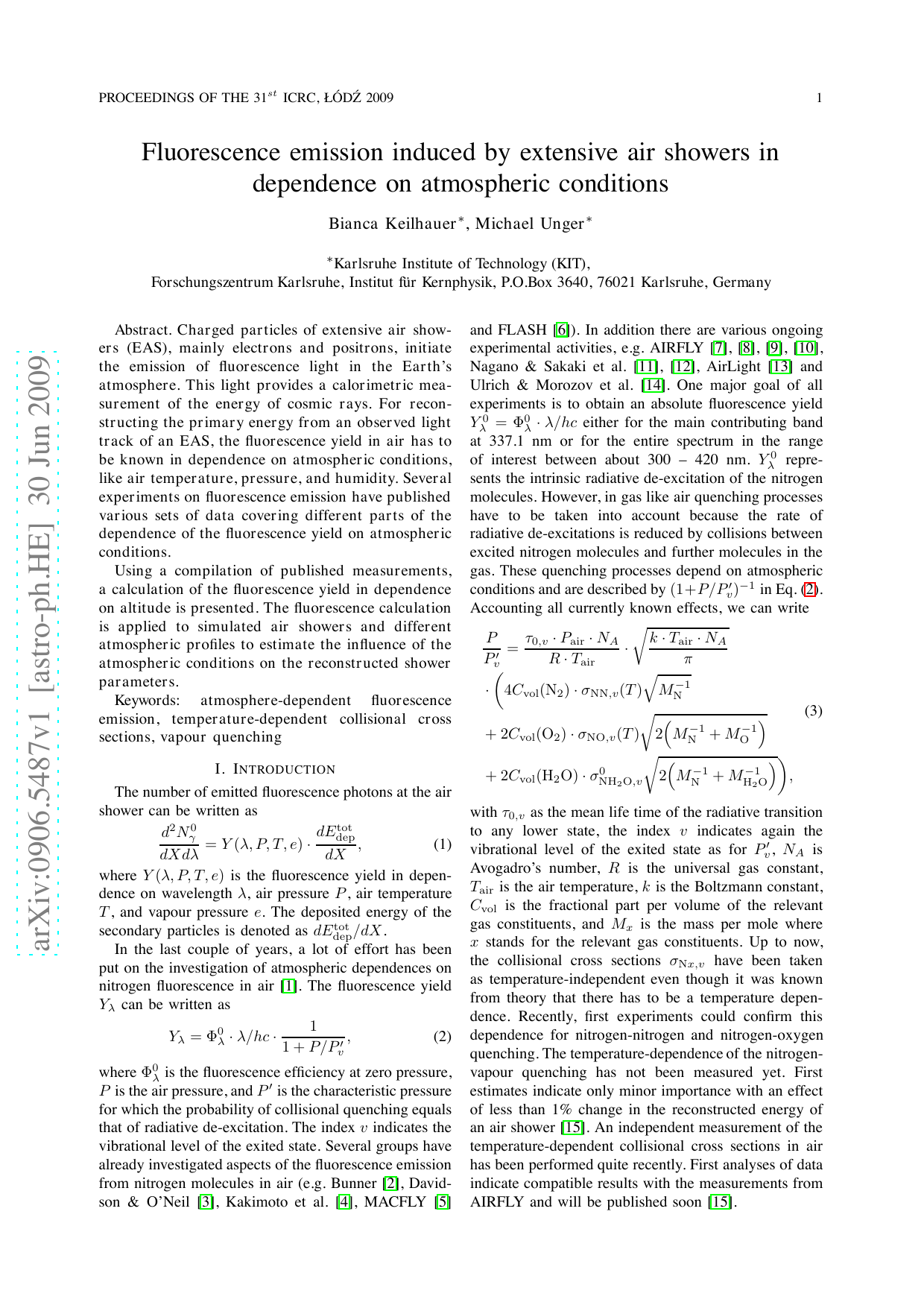
where Φ 0 λ is the fluorescence efficiency at zero pressure, P is the air pressure, and P ′ is the characteristic pressure for which the probability of collisional quenching equals that of radiative de-excitation. The index v indicates the vibrational level of the exited state. Several groups have already investigated aspects of the fluorescence emission from nitrogen molecules in air (e.g. Bunner [2], Davidson & O’Neil [3], Kakimoto et al. [4], MACFLY [5] and FLASH [6]). In addition there are various ongoing experimental activities, e.g. AIRFLY [7], [8], [9], [10], Nagano & Sakaki et al. [11], [12], AirLight [13] and Ulrich & Morozov et al. [14]. One major goal of all experiments is to obtain an absolute fluorescence yield Y 0 λ = Φ 0 λ • λ/hc either for the main contributing band at 337.1 nm or for the entire spectrum in the range of interest between about 300 -420 nm. Y 0 λ represents the intrinsic radiative de-excitation of the nitrogen molecules. However, in gas like air quenching processes have to be taken into account because the rate of radiative de-excitations is reduced by collisions between excited nitrogen molecules and further molecules in the gas. These quenching processes depend on atmospheric conditions and are described by (1+P/P ′ v ) -1 in Eq. ( 2). Accounting all currently known effects, we can write
with τ 0,v as the mean life time of the radiative transition to any lower state, the index v indicates again the vibrational level of the exited state as for P ′ v , N A is Avogadro’s number, R is the universal gas constant, T air is the air temperature, k is the Boltzmann constant, C vol is the fractional part per volume of the relevant gas constituents, and M x is the mass per mole where x stands for the relevant gas constituents. Up to now, the collisional cross sections σ Nx,v have been taken as temperature-independent even though it was known from theory that there has to be a temperature dependence. Recently, first experiments could confirm this dependence for nitrogen-nitrogen and nitrogen-oxygen quenching. The temperature-dependence of the nitrogenvapour quenching has not been measured yet. First estimates indicate only minor importance with an effect of less than 1% change in the reconstructed energy of an air shower [15]. An independent measurement of the temperature-dependent collisional cross sections in air has been performed quite recently. First analyses of data indicate compatible results with the measurements from AIRFLY and will be published soon [15].
Adopting this description of fluorescence emission for air shower reconstruction, we have to apply atmospheric profiles for temperature, pressure, and vapour pressure. This cannot be provided by simple atmospheric models as these usually do not include vapour profiles. However, profiles obtained with meteorological radio soundings do provide all necessary quantities [16].
For this study, we could use the simulation and reconstruction framework Off line [17] of the Pierre Auger Observatory [18]. Within this framework, we could obtain standard monthly models for the area of that observatory which do not include water vapour profiles [16]. Additionally, we had access to 109 actual nightly atmospheric profiles from local radio soundings that cover all conditions within a year. One of the advantages of the framework is that it features many implementations of different fluorescence models which can easily be interchanged.
The first implementation of a fluorescence model in Off line , referred to as K96, is based on measurements by Kakimoto et al. [4]. The fluorescence yield is parametrised in dependence on deposited energy and on altitude by considering the pressure and √ Tdependences. The second fluorescence model, N04, has the same functional form of parametrisation and describes data from Nagano et al. [19], [11]. These measurements provide spectrally resolved data for 15 wavelengths between 300 and 430 nm. Also in this description, only the pressure and √ T -dependences are considered. The third fluorescence description in Off line is given by the AIRFLY Collaboration in 2007, labelled with A07. The fluorescence yield is given as [9]
P0,T0 is the fluorescence yield at 337.1 nm as measured at their standard experimental conditions which are P 0 = 800 hPa and T 0 = 293 K. The other transitions have been measured relatively to that at 337.1 nm and are given by I λ P0,T0 . Overall, 34 transitions could be resolved between 295 and 430 nm. Since the ab
This content is AI-processed based on open access ArXiv data.