- Title: Approximate Query Processing using Deep Generative Models - ArXiv ID: 1903.10000 - Date: 2019-11-20 - Authors: Saravanan Thirumuruganathan, Shohedul Hasan, Nick Koudas, Gautam Das
📝 Abstract
Data is generated at an unprecedented rate surpassing our ability to analyze them. The database community has pioneered many novel techniques for Approximate Query Processing (AQP) that could give approximate results in a fraction of time needed for computing exact results. In this work, we explore the usage of deep learning (DL) for answering aggregate queries specifically for interactive applications such as data exploration and visualization. We use deep generative models, an unsupervised learning based approach, to learn the data distribution faithfully such that aggregate queries could be answered approximately by generating samples from the learned model. The model is often compact - few hundred KBs - so that arbitrary AQP queries could be answered on the client side without contacting the database server. Our other contributions include identifying model bias and minimizing it through a rejection sampling based approach and an algorithm to build model ensembles for AQP for improved accuracy. Our extensive experiments show that our proposed approach can provide answers with high accuracy and low latency.
💡 Summary & Analysis
This paper explores a method for speeding up data analysis using deep learning techniques, specifically focusing on approximate query processing (AQP). The authors propose an innovative approach that leverages variational autoencoders (VAEs) to learn the underlying distribution of a dataset. By training VAEs on this data, they can generate samples that reflect the true distribution and thus answer aggregate queries approximately but efficiently.
The core problem addressed is the increasing disparity between the rate at which data is generated and our ability to analyze it accurately and quickly. Traditional methods often require significant time to compute exact results, making them impractical for interactive applications like data exploration or visualization where speed is critical. The proposed solution involves training a VAE on the dataset to capture its distribution. Once trained, this model can generate samples that mimic the original data’s characteristics, allowing for approximate answers to be quickly generated without needing to contact the database server.
The authors also tackle issues of model bias and accuracy by introducing rejection sampling techniques and ensemble algorithms to improve the reliability of their approach. Their extensive experiments demonstrate that this method provides highly accurate results with low latency, making it suitable for real-time data analysis tasks.
In summary, this paper offers a promising avenue for enhancing data processing speed and efficiency in interactive applications through deep learning techniques, potentially revolutionizing how we handle large datasets in real-world scenarios.
📄 Full Paper Content (ArXiv Source)
# Background
In this section, we provide necessary background about generative models
and variational autoencoders in particular.
Suppose we are given a set of data points $`X=\{x_1, \ldots, x_n\}`$
that are distributed according to some unknown probability distribution
$`P(X)`$. Generative models seek to learn an approximate probability
distribution $`Q`$ such that $`Q`$ is very similar to $`P`$. Most
generative models also allow one to generate samples
$`X'=\{x'_1, \ldots, \}`$ from the model $`Q`$ such that the $`X'`$ has
similar statistical properties to $`X`$. Deep generative models use
powerful function approximators (typically, deep neural networks) for
learning to approximate the distribution.
VAEs are a class of generative models that can model various
complicated data distributions and generate samples. They are very
efficient to train, have an interpretable latent space and could be
adapted effectively to different domains such as images, text and music.
Latent variables are an intermediate data representation that captures
data characteristics used for generative modelling. Let $`X`$ be the
relational data that we wish to model and $`z`$ a latent variable. Then
$`P(X|z)`$ is the distribution of generating data given latent variable.
We can model $`P(X)`$ in relation to $`z`$ as $`P(X)=\int P(X|z)P(z)dz`$
marginalizing $`z`$ out of the joint probability $`P(X,z)`$. The
challenge is that we do not know $`P(z)`$ and $`P(X|z)`$. The underlying
idea in variational modelling is to infer $`P(z)`$ using $`P(z|X)`$.
We use a method called Variational Inference (VI) to infer $`P(z|X)`$ in
VAE. The main idea of VI is to approach inference as an optimization
problem. We model the true distribution $`P(z|X)`$ using a simpler
distribution (denoted as $`Q`$) that is easy to evaluate, e.g. Gaussian,
and minimize the difference between those two distribution using KL
divergence metric, which tells us how different $`P`$ is from $`Q`$.
Assume we wish to infer $`P(z|X)`$ using $`Q(z|X)`$. The KL divergence
is specified as:
We can connect $`Q(z|X)`$ which is a projection of the data into the
latent space and $`P(X|z)`$ which generates data given a latent variable
$`z`$ through Equation [eq:var2] that is also called as the
variational objective.
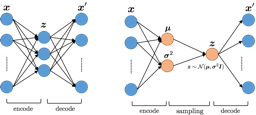
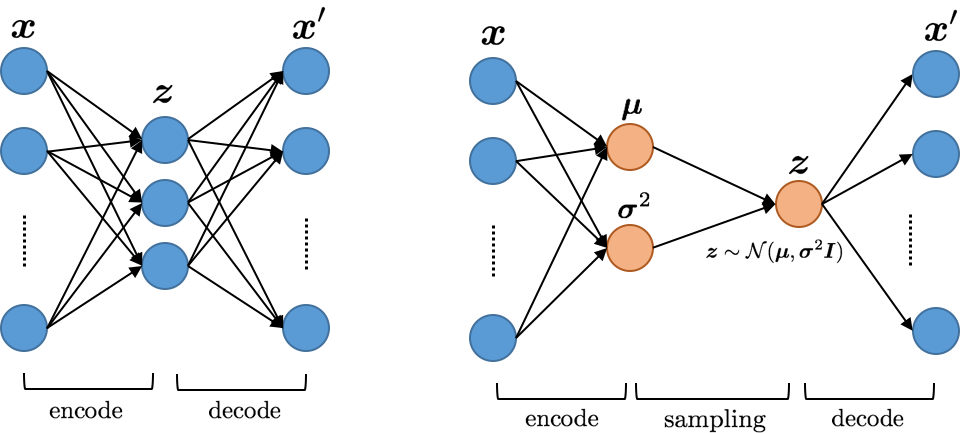
A different way to think of this equation is as $`Q(z|X)`$ encoding the
data using $`z`$ as an intermediate data representation and $`P(X|z)`$
generates data given a latent variable $`z`$. Typically $`Q(z|X)`$ is
implemented with a neural network mapping the underlying data space into
the latent space (encoder network). Similarly $`P(X|z)`$ is
implemented with a neural network and is responsible to generate data
following the distribution $`P(X)`$ given sample latent variables $`z`$
from the latent space (decoder network). The variational objective has
a very natural interpretation. We wish to model our data $`P(X)`$ under
some error function $`D_{KL}[Q(z|X||P(z|X)]`$. In other words, VAE tries
to identify the lower bound of $`\log(P(X))`$, which in practice is good
enough as trying to determine the exact distribution is often
intractable. For this we aim to maximize over some mapping from latent
variables to $`\log P(X|z)`$ and minimize the difference between our
simple distribution $`Q(z|X)`$ and the true latent distribution
$`P(z)`$. Since we need to sample from $`P(z)`$ in VAE typically one
chooses a simple distribution to sample from such as $`N(0,1)`$. Since
we wish to minimize the distance between $`Q(z|X)`$ and $`P(z)`$ in VAE
one typically assumes that $`Q(z|X)`$ is also normal with mean
$`\mu(X)`$ and variance $`\Sigma(X)`$. Both the encoder and the decoder
networks are trained end-to-end. After training, data can be generated
by sampling $`z`$ from a normal distribution and passing it to the
decoder network.
AQP Using Variational AutoEncoders
In this section, we provide an overview of our two phase approach for
using VAE for AQP. This requires solving a number of theoretical and
practical challenges such as input encodings and approximation errors
due to model bias.
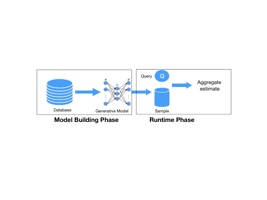
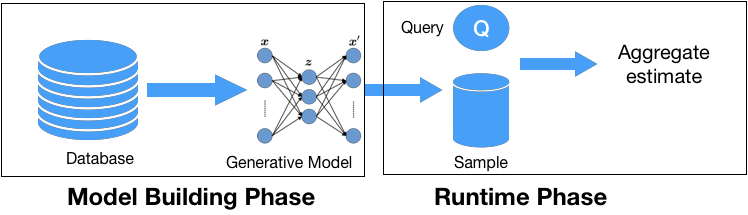
Our proposed approach proceeds in two phases. In the model building
phase, we train a deep generative model $`M_{R}`$ over the dataset $`R`$
such that it learns the underlying data distribution. In this section,
we assume that a single model is built for the entire dataset that we
relax in Section 13. Once the DL model is
trained, it can act as a succinct representation of the dataset. In the
run-time phase, the AQP system uses the DL model to generate samples
$`S`$ from the underlying distribution. The given query is rewritten to
run on $`S`$. The existing AQP techniques could be transparently used to
generate the aggregate estimate.
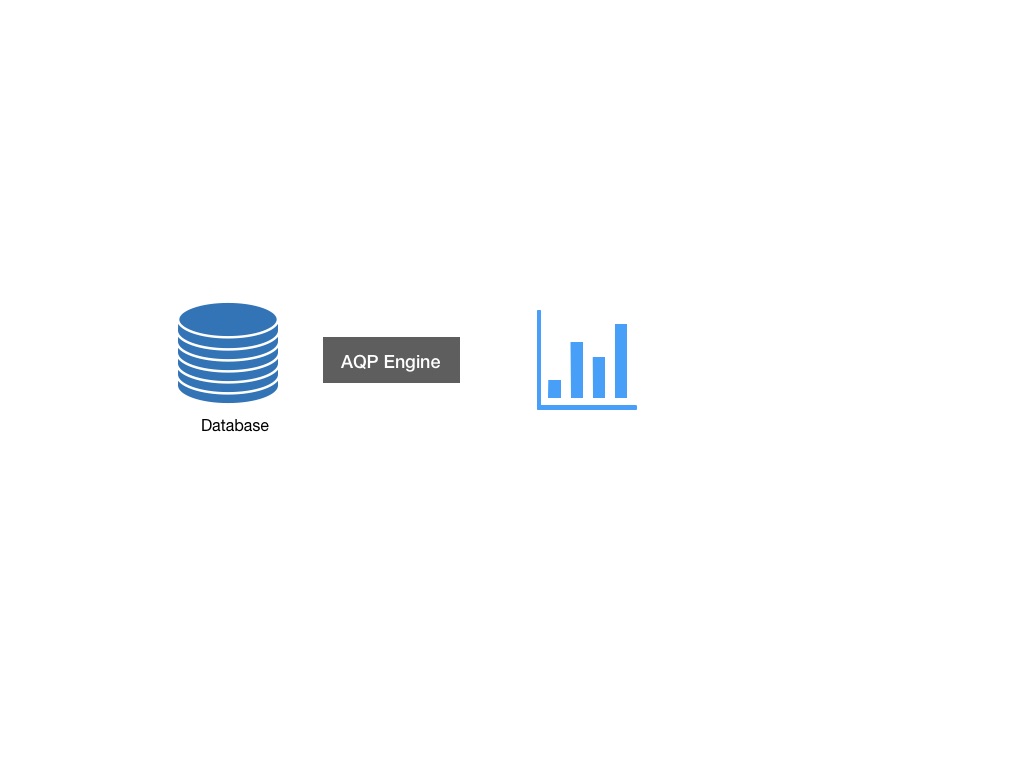
Figure 1 illustrates our approach.
/>Two Phase Approach for DL based AQP
Using VAE for AQP
In this subsection, we describe how to train a VAE over relational data
and use it for AQP.
In contrast to homogeneous domains such as images and text, relations
often consist of mixed data types that could be discrete or continuous.
The first step is to represent each tuple $`t`$ as a vector of dimension
$`d`$. For ease of exposition, we consider one-hot encoding and describe
other effective encodings in
Section 7.5. One-hot encoding
represents each tuple as a $`d = \sum_{i=1}^{m} |Dom(A_i)|`$ dimensional
vector where the position corresponding to a given domain value is set
to 1. Each tuple in a relation $`R`$ with two binary attributes $`A_1`$
and $`A_2`$, is represented as a $`4`$ dimensional binary vector. A
tuple with $`A_1=0,A_2=1`$ is represented as $`[1, 0, 0, 1]`$ while a
tuple with $`A_1=1,A_2=1`$ is represented as $`[0, 1, 0, 1]`$. This
approach is efficient for small attribute domains but becomes cumbersome
if a relation has millions of distinct values.
Once all the tuples are encoded appropriately, we could use VAE to learn
the underlying distribution. We denote the size of the input and latent
dimension by $`d`$ and $`d'`$ respectively. For one hot encoding,
$`d=\sum_{i=1}^{m} |Dom(A_i)|`$. As $`d'`$ increases, it results in more
accurate learning of the distribution at the cost of a larger model.
Once the model is trained, it could be used to generate samples $`X'`$.
The randomly generated tuples often share similar statistical properties
to tuples sampled from the underlying relation $`R`$ and hence are a
viable substitute for $`R`$. One could apply the existing AQP mechanisms
on the generated samples and use it to generate aggregate estimates
along with confidence intervals.
The sample tuples are generated as follows: we generate samples from the
latent space $`z`$ and then apply the decoder network to convert points
in latent space to tuples. Recall from
Section 6 that the latent space is often a
probability distribution that is easy to sample such as Gaussian. It is
possible to speed up the sampling from arbitrary Normal distributions
using the reparameterization trick. Instead of sampling from a
distribution $`N(\mu, \sigma)`$, we could sample from the standard
Normal distribution $`N(0, 1)`$ with zero mean and unit variance. A
sample $`\epsilon`$ from $`N(0, 1)`$ could be converted to a sample
$`N(\mu, \sigma)`$ as $`z = \mu + \sigma \odot \epsilon`$. Intuitively,
this shifts $`\epsilon`$ by the mean $`\mu`$ and scales it based on the
variance $`\sigma`$.
Handling Approximation Errors.
We consider approximation error caused due to model bias and propose an
effective rejection sampling to mitigate it.
Aggregates estimated over the sample could differ from the exact results
computed over the entire dataset and their difference is called the
sampling error. Both the traditional AQP and our proposed approach
suffer from sampling error. The techniques used to mitigate it - such as
increasing sample size - can also be applied to the samples from the
generative model.
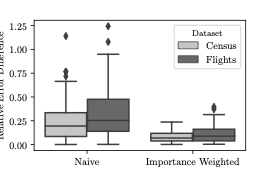
Another source of error is sampling bias. This could occur when the
samples are not representative of the underlying dataset and do not
approximate its data distribution appropriately. Aggregates generated
over these samples are often biased and need to be corrected. This
problem is present even in traditional AQP and mitigated through
techniques such as importance weighting and bootstrapping .
Our proposed approach also suffers from sampling bias due to a subtle
reason. Generative models learn the data distribution which is a very
challenging problem - especially in high dimensions. A DL model learns
an approximate distribution that is close enough. Uniform samples
generated from the approximate distribution would be biased samples from
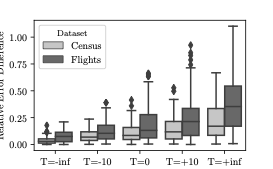
the original distribution resulting in biased estimates. As we shall
show later in the experiments, it is important to remove or reduce the
impact of model bias to get accurate estimates. Bootstrapping is not
applicable as it often works by resampling the sample data and
performing inference on the sampling distribution from them. Due to the
biased nature of samples, this approach provides incorrect results . It
is challenging to estimate the importance weight of a sample generated
by VAE. Popular approaches such as IWAE and AIS do not provide strong
bounds for the estimates.
We advocate for a rejection sampling based approach that has a number
of appealing properties and is well suited for AQP. Intuitively,
rejection sampling works as follows. Let $`x`$ be a sample generated
from the VAE model with probabilities $`p(x)`$ and $`q(x)`$ from the
original and approximate probability distributions respectively. We
accept the sample $`x`$ with probability $`\frac{p(x)}{M \times q(x)}`$
where $`M`$ is a constant upper bound on the ratio $`p(x)/q(x)`$ for all
$`x`$. We can see that the closer the ratio is to 1, the higher the
likelihood that the sample is accepted. On the other hand, if the two
distributions are far enough, then a larger fraction of samples will be
rejected. One can generate arbitrary number of samples from the VAE
model, apply rejection sampling on them and use the accepted samples to
generate unbiased and accurate aggregate estimates.
In order to accept/reject a sample $`x`$, we need the value of $`p(x)`$.
Estimating this value - such as by going to the underlying dataset - is
very expensive and defeats the purpose of using generative models. A
better approach is to approximately estimate it purely from the VAE
model.
We leverage an approach for variational rejection sampling that was
recently proposed in . For the sake of completeness, we describe the
approach as applied to AQP. Please refer to for further details. Sample
generation from VAE takes place in two steps. First, we generate a
sample $`z`$ in the latent space using the variational posterior
$`q(z|x)`$ and then we use the decoder to convert $`z`$ into a sample
$`x`$ in the original space. In order to generate samples from the true
posterior $`p(z|x)`$, we need to accept/reject sample $`z`$ with
acceptance probability
MATH
\begin{equation}
    a(z|x, M) = \frac{p(z|x)}{ M \times q(z|x)}
    \label{eq:acceptanceBasic}
\end{equation}
Click to expand and view more
where $`M`$ is an upper bound on the ratio $`p(z|x) / q(z|x)`$.
Estimating the true posterior $`p(z|x)`$ requires access to the dataset
and is very expensive. However, we do know that the value of $`p(x, z)`$
from the VAE is within a constant normalization factor $`p(x)`$ as
$`p(z|x) = \frac{p(x, z)}{p(x)}`$. Thus, we can redefine
Equation [eq:acceptanceBasic] as
We can now conduct rejection sampling if we know the value of $`M'`$.
First, we generate a sample $`z`$ from the variational posterior
$`q(z|x)`$. Next, we draw a random number $`U`$ in the interval
$`[0, 1]`$ uniformly at random. If this number is smaller than the
acceptance probability $`a(z|x, M')`$, then we accept the sample and
reject it otherwise. That way the number of times that we have to repeat
this process until we accept a sample is itself a random variable with
geometric distribution p = $`P(U \leq a(z|x,M'))`$;
$`P(N=n)=(1-p)^{n-1}p, n \geq 1`$. Thus on average the number of trials
required to generate a sample is $`E(N) = 1/p`$. By a direct calculation
it is easy to show that $`p=1/M'`$. We set the value of $`M'`$ as
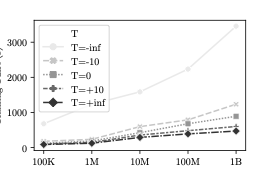
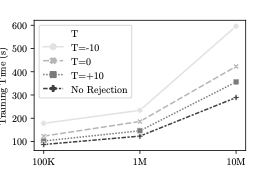
$`M' = e^{-T}`$ where $`T \in [-\infty, +\infty]`$ is an arbitrary
threshold function. This definition has a number of appealing
properties. First, this function is differentiable and can be easily
plugged into the VAE’s objective function thereby allowing us to learn a
suitable value of $`T`$ for the dataset during training . Please refer
to Section 16 for a heuristic method for
setting appropriate values of $`T`$ during model building and sample
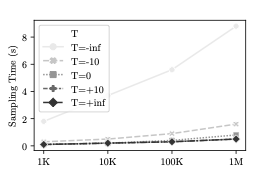
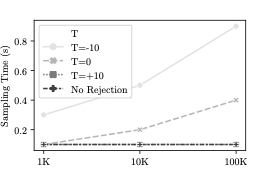
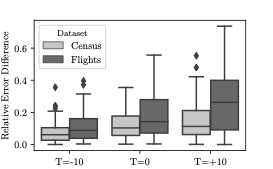
generation. Second, the parameter $`T`$ when set, establishes a
trade-off between computational efficiency and accuracy. If
$`T \rightarrow +\infty`$, then every sample is accepted (no rejection)
resulting into fast sample generation at the expense of the quality of
the approximation to the true underlying distribution. In contrast when
$`T \rightarrow -\infty`$, we ensure that almost every sample is
guaranteed to be from the true posterior distribution, by making the
acceptance probability small and as a result increasing sample
generation time. Since $`a`$ should be a probability we change equation
Equation [eq:acceptanceAdvanced] to:
Algorithm [alg:VAEforAQP] provides the
pseudocode for the overall workflow of performing AQP using VAE. In the
model building phase, we encode the input relation $`R`$ using an
appropriate mechanism (see Section
7.5). The VAE model is trained
on the encoded input and stored along with appropriate metadata.
Input: VAE model $`\mathcal{V}`$ $`T=0`$, $`S_{D}`$ = sample from
$`D`$, $`S_z = \{\}`$ Sample $`z \sim q(z|x)`$ Accept or reject $`z`$
based on
Equation [eq:acceptanceFinal]If
$`z`$ is accepted, $`S_z = S_z \cup \{z\}`$ $`S_M=`$Decoder($`S_z)`$ //
Convert samples to original space Test null hypothesis
$`H_0: P_S = P_D`$ using
Equation [eq:crossMatchTestStatistic]
$`T = T - 1`$ Goto Step 3 Output: Model $`\mathcal{V}`$ and $`T`$
Making VAE practical for relational AQP
In this subsection, we propose two practical improvements for training
VAE for AQP over relational data.
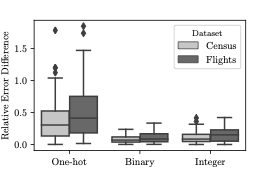
One-hot encoding of tuples is an effective approach for relatively small
attribute domains. If the relation has millions of distinct values, then
it causes two major issues. First, the encoded vector becomes very
sparse resulting in poor performance . Second, it increases the number
of parameters learned by the model thereby increasing the model size and
the training time.
A promising approach to improve one-hot encoding is to make the
representation denser using binary encoding. Without loss of
generality, let the domain $`Dom(A_j)`$ be its zero-indexed position
$`[0, 1, \ldots, |Dom(A_j)|-1]`$. We can now concisely represent these
values using $`\lceil \log_2 |Dom(A_j)| \rceil`$ dimensional vector.
Once again consider the example $`Dom(A_j) = \{Low, Medium, High\}`$.
Instead of representing $`A_j`$ as a 3-dimensional vectors
($`001,010,100`$), we can now represent them in
$`\lceil \log_2(3) \rceil = 2`$-dimensional vector
$`\eta(Low)=00, \eta(Medium)=01, \eta(High)=10`$. This approach is then
repeated for each attribute resulting a
$`d = \sum_{i=1}^{n} \lceil \log_2 |Dom(A_i)| \rceil`$-dimensional
vector (for $`n`$ attributes) that is exponentially smaller and denser
than the one-hot encoding that requires $`\sum_{i=1}^{n} |Dom(A_i)|`$
dimensions.
Typically, samples are obtained from VAE in two steps: (a) generate a
sample $`z`$ in the latent space $`z \sim q(z|x)`$ and (b) generate a
sample $`x'`$ in the original space by passing $`z`$ to the decoder.
While this approach is widely used in many domains such as images and
music, it is not appropriate for databases. Typically, the output of the
decoder is stochastic. In other words, for the same value of $`z`$, it
is possible to generate multiple reconstructed tuples from the
distribution $`p(x|z)`$. However, blindly generating a random tuple from
the decoder output could return an invalid tuple. For images and music,
obtaining incorrect values for a few pixels/notes is often
imperceptible. However, getting an attribute wrong could result in a
(slightly) incorrect estimate Typically, the samples generated are often
more correct than wrong. We could minimize the likelihood of an
aberration by generating multiple samples for the same value of $`z`$.
In other words, for the same latent space sample $`z`$, we generate
multiple samples $`X'=\{x'_1, x'_2, \ldots, \}`$ in the tuple space.
These samples could then be aggregated to obtain a single sample tuple
$`x'`$. The aggregation could be based on max (for each attribute
$`A_j`$, pick the value that occurred most in $`X'`$) or weighted random
sampling (for each attribute $`A_j`$, pick the value based on the
frequency distribution of $`A_j`$ in $`X'`$). Both these approaches
provide sample tuples that are much more robust resulting in better
accuracy estimates.
Conclusion
We proposed a model based approach for AQP and demonstrated
experimentally that the generated samples are realistic and produce
accurate aggregate estimates. We identify the issue of model bias and
propose a rejection sampling based approach to mitigate it. We proposed
dynamic programming based algorithms for identifying optimal partitions
to train multiple generative models. Our approach could integrated
easily into AQP systems and can satisfy arbitrary accuracy requirements
by generating as many samples as needed without going back to the data.
There are a number of interesting questions to consider in the future.
Some of them include better mechanisms for generating conditional
samples that satisfy certain constraints. Moreover, it would be
interesting to study the applicability of generative models in other
data management problems such as synthetic data generation for
structured and graph databases extending ideas in .
The copyright of this content belongs to the respective researchers. We deeply appreciate their hard work and contribution to the advancement of human civilization.