Title: E(A+M)PEC - An OpenCL Atomic & Molecular Plasma Emission Code For Interstellar Medium Simulations
ArXiv ID: 1109.5362
Date: 2019-08-19
Authors: Miguel A. de Avillez (U. Evora, Portugal), Emanuele Spitoni (U. Evora), and Dieter Breitschwerdt (Tech. Univ. Berlin, Germany)
📝 Abstract
E(A+M)PEC traces the ionization structure, cooling and emission spectra of plasmas. It is written in OpenCL, runs in NVIDIA Graphics Processor Units and can be coupled to any HD or MHD code to follow the dynamical and thermal evolution of any plasma in, e.g., the interstellar medium (ISM).
💡 Deep Analysis
📄 Full Content
The thermal evolution of the ISM is determined by heating and cooling processes which may not be synchronized with ionization and recombination processes and the system deviates from collisional ionization equilibrium (CIE). A step forward in ISM modelling requires that both the thermal and dynamical evolutions be treated in a selfconsistent way and under non-equilibrium ionization conditions (NEI).
E(A+M)PEC traces the ten most abundant elements in nature, includes up to date solar abundances and atomic and molecular data (see e.g., http://www.lca.uevora.pt/research
and references therein). The physical processes comprise electron impact ionization, excitation auto-ionization, radiative and dielectronic recombination, charge-exchange reactions, ionization of Hi as result of He ions recombination, continuum (free-free, free-bound, two-photon) and line mission (λ ∈ [1Å, 610µ]), and H, C and O chemistry,
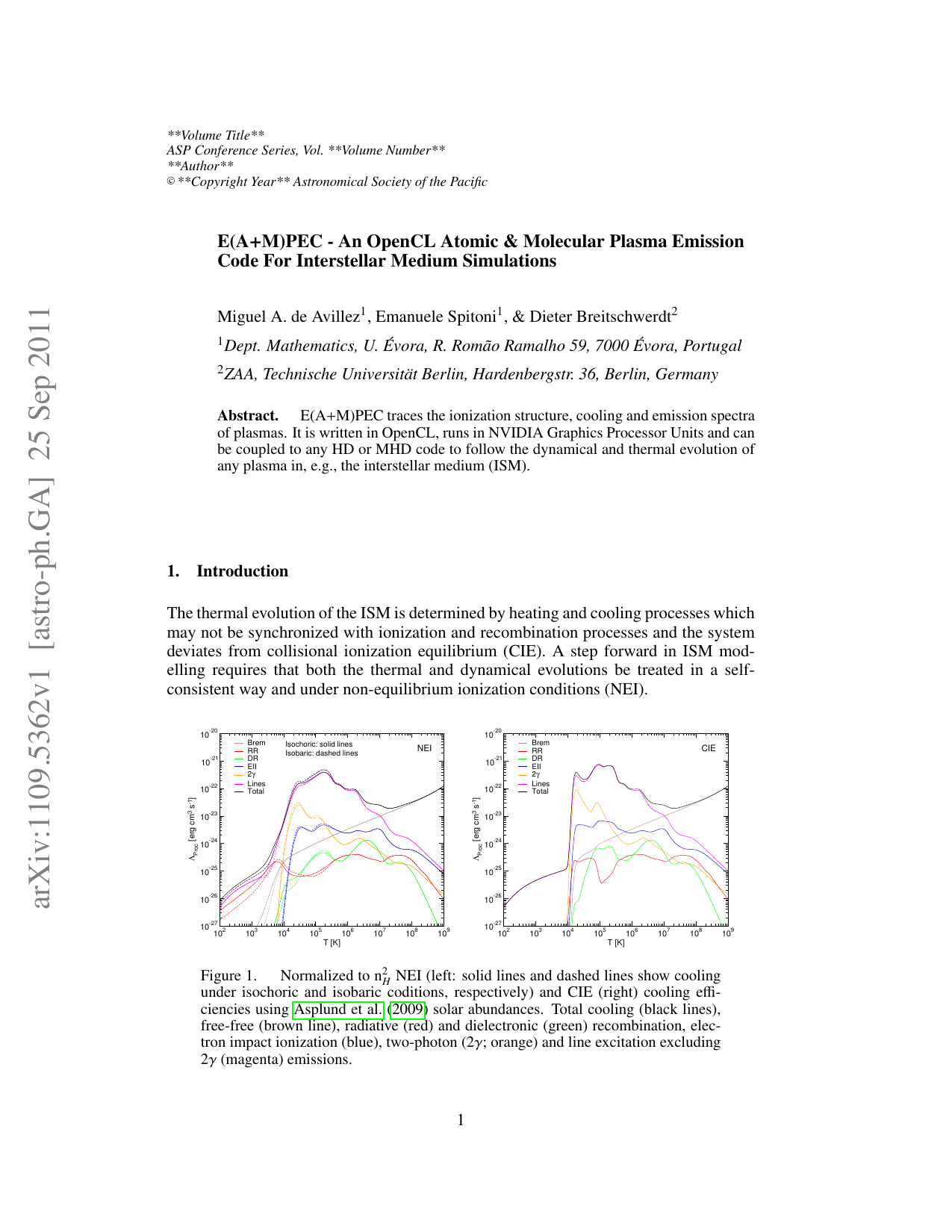
The cooling efficiencies of a plasma evolving from 10 9 K (where it was fully ionized) to 100 K under CIE and NEI (isochoric and isobaric) conditions are shown in Figure 1. Departure from CIE occurs at some 10 6 K. As recombination lags behind, single and double ionized species exist at lower temperatures (Figure 2) something that does not occur under CIE (because ionization and recombination is synchronized) and therefore neutrals form at temperatures near 10 4 K. These differences also affect the emission spectra -with recombination lagging behind, typically around 10 5 K, the spectra at λ < 100Å becomes free-bound dominated under NEI conditions.
The ionization structure, cooling and emission spectra obtained with the E(A+M)PEC running in NVIDIA GPUs are similar (though with some deviations due to different atomic data and abundances) to results of, e.g, Schmutzler & Tscharnuter (1993), Gnat & Sternberg (2007) and Bryans et al. (2009). Regarding ISM simulations, it should be stressed that the interstellar cooling function is changing in space and time (Avillez & Breitschwerdt, submitted).