Intelligent Knowledge Distribution Constrained-Action POMDPs for Resource-Aware Multi-Agent Communication
📝 Original Paper Info
- Title: Intelligent Knowledge Distribution Constrained-Action POMDPs for Resource-Aware Multi-Agent Communication- ArXiv ID: 1903.03086
- Date: 2019-03-08
- Authors: Michael C. Fowler and T. Charles Clancy and Ryan K. Williams
📝 Abstract
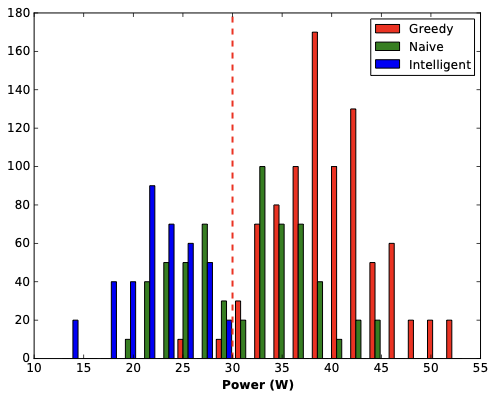
This paper addresses a fundamental question of multi-agent knowledge distribution: what information should be sent to whom and when, with the limited resources available to each agent? Communication requirements for multi-agent systems can be rather high when an accurate picture of the environment and the state of other agents must be maintained. To reduce the impact of multi-agent coordination on networked systems, e.g., power and bandwidth, this paper introduces two concepts for partially observable Markov decision processes (POMDPs): 1) action-based constraints which yield constrained-action POMDPs (CA-POMDPs); and 2) soft probabilistic constraint satisfaction for the resulting infinite-horizon controllers. To enable constraint analysis over an infinite horizon, an unconstrained policy is first represented as a Finite State Controller (FSC) and optimized with policy iteration. The FSC representation then allows for a combination of Markov chain Monte Carlo and discrete optimization to improve the probabilistic constraint satisfaction of the controller while minimizing the impact to the value function. Within the CA-POMDP framework we then propose Intelligent Knowledge Distribution (IKD) which yields per-agent policies for distributing knowledge between agents subject to interaction constraints. Finally, the CA-POMDP and IKD concepts are validated using an asset tracking problem where multiple unmanned aerial vehicles (UAVs) with heterogeneous sensors collaborate to localize a ground asset to assist in avoiding unseen obstacles in a disaster area. The IKD model was able to maintain asset tracking through multi-agent communications while only violating soft power and bandwidth constraints 3% of the time, while greedy and naive approaches violated constraints more than 60% of the time.💡 Summary & Analysis
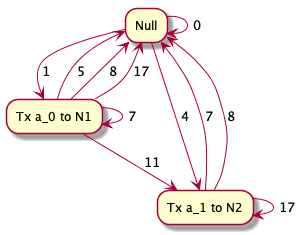
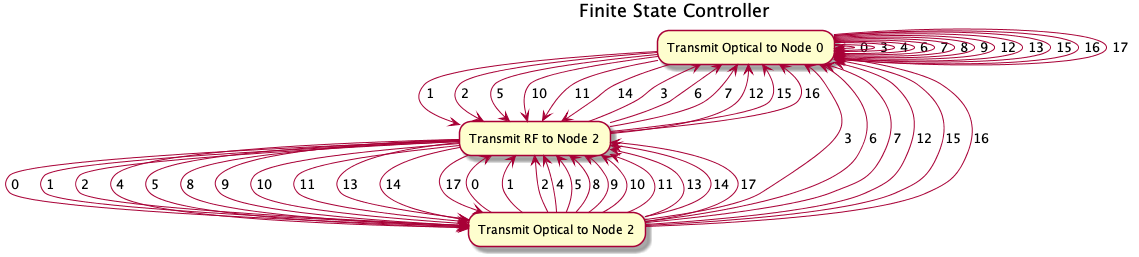
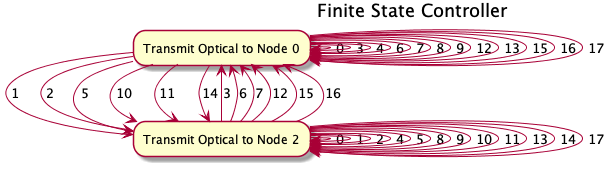
This paper delves into the efficient distribution of information among multiple agents, considering limited resources such as power and bandwidth. The central issue addressed is determining what information should be communicated to whom and when, within constraints imposed by available resources. In multi-agent systems, maintaining an accurate picture of both the environment and other agents often requires significant communication overhead, which can strain networked systems.To tackle this problem, the researchers introduce a modified version of Partially Observable Markov Decision Processes (POMDPs) called Constrained-Action POMDPs (CA-POMDPs). This framework incorporates action-based constraints to ensure that information is shared efficiently without overburdening system resources. Additionally, they propose an approach for probabilistic constraint satisfaction over an infinite horizon by first representing unconstrained policies as Finite State Controllers (FSCs) and optimizing these with policy iteration techniques.
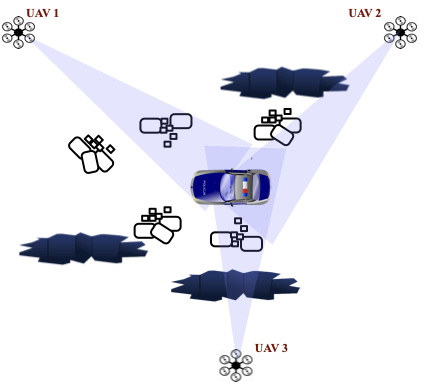
The paper also presents Intelligent Knowledge Distribution (IKD), a model within the CA-POMDP framework that generates per-agent policies for distributing knowledge between agents while adhering to interaction constraints. The effectiveness of this approach is demonstrated through an asset-tracking scenario involving multiple unmanned aerial vehicles (UAVs) equipped with heterogeneous sensors collaborating to locate and track a ground asset in a disaster area.
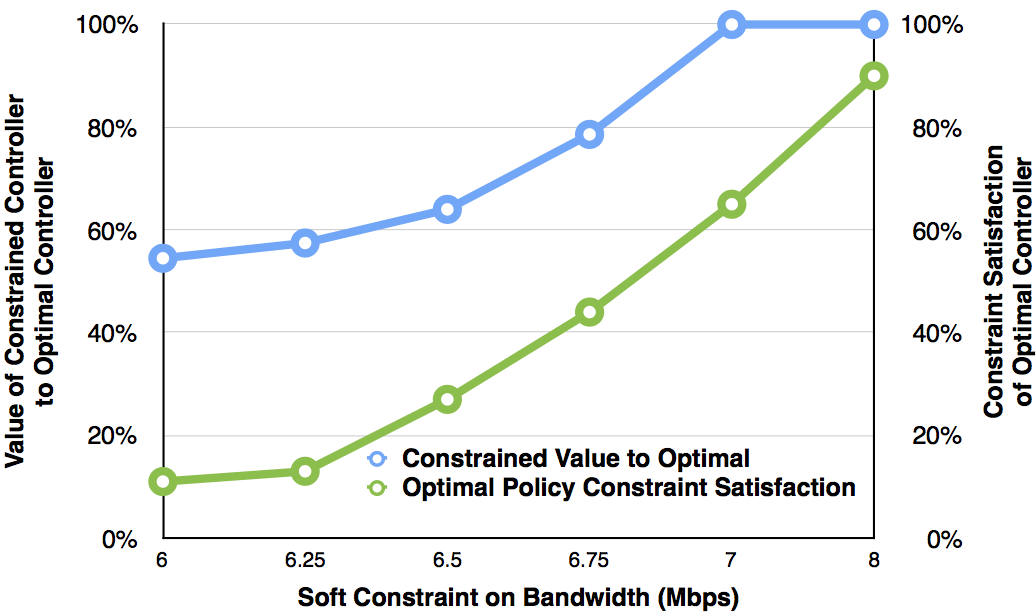
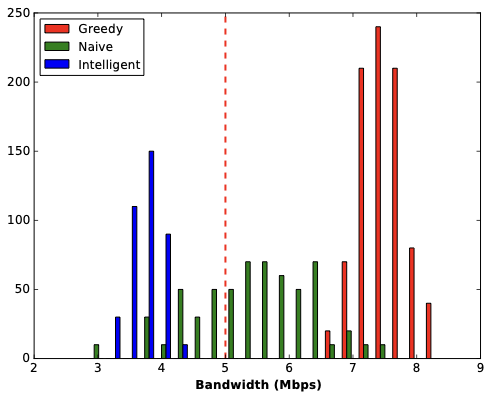
The results show that the IKD model maintains efficient communication between UAVs, violating soft power and bandwidth constraints only 3% of the time. This contrasts sharply with greedy or naive approaches which violated constraints more than 60% of the time. The significance of this research lies in its potential to improve resource management in networked multi-agent systems, offering practical solutions for real-time monitoring and disaster response scenarios.
📄 Full Paper Content (ArXiv Source)
📊 논문 시각자료 (Figures)