Recently, IBM, Google, and Intel showcased quantum computers ranging from 49 to 72 qubits. While these systems represent a significant milestone in the advancement of quantum computing, existing and near-term quantum computers are not yet large enough to fully support quantum error-correction. Such systems with few tens to few hundreds of qubits are termed as Noisy Intermediate Scale Quantum computers (NISQ), and these systems can provide benefits for a class of quantum algorithms. In this paper, we study the problems of Qubit-Allocation (mapping of program qubits to machine qubits) and Qubit-Movement(routing qubits from one location to another to perform entanglement). We observe that there exists variation in the error rates of different qubits and links, which can have an impact on the decisions for qubit movement and qubit allocation. We analyze characterization data for the IBM-Q20 quantum computer gathered over 52 days to understand and quantify the variation in the error-rates and find that there is indeed significant variability in the error rates of the qubits and the links connecting them. We define reliability metrics for NISQ computers and show that the device variability has the substantial impact on the overall system reliability. To exploit the variability in error rate, we propose Variation-Aware Qubit Movement (VQM) and Variation-Aware Qubit Allocation (VQA), policies that optimize the movement and allocation of qubits to avoid the weaker qubits and links and guide more operations towards the stronger qubits and links. We show that our Variation-Aware policies improve the reliability of the NISQ system up to 2.5x.
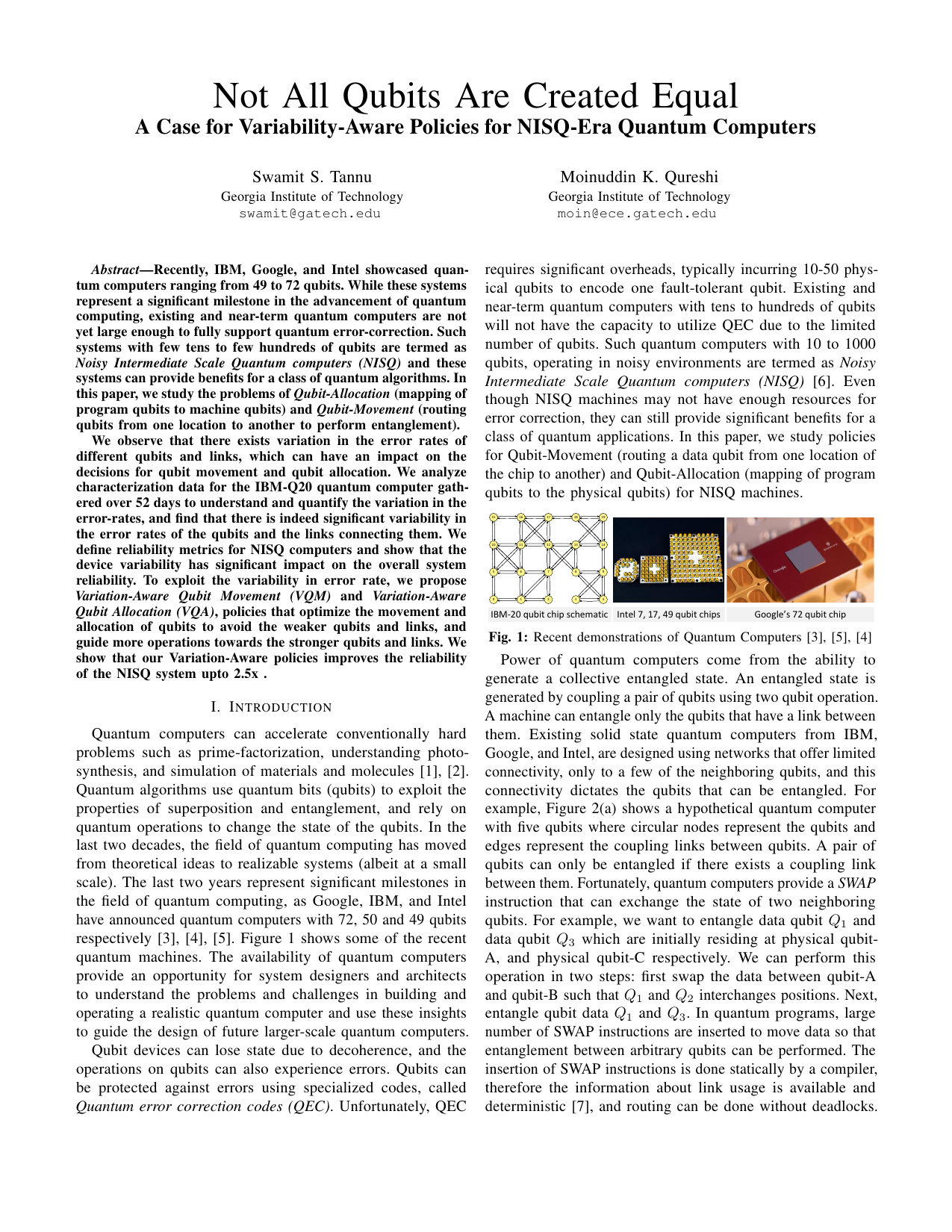
Quantum computers can accelerate conventionally hard problems such as prime-factorization, understanding photosynthesis, and simulation of materials and molecules [1], [2]. Quantum algorithms use quantum bits (qubits) to exploit the properties of superposition and entanglement, and rely on quantum operations to change the state of the qubits. In the last two decades, the field of quantum computing has moved from theoretical ideas to realizable systems (albeit at a small scale). The last two years represent significant milestones in the field of quantum computing, as Google, IBM, and Intel have announced quantum computers with 72, 50 and 49 qubits respectively [3], [4], [5]. Figure 1 shows some of the recent quantum machines. The availability of quantum computers provide an opportunity for system designers and architects to understand the problems and challenges in building and operating a realistic quantum computer and use these insights to guide the design of future larger-scale quantum computers.
Qubit devices can lose state due to decoherence, and the operations on qubits can also experience errors. Qubits can be protected against errors using specialized codes, called Quantum error correction codes (QEC). Unfortunately, QEC requires significant overheads, typically incurring 10-50 physical qubits to encode one fault-tolerant qubit. Existing and near-term quantum computers with tens to hundreds of qubits will not have the capacity to utilize QEC due to the limited number of qubits. Such quantum computers with 10 to 1000 qubits, operating in noisy environments are termed as Noisy Intermediate Scale Quantum computers (NISQ) [6]. Even though NISQ machines may not have enough resources for error correction, they can still provide significant benefits for a class of quantum applications. In this paper, we study policies for Qubit-Movement (routing a data qubit from one location of the chip to another) and Qubit-Allocation (mapping of program qubits to the physical qubits) for NISQ machines. Fig. 1: Recent demonstrations of Quantum Computers [3], [5], [4] Power of quantum computers come from the ability to generate a collective entangled state. An entangled state is generated by coupling a pair of qubits using two qubit operation. A machine can entangle only the qubits that have a link between them. Existing solid state quantum computers from IBM, Google, and Intel, are designed using networks that offer limited connectivity, only to a few of the neighboring qubits, and this connectivity dictates the qubits that can be entangled. For example, Figure 2(a) shows a hypothetical quantum computer with five qubits where circular nodes represent the qubits and edges represent the coupling links between qubits. A pair of qubits can only be entangled if there exists a coupling link between them. Fortunately, quantum computers provide a SWAP instruction that can exchange the state of two neighboring qubits. For example, we want to entangle data qubit Q 1 and data qubit Q 3 which are initially residing at physical qubit-A, and physical qubit-C respectively. We can perform this operation in two steps: first swap the data between qubit-A and qubit-B such that Q 1 and Q 2 interchanges positions. Next, entangle qubit data Q 1 and Q 3 . In quantum programs, large number of SWAP instructions are inserted to move data so that entanglement between arbitrary qubits can be performed. The insertion of SWAP instructions is done statically by a compiler, therefore the information about link usage is available and deterministic [7], and routing can be done without deadlocks. Fig. 2: (a) A hypothetical quantum computer with five-qubits -the number on the edge denotes the success probability when that edge is used (b) Variation-Aware Qubit Mapping (VQM) can use more SWAP instructions and yet have higher probability of success (c) Variation-Aware Qubit Allocation (VQA) tries to select the mapping that improves overall system reliability.
The Qubit-Movement policy deals with the problem of selecting a route to move the data of one qubit to another. For example, in Figure 2(a), we may choose the route A-B-C for going from A to C, as doing so would minimize the number of SWAP operations. The Qubit-Allocation policy deals with the problem of mapping of program qubits to the physical qubits. For example, in Figure 2(a), if we want to map three program qubits to five physical qubits, we would choose any of 3 connected qubits (for example, Q 1 maps to A, Q 2 maps to B, and Q 3 maps to C), as placing qubits nearby results in efficient movement. Recent studies [8], [9], [10] have proposed qubit allocation policies based on minimizing the number of SWAP instructions. These studies assume uniformity in cost of performing SWAP operations. However, in reality, we expect variation in the behavior of different qubits and links, and optimizing for a uniform behavior may not result in the best policy when device variation is taken into account.
To und
This content is AI-processed based on open access ArXiv data.