The e-commerce share in the global retail spend is showing a steady increase over the years indicating an evident shift of consumer attention from bricks and mortar to clicks in retail sector. In recent years, online marketplaces have become one of the key contributors to this growth. As the business model matures, the number and types of frauds getting reported in the area is also growing on a daily basis. Fraudulent e-commerce buyers and their transactions are being studied in detail and multiple strategies to control and prevent them are discussed. Another area of fraud happening in marketplaces are on the seller side and is called merchant fraud. Goods/services offered and sold at cheap rates, but never shipped is a simple example of this type of fraud. This paper attempts to suggest a framework to detect such fraudulent sellers with the help of machine learning techniques. The model leverages the historic data from the marketplace and detect any possible fraudulent behaviours from sellers and alert to the marketplace.
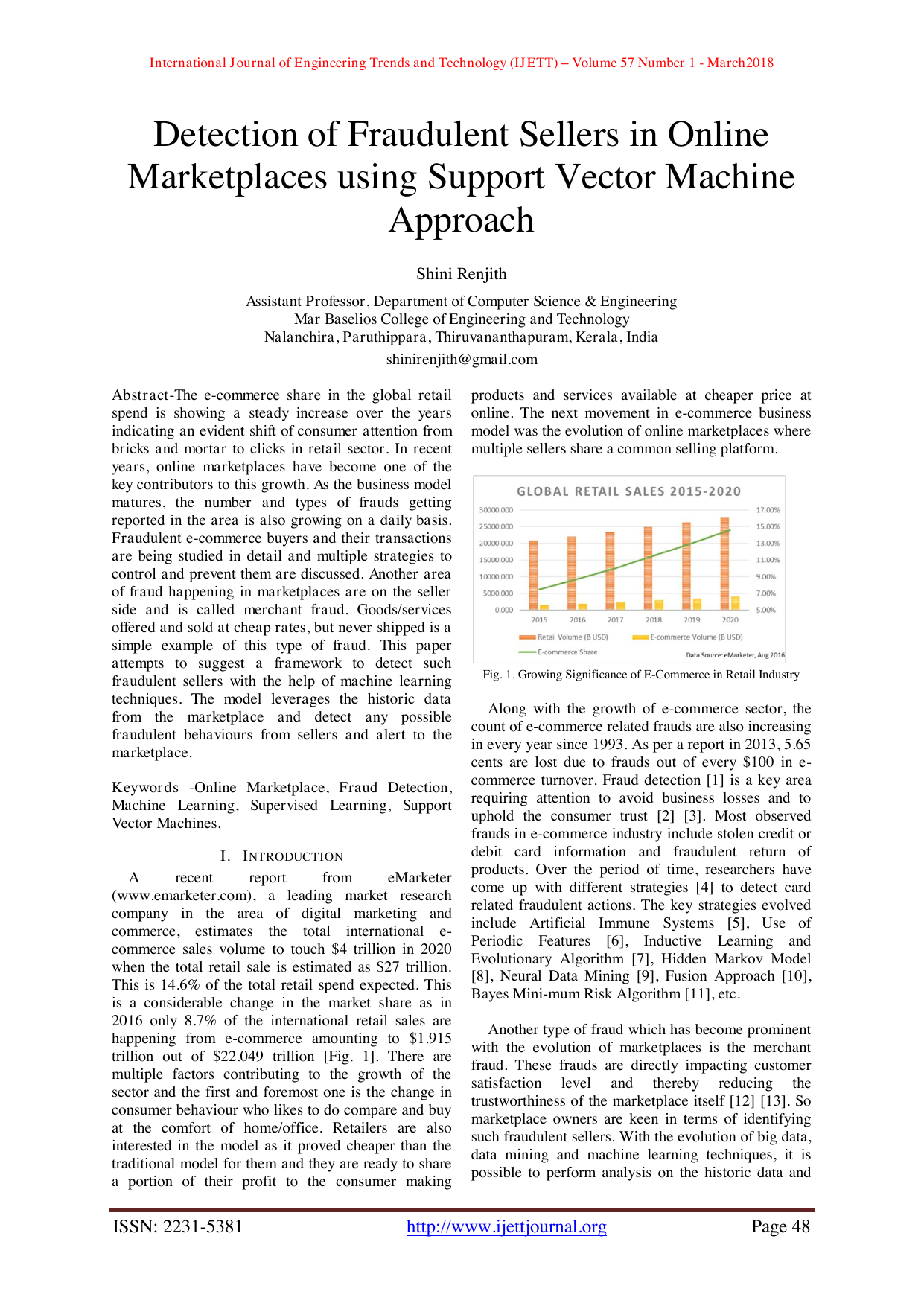
A recent report from eMarketer (www.emarketer.com), a leading market research company in the area of digital marketing and commerce, estimates the total international ecommerce sales volume to touch $4 trillion in 2020 when the total retail sale is estimated as $27 trillion. This is 14.6% of the total retail spend expected. This is a considerable change in the market share as in 2016 only 8.7% of the international retail sales are happening from e-commerce amounting to $1.915 trillion out of $22.049 trillion [Fig. 1]. There are multiple factors contributing to the growth of the sector and the first and foremost one is the change in consumer behaviour who likes to do compare and buy at the comfort of home/office. Retailers are also interested in the model as it proved cheaper than the traditional model for them and they are ready to share a portion of their profit to the consumer making products and services available at cheaper price at online. The next movement in e-commerce business model was the evolution of online marketplaces where multiple sellers share a common selling platform. Along with the growth of e-commerce sector, the count of e-commerce related frauds are also increasing in every year since 1993. As per a report in 2013, 5.65 cents are lost due to frauds out of every $100 in ecommerce turnover. Fraud detection [1] is a key area requiring attention to avoid business losses and to uphold the consumer trust [2] [3]. Most observed frauds in e-commerce industry include stolen credit or debit card information and fraudulent return of products. Over the period of time, researchers have come up with different strategies [4] to detect card related fraudulent actions. The key strategies evolved include Artificial Immune Systems [5], Use of Periodic Features [6], Inductive Learning and Evolutionary Algorithm [7], Hidden Markov Model [8], Neural Data Mining [9], Fusion Approach [10], Bayes Mini-mum Risk Algorithm [11], etc.
Another type of fraud which has become prominent with the evolution of marketplaces is the merchant fraud. These frauds are directly impacting customer satisfaction level and thereby reducing the trustworthiness of the marketplace itself [12] [13]. So marketplace owners are keen in terms of identifying such fraudulent sellers. With the evolution of big data, data mining and machine learning techniques, it is possible to perform analysis on the historic data and correlate it with seller behaviours to identify potential fraudulent moves.
The proposed model results in proactive identification of fraudulent selling attempts in a marketplace with the help of machine learning strategies. Next section of the paper explains the concepts of online marketplace, merchant fraud and also explains the machine learning paradigm. Subsequent sections of this paper deals with the details of the proposed solution frame-work.
An online marketplace [Fig. 2] can be considered as a type of e-commerce portal where products and services are offered by multiple vendors, who may be brands, shops or persons. The marketplace owner will take care of customer attractions and money transactions. The vendors will deal with manufacturing, packaging and shipping. The consumers experience superior shopping experience from online marketplaces and some of the key reasons for the same include a. More selection opportunities among wide range of products in one place b. Competitive pricing among sellers c. Better availability of inventory as multiple vendors sell same product under the same platform. d. Convenience and increased privacy of transactions being done at one place which is not shared with individual sellers.
Merchant fraud cover the fraudulent transactions happening from the sellers on marketplace. There are different types of merchant frauds observed. The most prominent one in this category is merchant identify fraud. In this scenario, a criminal impersonate a legitimate seller and charge to consumers’ credit or debit card and after collecting some revenue he/she vanishes leaving be-hind all issues like chargebacks and tainted reputation. Another scenario is where some sellers try to create un-due profit by doing some type of malpractice in listing, pricing and shipping of products and services.
Machine Learning [14] is a computer science discipline and a branch of artificial intelligence that deals with computers or machines learning from the past transactions to perform certain tasks and improving its performances with accrued experiences. An intelligent decision making algorithm can be developed using the supervised machine learning technique. This approach requires some existing data, called training set where input scenarios and output scenarios are captured and agreed upon. The learning algorithm do an iterative process to arrive at some logic which will help itself to predict the output for an input scenario where output data is not available [Fig. 3]. The objective of machine learning is to create
This content is AI-processed based on open access ArXiv data.