This paper reviews the current development of artificial intelligence (AI) techniques for the application area of robot communication. The study of the control and operation of multiple robots collaboratively toward a common goal is fast growing. Communication among members of a robot team and even including humans is becoming essential in many real-world applications. The survey focuses on the AI techniques for robot communication to enhance the communication capability of the multi-robot team, making more complex activities, taking an appreciated decision, taking coordinated action, and performing their tasks efficiently.
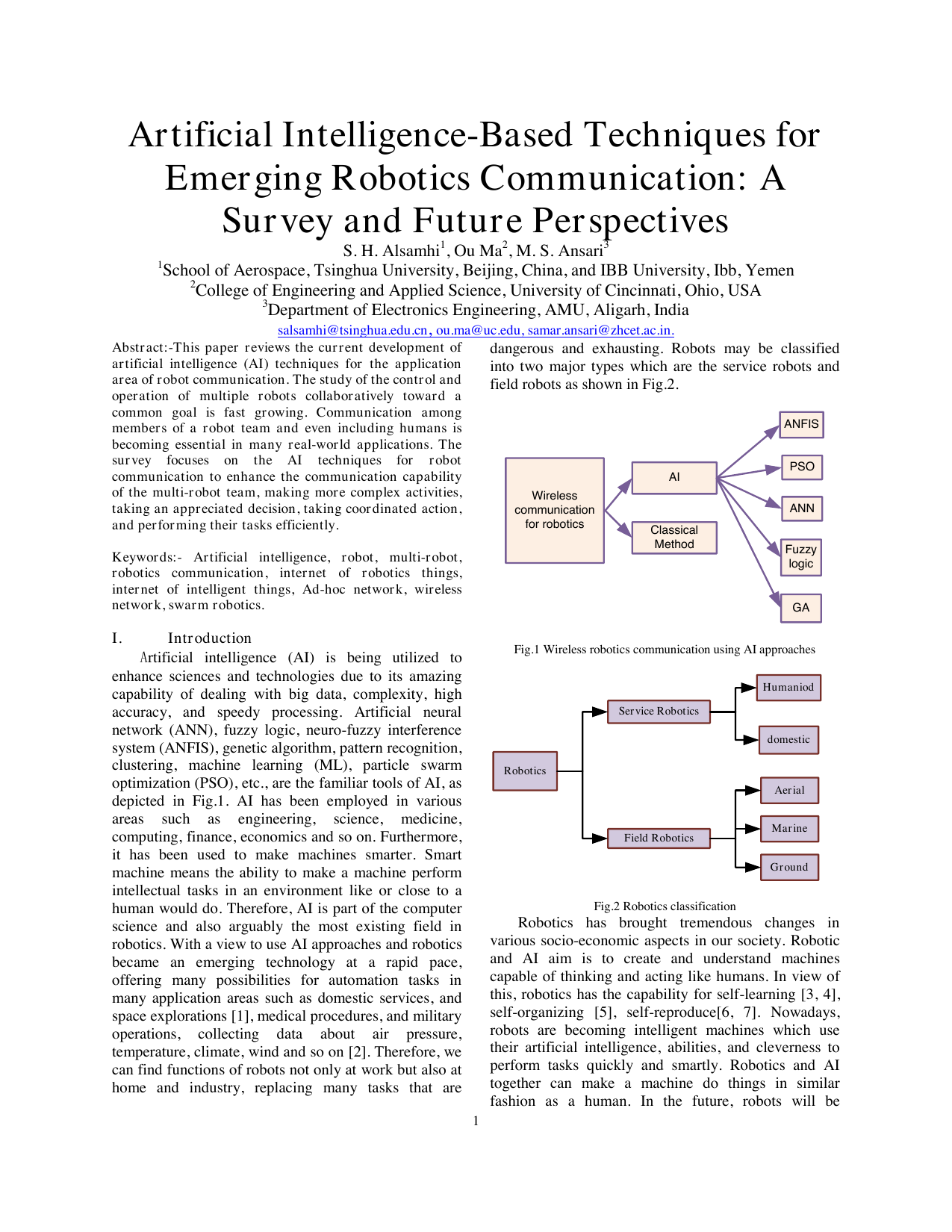
Artificial intelligence (AI) is being utilized to enhance sciences and technologies due to its amazing capability of dealing with big data, complexity, high accuracy, and speedy processing. Artificial neural network (ANN), fuzzy logic, neuro-fuzzy interference system (ANFIS), genetic algorithm, pattern recognition, clustering, machine learning (ML), particle swarm optimization (PSO), etc., are the familiar tools of AI, as depicted in Fig. 1. AI has been employed in various areas such as engineering, science, medicine, computing, finance, economics and so on. Furthermore, it has been used to make machines smarter. Smart machine means the ability to make a machine perform intellectual tasks in an environment like or close to a human would do. Therefore, AI is part of the computer science and also arguably the most existing field in robotics. With a view to use AI approaches and robotics became an emerging technology at a rapid pace, offering many possibilities for automation tasks in many application areas such as domestic services, and space explorations [1], medical procedures, and military operations, collecting data about air pressure, temperature, climate, wind and so on [2]. Therefore, we can find functions of robots not only at work but also at home and industry, replacing many tasks that are dangerous and exhausting. Robots may be classified into two major types which are the service robots and field robots as shown in Fig. 2. Robotics has brought tremendous changes in various socio-economic aspects in our society. Robotic and AI aim is to create and understand machines capable of thinking and acting like humans. In view of this, robotics has the capability for self-learning [3,4], self-organizing [5], self-reproduce [6,7]. Nowadays, robots are becoming intelligent machines which use their artificial intelligence, abilities, and cleverness to perform tasks quickly and smartly. Robotics and AI together can make a machine do things in similar fashion as a human. In the future, robots will be everywhere, and they will help humans at any time in anywhere. To do that, communication among robots themselves and with humans is necessary. Therefore, robotics technologies have often combined with communication network technologies in both research and practice. The combination of both technologies will help robots to move autonomously and extend robotic functions to perform any given tasks effectively and efficiently.
Wireless network plays a vital rule in sharing and transmitting data between robots over the pervasive network, communicating with each other also with humans. A robot network is a group of robots that are communicated via wire or wireless communication technology performing tasks for a common goal in a coordinated manner. Communication can be teleoperated or autonomous [8]. Teleoperated robots refer to the robots which are fully controlled by human operators via communication networks. On the other hand, autonomous robots perform tasks or behave with a high degree of autonomy. Swarm robots are a group of robots placed in distribution fashion to perform a common task by sensing and sharing information via a communication network through internet or other means autonomously without direct intervention of a human. Efficient communication in cooperative robot team tasks is addressed in [9]. Communication among robots also needs to ensure collision prevention and maintain the communication link quality between them. Much research has been done in the area of robot-team communications [10,11]. Intelligent robot communication is very important when the robots are either in the sky, on the ground, in water or in another environment, as shown in Fig. 3.
Currently, AI and internet of things (IoT) make revaluation in the robotic domains applications. IoT represents the body part of robots that performs physical tasks, whereas the AI represents the brain part of robots that controls the physical robots according to the application needs [12,13]. The difference between robotic things and IoT is that robots have intelligence concepts [14]. Pervasive robotics is closely interrelated with the internet of intelligent things (IoIT) [13]. The combination of robots, AI and IoT will result in robot systems having high capabilities to perform complex tasks autonomously. Therefore, with the help of IoT, robots can connect with each other and with humans easily, facilitating the high quality of exchanging data among them and with humans. Razafimandimby et al. [15] addressed the key technology for keeping connectivity between internet of robotic things (IoRT) to provide the desired quality of service (QoS) by using ANN.
This paper is focused on surveying AI methods for robot communication to enhance the communication capability of robots with each other, making activities, taking necessary and appreciated decisions, taking autonomous and coordinated actions and performed their tasks easily. The rest of the paper is or
This content is AI-processed based on open access ArXiv data.