Title: Micro-Data Learning: The Other End of the Spectrum
ArXiv ID: 1610.00946
Date: 2017-09-20
Authors: Jean-Baptiste Mouret (LORIA, LARSEN)
📝 Abstract
Many fields are now snowed under with an avalanche of data, which raises considerable challenges for computer scientists. Meanwhile, robotics (among other fields) can often only use a few dozen data points because acquiring them involves a process that is expensive or time-consuming. How can an algorithm learn with only a few data points?
💡 Deep Analysis
📄 Full Content
ERCIM NEWS 107 October 2016
18
Special Theme: Machine Learning
Watching a child learn reveals how well
humans can learn: a child may only need
a few examples of a concept to “learn it”.
By contrast, the impressive results
achieved with modern machine learning
(in particular, by deep learning) are made
possible largely by the use of huge
datasets. For instance, the ImageNet data-
base used in image recognition contains
about 1.2 million labelled examples;
DeepMinds's AlphaGo used more than 38
million positions to train their algorithm
to play Go; and the same company used
more than 38 days of play to train a neural
network to play Atari 2600 games, such
as Space Invaders or Breakout.
Like children, robots have to face the
real world, in which trying something
might take seconds, hours, or days. And
seeing the consequence of this trial
might take much more. When robots
share our world, they are expected to
learn like humans or animals, that is, in
far fewer than a million trials. Robots
are not alone to be cursed by the price of
data: Any learning process that involves
physical tests or precise simulations
(e.g., computational fluid dynamics)
comes up against the same issue. In
short, while data might be abundant in
the virtual world, it is often a scarce
resource in the physical world. I refer to
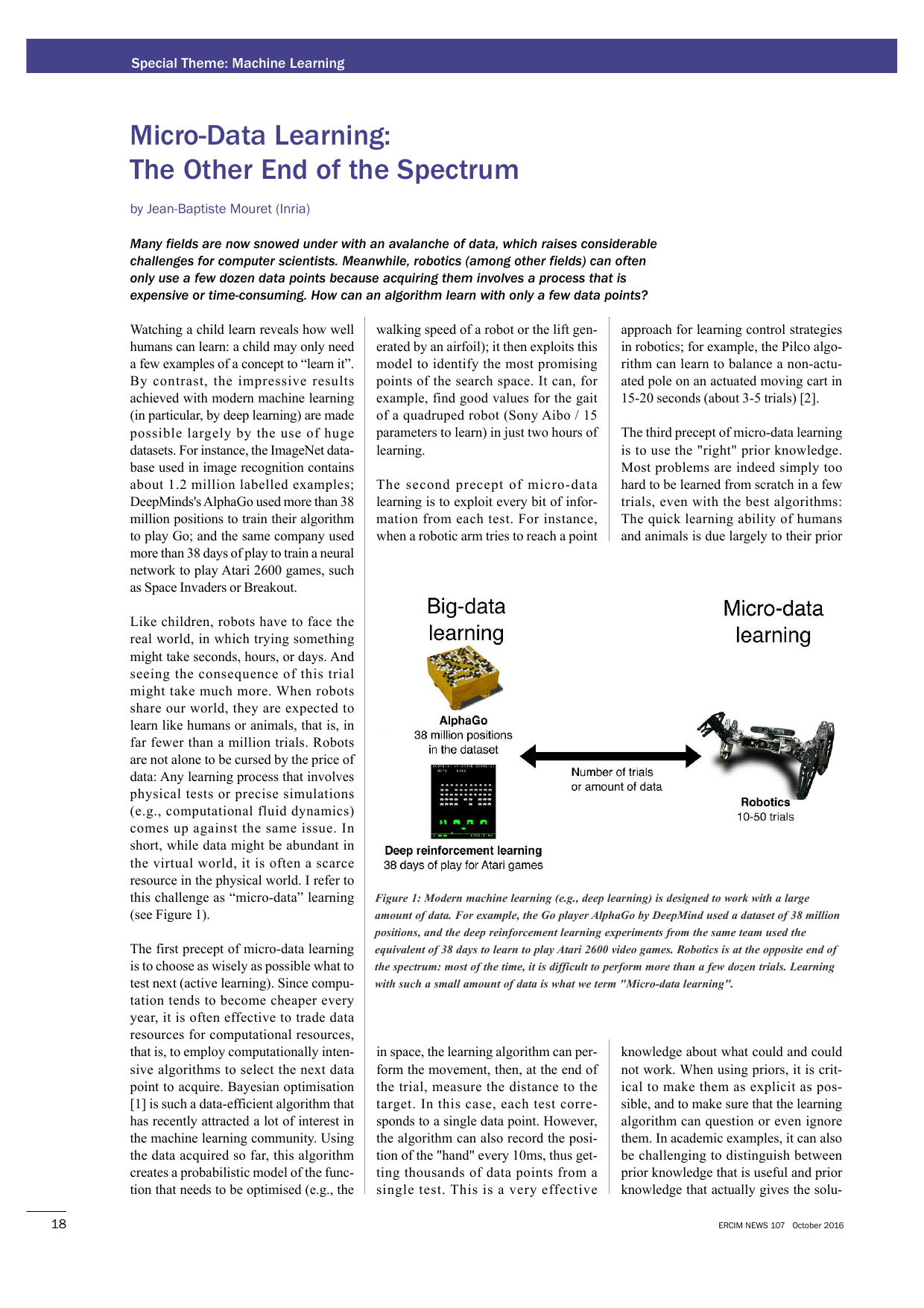
this challenge as “micro-data” learning
(see Figure 1).
The first precept of micro-data learning
is to choose as wisely as possible what to
test next (active learning). Since compu-
tation tends to become cheaper every
year, it is often effective to trade data
resources for computational resources,
that is, to employ computationally inten-
sive algorithms to select the next data
point to acquire. Bayesian optimisation
[1] is such a data-efficient algorithm that
has recently attracted a lot of interest in
the machine learning community. Using
the data acquired so far, this algorithm
creates a probabilistic model of the func-
tion that needs to be optimised (e.g., the
walking speed of a robot or the lift gen-
erated by an airfoil); it then exploits this
model to identify the most promising
points of the search space. It can, for
example, find good values for the gait
of a quadruped robot (Sony Aibo / 15
parameters to learn) in just two hours of
learning.
The second precept of micro-data
learning is to exploit every bit of infor-
mation from each test. For instance,
when a robotic arm tries to reach a point
in space, the learning algorithm can per-
form the movement, then, at the end of
the trial, measure the distance to the
target. In this case, each test corre-
sponds to a single data point. However,
the algorithm can also record the posi-
tion of the "hand" every 10ms, thus get-
ting thousands of data points from a
single test. This is a very effective
approach for learning control strategies
in robotics; for example, the Pilco algo-
rithm can learn to balance a non-actu-
ated pole on an actuated moving cart in
15-20 seconds (about 3-5 trials) [2].
The third precept of micro-data learning
is to use the "right" prior knowledge.
Most problems are indeed simply too
hard to be learned from scratch in a few
trials, even with the best algorithms:
The quick learning ability of humans
and animals is due largely to their prior
knowledge about what could and could
not work. When using priors, it is crit-
ical to make them as explicit as pos-
sible, and to make sure that the learning
algorithm can question or even ignore
them. In academic examples, it can also
be challenging to distinguish between
prior knowledge that is useful and prior
knowledge that actually gives the solu-
Micro-Data Learning:
The Other End of the Spectrum
by Jean-Baptiste Mouret (Inria)
Many fields are now snowed under with an avalanche of data, which raises considerable
challenges for computer scientists. Meanwhile, robotics (among other fields) can often
only use a few dozen data points because acquiring them involves a process that is
expensive or time-consuming. How can an algorithm learn with only a few data points?
Figure 1: Modern machine learning (e.g., deep learning) is designed to work with a large
amount of data. For example, the Go player AlphaGo by DeepMind used a dataset of 38 million
positions, and the deep reinforcement learning experiments from the same team used the
equivalent of 38 days to learn to play Atari 2600 video games. Robotics is at the opposite end of
the spectrum: most of the time, it is difficult to perform more than a few dozen trials. Learning
with such a small amount of data is what we term "Micro-data learning".
ERCIM NEWS 107 October 2016
19
tion to the algorithm, which leaves
nothing to learn.
We focused on prior knowledge in our
recent article about damage recovery in
robotics [3, L1]. In this scenario, a six-
legged walking robot needs to discover
a new way to walk by trial-and-error
because it is damaged. Before the mis-
sion, a novel algorithm explores a large
search space with a simulation of the
intact robot