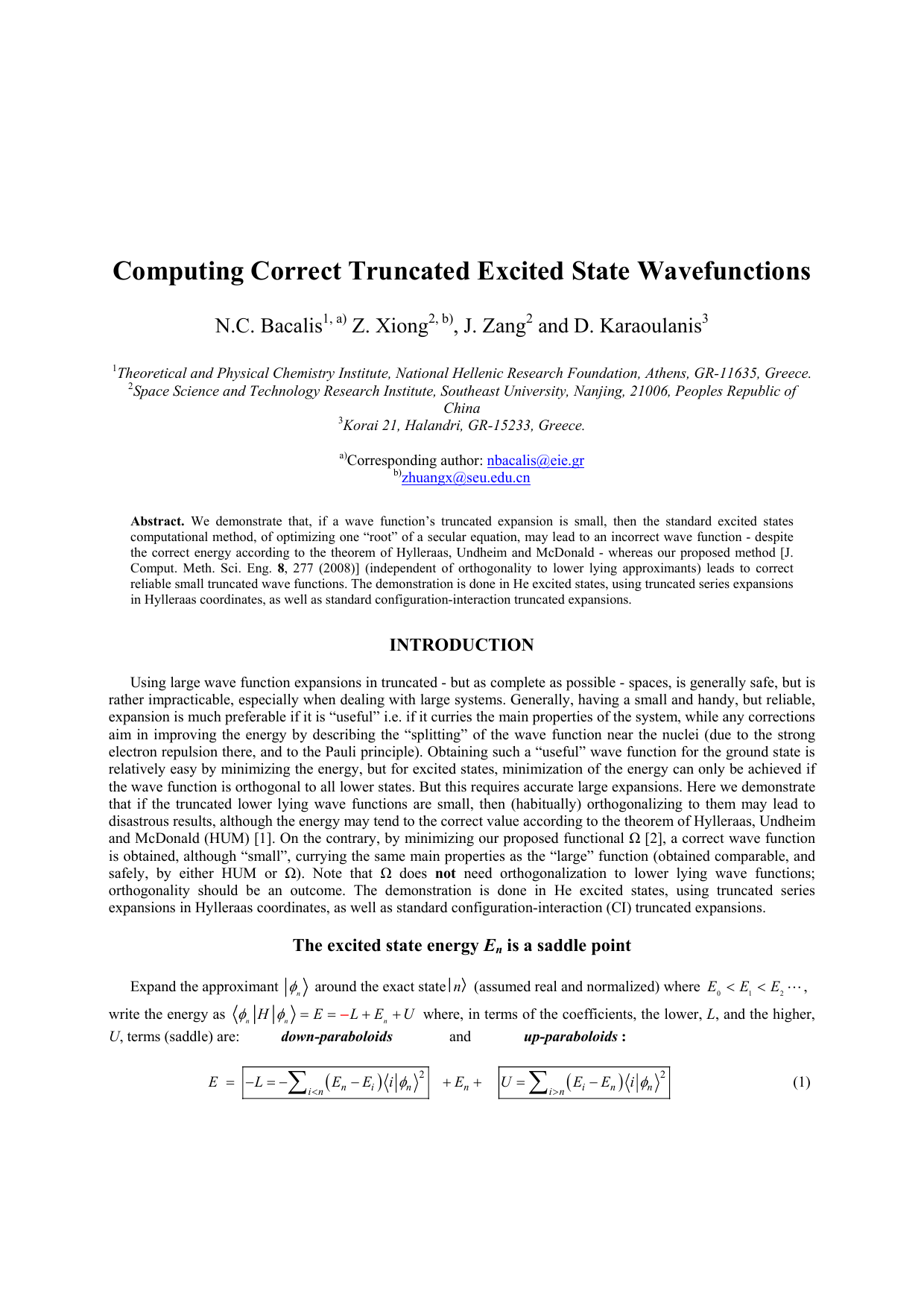
We demonstrate that, if a truncated expansion of a wave function is small, then the standard excited states computational method, of optimizing one root of a secular equation, may lead to an incorrect wave function - despite the correct energy according to the theorem of Hylleraas, Undheim and McDonald - whereas our proposed method [J. Comput. Meth. Sci. Eng. 8, 277 (2008)] (independent of orthogonality to lower lying approximants) leads to correct reliable small truncated wave functions. The demonstration is done in He excited states, using truncated series expansions in Hylleraas coordinates, as well as standard configuration-interaction truncated expansions.
Using large wave function expansions in truncated -but as complete as possible -spaces, is generally safe, but is rather impracticable, especially when dealing with large systems. Generally, having a small and handy, but reliable, expansion is much preferable if it is "useful" i.e. if it curries the main properties of the system, while any corrections aim in improving the energy by describing the "splitting" of the wave function near the nuclei (due to the strong electron repulsion there, and to the Pauli principle). Obtaining such a "useful" wave function for the ground state is relatively easy by minimizing the energy, but for excited states, minimization of the energy can only be achieved if the wave function is orthogonal to all lower states. But this requires accurate large expansions. Here we demonstrate that if the truncated lower lying wave functions are small, then (habitually) orthogonalizing to them may lead to disastrous results, although the energy may tend to the correct value according to the theorem of Hylleraas, Undheim and McDonald (HUM) [1]. On the contrary, by minimizing our proposed functional Ω [2], a correct wave function is obtained, although "small", currying the same main properties as the "large" function (obtained comparable, and safely, by either HUM or Ω). Note that Ω does not need orthogonalization to lower lying wave functions; orthogonality should be an outcome. The demonstration is done in He excited states, using truncated series expansions in Hylleraas coordinates, as well as standard configuration-interaction (CI) truncated expansions.
Expand the approximant n φ around the exact state n (assumed real and normalized) where 0 12
where, in terms of the coefficients, the lower, L, and the higher, U, terms (saddle) are: down-paraboloids and up-paraboloids : , the closest function to ψ 1 while orthogonal to φ 0 , lies below E 1 (and the minimum is even lower). The HUM theorem demands E[φ n ] > E n while φ n is orthogonal to all lower “roots” φ i of the secular equation. Therefore, φ 1 + is not accessible by HUM (and even more inaccessible is ψ 1 ).
Even worse, note that in optimizing any HUM root (say φ 1 ), all other roots (φ 0 ,φ 2 , …) get deteriorated since we may have 2 1 1 1 , , :
Therefore, the optimized HUM 2 nd root φ 1 (although
) is orthogonal to a deteriorated 1 st root φ 0 , i.e. φ 1 just stops at E 1 and cannot approach a worse φ 1 + (the closest to ψ 1 while orthogonal to the deteriorated φ 0 ), thus, φ 1 is much more veered away from the exact ψ 1 . This is clearly demonstrated below for He. (If the optimized HUM roots are misleading for He, i.e. the smallest atom, there is no guarantee for larger systems!)
We need very accurate (truncated) functions Ψ n to resemble> eigenfunctions ψ n and truncated approximants Φ n to check the closeness to Ψ n . As truncated functions we use 1. For He 1 S (1s 2 and 1s2s): Series expansion in Hylleraas variables
, , s r r t r r u r r = + = -= -.
Φ(r 1 ,r 2 ) consist of one Slater determinant of (non-linear) variational Laguerre-type orbitals, 1s, 2s multiplied by a truncated power series of s,t,u, as (linear) eigenvectors of 1 st or 2 nd root of a secular equation. For the “exact” Ψ n we go up to 27 terms, E 0 ≈ -2.90371 a.u., E 1 ≈ -2.14584 a.u., compared to Pekeris’ 95 terms: E 0 = -2.90372, E 1 = -2.14597 a.u. [3]. For the “truncated” trial functions Φ n we go up to 8 terms. 2. For He 1 S (1s 2 , 1s2s and 1s3s) and for He 3 S (1s2s and 1s3s) we use Configuration Interaction (CI) in spherical coordinates (r,θ,φ). Φ(r 1 ,r 2 ) is a linear combination of configurations out of Slater determinants (SD) of atomic (non-linear) variationally optimized Laguerre-type spin-orbitals (orthogonalized) and the linear CI coefficients are the eigenvectors of the roots of the secular equation. As “exact” Ψ n we use a “large” expansion in 1s, 2s, 3s, 4s, 5s, 2p, 3p, 4p, 5p, 3d, 4d, 5d, 4f, 5f. 1 S: E 0 ≈ -2.90324 a.u., E 1 ≈ -2.14594 a.u., E 2 ≈ -2.06125 a.u. (exact: - 2.06127 a.u. [3]), 3 S: E 0 ≈ -2.17521 a.u., E 1 ≈ -2.06869 a.u. (exact: -2.17536, -2.06881 a.u. [3]). As “truncated” trial functions Φ n we use a “small” expansion in 1s, 2s, 3s.
We shall use two methods: 1. Minimimizing (optimizing) directly the n th HUM root, which, [cf. above], must be veered away from the exact eigenfunction ψ n , because, according to the HUM theorem it tends to the exact energy from above, unable to get closer to the exact ψ n , that would require taking lower energies, due to orthogonality to deteriorated lower roots.
- Minimimizing the functional Ω ν that has minimum at the exact
obtained by inverting the sign of L (the down parabolas): Ε=+L + E n + U. The lower φ i may be inaccurate and very “small”, provided that the Hessian and all its principal minors along the main diagonal be positive, easy to fulfill because their main term is large and the overlaps in 1+2[…] (c.f. ref. [2]) are small.
The main orbitals of the Hylleraas wave fun
This content is AI-processed based on open access ArXiv data.