We consider a state-dependent full-duplex relay channel with the state of the channel non-causally available at only the relay. In the framework of cooperative wireless networks, some specific terminals can be equipped with cognition capabilities, i.e, the relay in our model. In the discrete memoryless (DM) case, we derive lower and upper bounds on channel capacity. The lower bound is obtained by a coding scheme at the relay that consists in a combination of codeword splitting, Gel'fand-Pinsker binning, and a decode-and-forward scheme. The upper bound is better than that obtained by assuming that the channel state is available at the source and the destination as well. For the Gaussian case, we also derive lower and upper bounds on channel capacity. The lower bound is obtained by a coding scheme which is based on a combination of codeword splitting and Generalized dirty paper coding. The upper bound is also better than that obtained by assuming that the channel state is available at the source, the relay, and the destination. The two bounds meet, and so give the capacity, in some special cases for the degraded Gaussian case.
Channels that depend on random parameters have received considerable attention over the last decade, due to a wide range of possible applications. This includes single user models [1], [2], [3], [4] and multiuser models (see, e.g., [5], [6], [7] and references therein). For multiuser models, one key issue in the study of state-dependent channels is whether the parameters controlling the channel are known symmetrically, i.e., to all, or asymmetrically, i.e., to only some of, the users in the communication model. The broadcast channel (BC) with state available at the transmitter but not at the receivers is considered in [5], [6], [8]. The multiple access channel (MAC) with partial state information at all the encoders and full state information at the decoder is considered in [9].
In the Gaussian case, the MAC with all informed encoders, the BC with informed encoder, the physically degraded relay channel (RC) with informed source and informed relay, and the physically degraded relay broadcast channel (RBC) with informed source and informed relay are studied in [5], [10], [11]. In all these cases, it is shown that some variants of Costa’s dirty paper coding (DPC) [3] achieve the respective capacity or the respective capacity region. Also, since for all these models the variant of DPC achieves the trivial upper or outer bound obtained by assuming that the channel state is also available at the decoders in the model, it is not required to obtain any non-trivial upper or outer bounds. For all these models, the key assumption that makes the problem relatively easy is the availability of the channel state at all the encoders in the communication model. It is interesting to study state-dependent multi-user models in which only some, i.e., not all, the encoders are informed about the channel state, because the uninformed encoders in the model cannot apply DPC.
The state-dependent MAC with some, but not all, encoders informed of the channel state is considered in [12], [13], [14], [15], [16] and the state-dependent relay channel with only informed source is considered in [11], [17]. For all these models, in the Gaussian case, the informed encoder applies a slightly generalized DPC (GDPC) in which the channel input and the channel state are correlated. In these models, the uninformed encoders benefit from the GDPC applied by the informed encoders because the negative correlation between the codewords at the informed encoders and the channel state can be interpreted as partial state cancellation. For the state-dependent MAC with one informed encoder, the capacity region for the Gaussian case is obtained by deriving a non-trivial upper bound in the case in which the message sets are degraded [15].
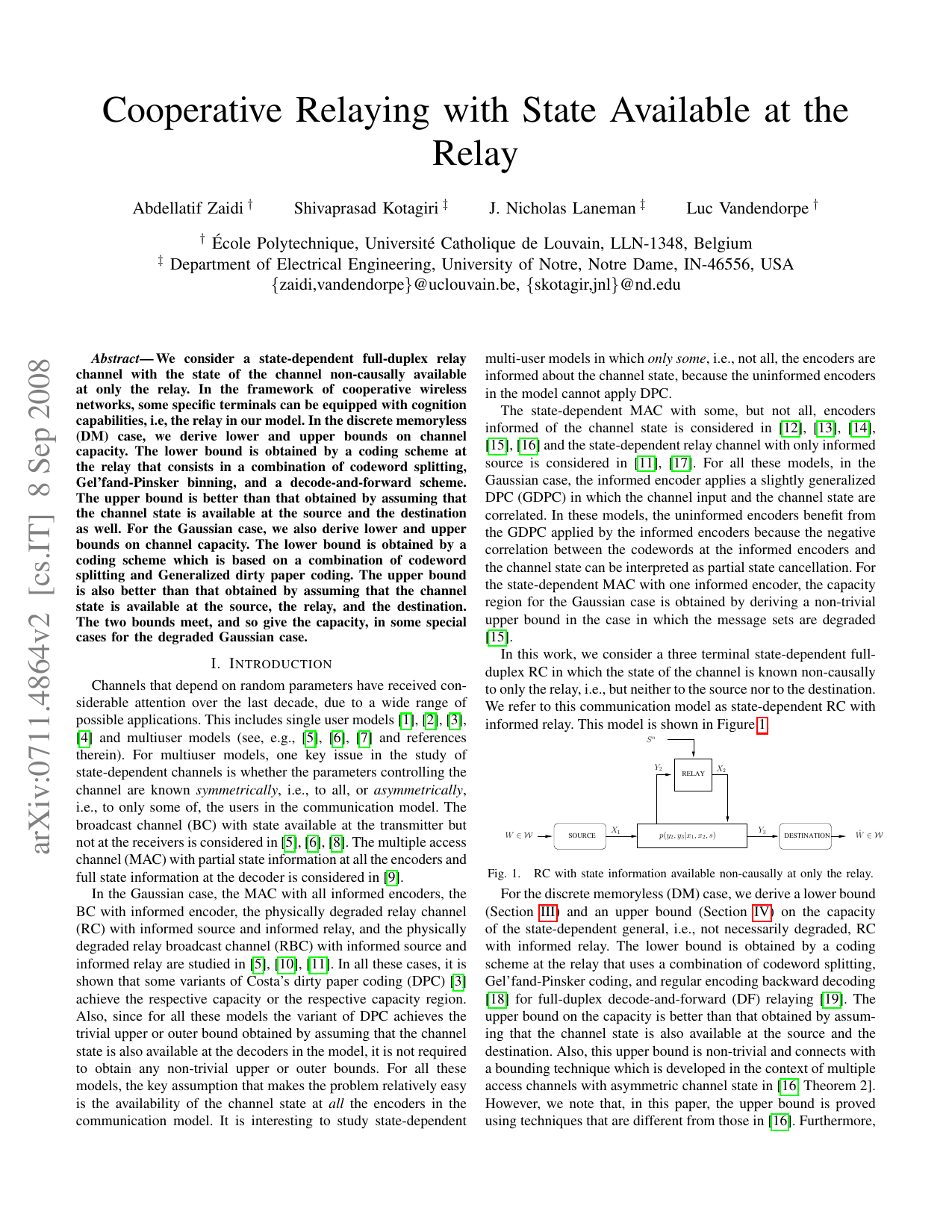
In this work, we consider a three terminal state-dependent fullduplex RC in which the state of the channel is known non-causally to only the relay, i.e., but neither to the source nor to the destination. We refer to this communication model as state-dependent RC with informed relay. This model is shown in Figure 1. For the discrete memoryless (DM) case, we derive a lower bound (Section III) and an upper bound (Section IV) on the capacity of the state-dependent general, i.e., not necessarily degraded, RC with informed relay. The lower bound is obtained by a coding scheme at the relay that uses a combination of codeword splitting, Gel’fand-Pinsker coding, and regular encoding backward decoding [18] for full-duplex decode-and-forward (DF) relaying [19]. The upper bound on the capacity is better than that obtained by assuming that the channel state is also available at the source and the destination. Also, this upper bound is non-trivial and connects with a bounding technique which is developed in the context of multiple access channels with asymmetric channel state in [16,Theorem 2]. However, we note that, in this paper, the upper bound is proved using techniques that are different from those in [16]. Furthermore, we also specialize the results in the DM case to the case in which the channel is physically degraded.
For the Gaussian case (Section V), we derive lower and upper bounds on channel capacity by applying the concepts developed in the DM case to the case in which the CSI is additive Gaussian, i.e., models an additive Gaussian interference, and the ambient noise is additive Gaussian. Furthermore, we point out the loss caused by the asymmetry and show that the lower bound is (in general) close and is tight in a number of special cases if the channel is physically degraded. The key idea for the lower bound is an appropriate code construction which allows the source and the relay to send coherent signals (by enabling correlation between source and relay signals, though only one of the two encoders is informed) and, at the same time, have the source possibly benefit from the availability of the CSI at the relay (through a generalized DPC). Also, we characterize the optimal strategy of the relay balancing the tradeoff betwee
This content is AI-processed based on open access ArXiv data.