We model two temperature viscous accretion flows in the sub-Keplerian, optically thin, regime around rotating black holes including important radiation effects self-consistently. The model successfully explains observed luminosities from ultra-luminous to under-luminous sources and predicts the spin parameter of black holes.
It is well known that the low-hard state of Cyg X-1 can not be explained 1 by the Keplerian accretion disk. 2 Therefore, Eardley, Lightman & Shapiro 3 initiated to model the two temperature hot accretion flow. Later, Muchotrzeb & Paczyński 4 introduced the idea of sub-Keplerian, transonic accretion, which was later improved by other authors, [5][6][7][8] by discussing importance of advection. Most of them introduced various cooling mechanisms, e.g., blackbody, bremsstrahlung, synchrotron, inverse-Compton radiation, appropriately according to their models. However, none of them attempted to understand the variation of cooling/advective efficiency in the flow while infalling towards the black hole. Generally, it is expected that far away from the black hole the flow to be relatively cooler, while in the vicinity of the black hole it is hotter.
We, in the approximation of optically thin two temperature flow, plan to understand how the flow behavior, in the light of advective efficiency, changes while infalling towards a rotating black hole. This successfully explains luminosities of observed low to high luminous sources, in the framework of a single model, which has not been attempted yet. In reproducing the correct luminosity of a source, the present model also predicts the spin parameter of the black hole at the center.
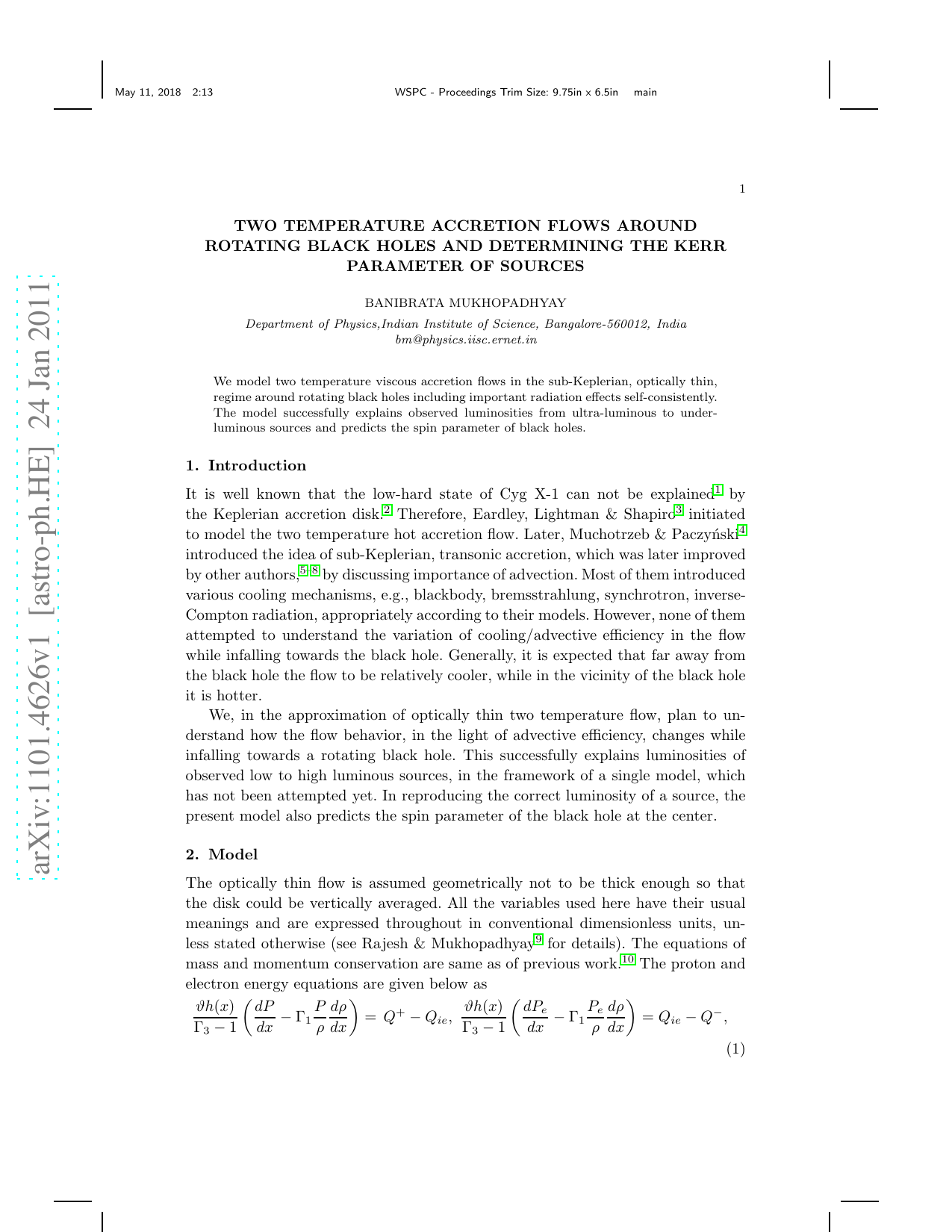
The optically thin flow is assumed geometrically not to be thick enough so that the disk could be vertically averaged. All the variables used here have their usual meanings and are expressed throughout in conventional dimensionless units, unless stated otherwise (see Rajesh & Mukhopadhyay 9 for details). The equations of mass and momentum conservation are same as of previous work. 10 The proton and electron energy equations are given below as ϑh(x)
when the Coulomb coupling Q ie is given by
where n i and n e respectively denote number densities of ion and electron, e the electron charge, ln(Λ) the Coulomb logarithm, and total heat radiated away (Q -) by the bremsstrahlung (q br ), synchrotron (q syn ) processes and inverse Comptonization (q comp ) due to soft synchrotron photons is given by
where
when τ es is the scattering optical depth, ν a is the synchrotron self-absorption cut off frequency. Now following previous work, 9 we solve the set of disk conservation equations to obtain solution. We define a quantity called cooling factor, f , such that
which determines the efficiency of cooling in the flow.
We concentrate on two extreme cases: stellar mass black hole with super-Eddington accretion (StBSupA) and super-massive black hole with sub-Eddington accretion (SuBSubA). While the former describes highly luminous X-ray sources (e.g. SS433), the later is for low luminous AGNs and quasars (e.g. Sgr A * ). For StBSupA, density of the flow is higher than that of SuBSubA, which results in efficient cooling processes therein compared to the later case. As a result the flow is cooler in StBSupA than that in SuBSubA. Hence the difference in temperature between protons and electrons in StBSupA ( < ∼ 10K) is smaller in the former case compared to the later case ( > ∼ 100K). Figure 1 shows that f is very small in StBSupA until very close to the black hole, while in SuBSubA it is very high in most of the inner disk region. However, in either of the cases, flow appears hotter around rotating black holes compared to nonrotating ones. This is because the specific angular momentum of the flow is smaller around rotating black holes compared to nonrotating ones which results in a faster infall and hence low residence time of the flow in the former case which does not allow the cooling processes to complete before the flow impinges into the black hole. It has already been understood that the under-luminous source Sgr A * of mass M = 4.5 × 10 6 accretes in a sub-Eddington accretion rate giving rise to a very low luminosity L ∼ 10 33 erg/sec. Based on our model with ṁ = 10 -5 , 0.05 < ∼ α < ∼ 0.2, 4.9 × 10 32 < ∼ L < ∼ 2.5 × 10 33 only if 0.2 < ∼ a < ∼ 0.5. This argues the black hole to be of intermediate spin.
We have the following punchline out of our two temperature, optically thin, sub-Keplerian accretion disk.
• During infall, the flow governs much lower electron temperature (∼ 10 8-9.5 K) compared to proton temperature (∼ 10 10.2-11.8 K), in the range of accretion rate 10 -2 < ∼ ṁ < ∼ 100. This could explain hard X-rays and γ-rays from AGNs and X-ray binaries.
• Weakly viscous flows are cooling dominated compared to their highly viscous counter part of radiatively inefficient flows.
• The model flows transit from radiatively inefficient phase to cooling dominated phase and vice versa, depending on the system, during infall.
• The model is able to reproduce a wide range of luminosities observed from underfed AGNs and quasars (e.g. Sgr A * ) to highly-luminous X-ray sources (e.g. SS433), as well as highly-luminous quasars (e.g. PKS 0743-67).
• Based on our results Sgr A * appears to be an inter
This content is AI-processed based on open access ArXiv data.