This presentation focuses on differences between quantum computing and quantum cryptography. Both are discussed related to classical computer systems in terms of vulnerability. Research concerning quantum cryptography is analyzed in terms of work done by the University of Cambridge in partnership with a division of Toshiba, and also attacks demonstrated by Swedish researchers against QKD of energy-time entangled systems. Quantum computing is covered in terms of classical cryptography related to weaknesses presented by Shor's algorithm. Previous classical vulnerabilities also discussed were conducted by Israeli researchers as a side-channel attack using parabolic curve microphones, which has since been patched.
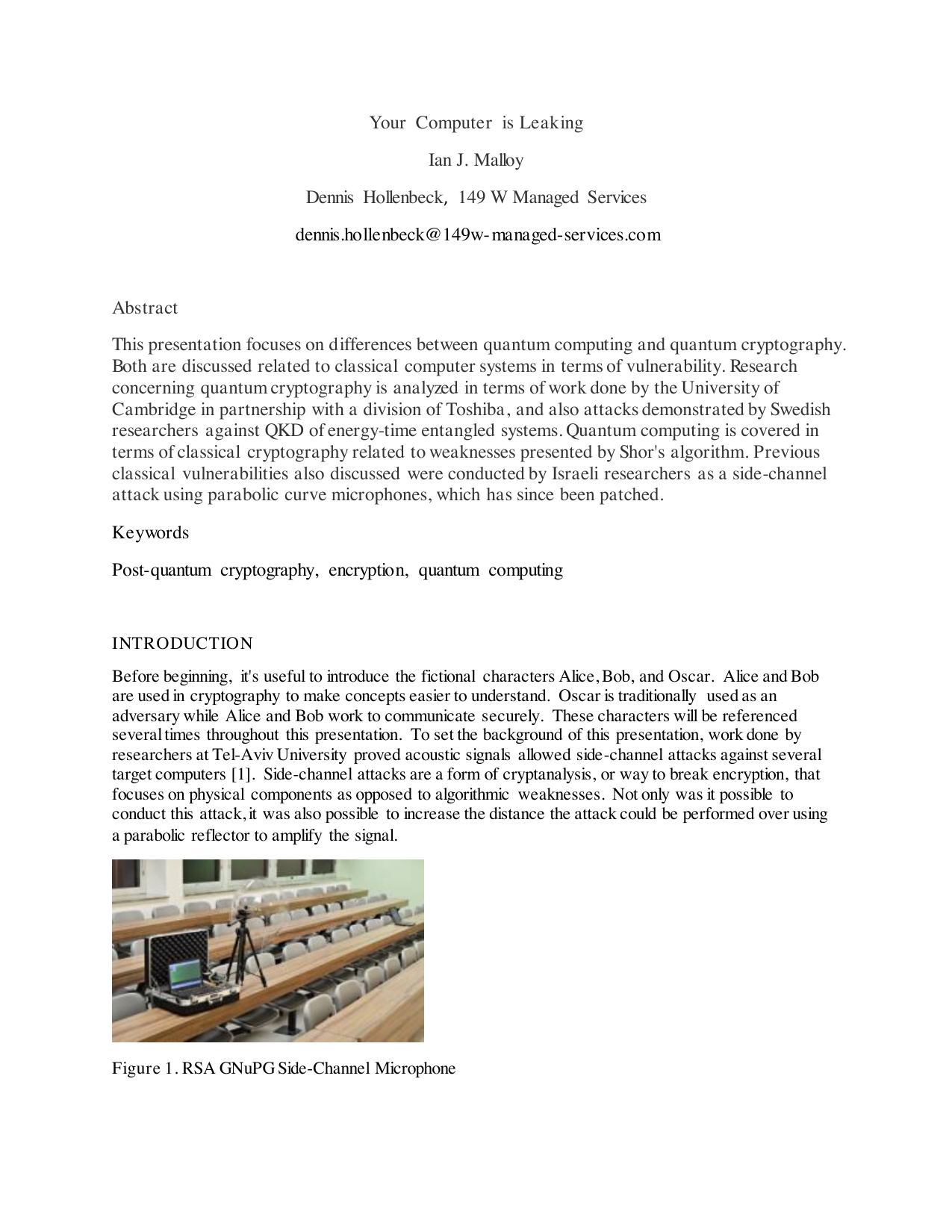
Before beginning, it's useful to introduce the fictional characters Alice, Bob, and Oscar. Alice and Bob are used in cryptography to make concepts easier to understand. Oscar is traditionally used as an adversary while Alice and Bob work to communicate securely. These characters will be referenced several times throughout this presentation. To set the background of this presentation, work done by researchers at Tel-Aviv University proved acoustic signals allowed side-channel attacks against several target computers [1]. Side-channel attacks are a form of cryptanalysis, or way to break encryption, that focuses on physical components as opposed to algorithmic weaknesses. Not only was it possible to conduct this attack, it was also possible to increase the distance the attack could be performed over using a parabolic reflector to amplify the signal.
There was a proclaimed patch issued that fixed this vulnerability, but there are always ways to improve attacks. This research is important to keep in mind because it demonstrates both creative ways to crack encryption and also how radio waves are potentially tied to acoustic signals generated by data processes. This specific attack covered a wide-range of devices but focused on a specific implementation of a specific algorithm. Regardless, the risks are real and have a potential to be increased significantly. Shifting from classical cryptography and communications, there is a strong focus on developing quantum computing and quantum cryptography. Quantum computing is based on the qubit, geometrically represented by a Bloch Sphere, and quantum cryptography which involves quantum key distribution (QKD) to secure communications between Alice and Bob.
The University of Cambridge partnered with a research division of Toshiba and were able to use a combination of “lit” and “dark” telecommunication fibers to effectively use QKD to secure communications [2]. Quantum key distribution is equivalent to a one-time pad but doesn’t require Alice and Bob to physically meet to share keys beforehand. It was assumed that QKD was essentially bullet proof, or that it couldn’t be hacked, since any attempt by Oscar to listen in on Alice and Bob would alert Alice and Bob immediately. Basically Alice and Bob are observing their communications so that if Oscar tried anything it would change measurements that Alice and Bob are conducting on particles. A demonstration of how Oscar can listen to Alice and Bob without triggering changes in measurement of the particles was conducted by researchers towards the end of 2015 [3]. Essentially, it was shown that Oscar could hack Bell’s inequality using classical light sources to spoof the measurements Alice and Bob expected. Bell’s inequality is an expected statistical result that occurs after particles are entangled and then separated. In Quantum Key Distribution, the difference from a one time pad is that QKD doesn’t require a rendezvous between Alice and Bob to exchange keys. The expectation is that once Alice and Bob begin communicating, any attempts by Oscar will spoil the measurements of Alice and Bob.
The weaknesses of discrete logarithm problems and cryptography based upon integer factorization problems become evident when you start to understand what a qubit is able to do computationally. If you think of a classical bit, some form of 0’s or 1’s, and then move to a qubit that can be both 0 and 1 the ability to combine calculations is significantly advanced. If you can keep several qubits in a state of coherence, and each can enter states of superposition to approximate solutions to problems, then breaking certain forms of encryption is simplified.
Disclosures by Edward Snowden revealed an interest of the NSA to actively research the feasibility and requirements to build a quantum computer specifically designed to break encryption [5]. The NSA has also released a notice of adjustments to their Suite-B cryptography which first appeared as a desire to seek post-quantum cryptography in the “not too distant future,” which appears to be now given the move for NIST requesting expert advice. NIST is interested in proposals for new standards in encryption that will survive in a post-quantum world.
Vulnerable cryptography in a post-quantum world shares the same threat in common, Shor’s algorithm. Any system now or in the future that relies on either integer factorization or discrete logarithm problems will be vulnerable to cryptanalysis from quantum computers implementing Shor’s algorithm. There are still issues with controlling enough qubits to factor numbers as large as those used in modern cryptography, and this is a critical challenge for researchers in quantum computing.
While the NSA has been working on establishing the feasibility of a quantum computer to break encryption, whether they succeed or not still raises the question of how they would deploy this type of system. With the move from seeking “in the near future” to the current reques
This content is AI-processed based on open access ArXiv data.