Cosmological and astrophysical observations provide increasing evidence of the existence of dark matter in our Universe. Dark matter particles with a mass above a few GeV can be captured by the Sun, accumulate in the core, annihilate, and produce high energy neutrinos either directly or by subsequent decays of Standard Model particles. We investigate the prospects for indirect dark matter detection in the IceCube/DeepCore neutrino telescope and its capabilities to determine the dark matter mass.
Introduction.-Establishing the particle identity of the dark matter (DM) of the Universe is one of the fundamental questions which needs to be addressed in modern physics [1]. One of the currently favored candidates is a weakly interacting massive particle (WIMP), a stable neutral particle with a mass in the GeV-TeV range, which is predicted in many extensions of the Standard Model of particle physics (SM).
The DM particle properties might be tested in direct and indirect searches and in collider experiments. Direct searches look for the recoil of nuclei due to WIMPs passing through the detector and are sensitive to the spindependent WIMP-proton (-neutron) cross section, σ p(n) SD , and the spin-independent one, σ SI . Indirect searches focus on the products of DM annihilations (or decays), such as gamma-rays, positrons, anti-protons and neutrinos, in regions where the DM density is expected to be high, such as the center of the Milky Way, dwarf galaxies, clusters of galaxies, etc. Colliders could produce DM particles and make possible the study of their properties. In addition to each individual search, their combination is crucial in constraining DM properties [2][3][4][5][6]. In particular, the determination of the DM mass is of great theoretical importance in order to establish the DM particle identity but it is a challenging task.
One of the astrophysical objects of particular interest for indirect searches is the Sun as a high DM density could be present: DM particles, traversing it, can get scattered to velocities lower than the escape velocity and be captured. The annihilations of these DM particles would give rise to a neutrino flux, which is produced either directly or indirectly via the decay of other products of the annihilations. Depending on the annihilation channel, the neutrino energy is different: neutrinos from particles which decay very fast have typically high energies and longer lived particles, such as muons and light quarks, significantly loose energy before decaying and produce softer neutrinos [2]. Therefore, the neutrino spectrum depends on several DM properties, such as its mass, the DM-nucleon cross section and the branching ratios for the various possible annihilation channels.
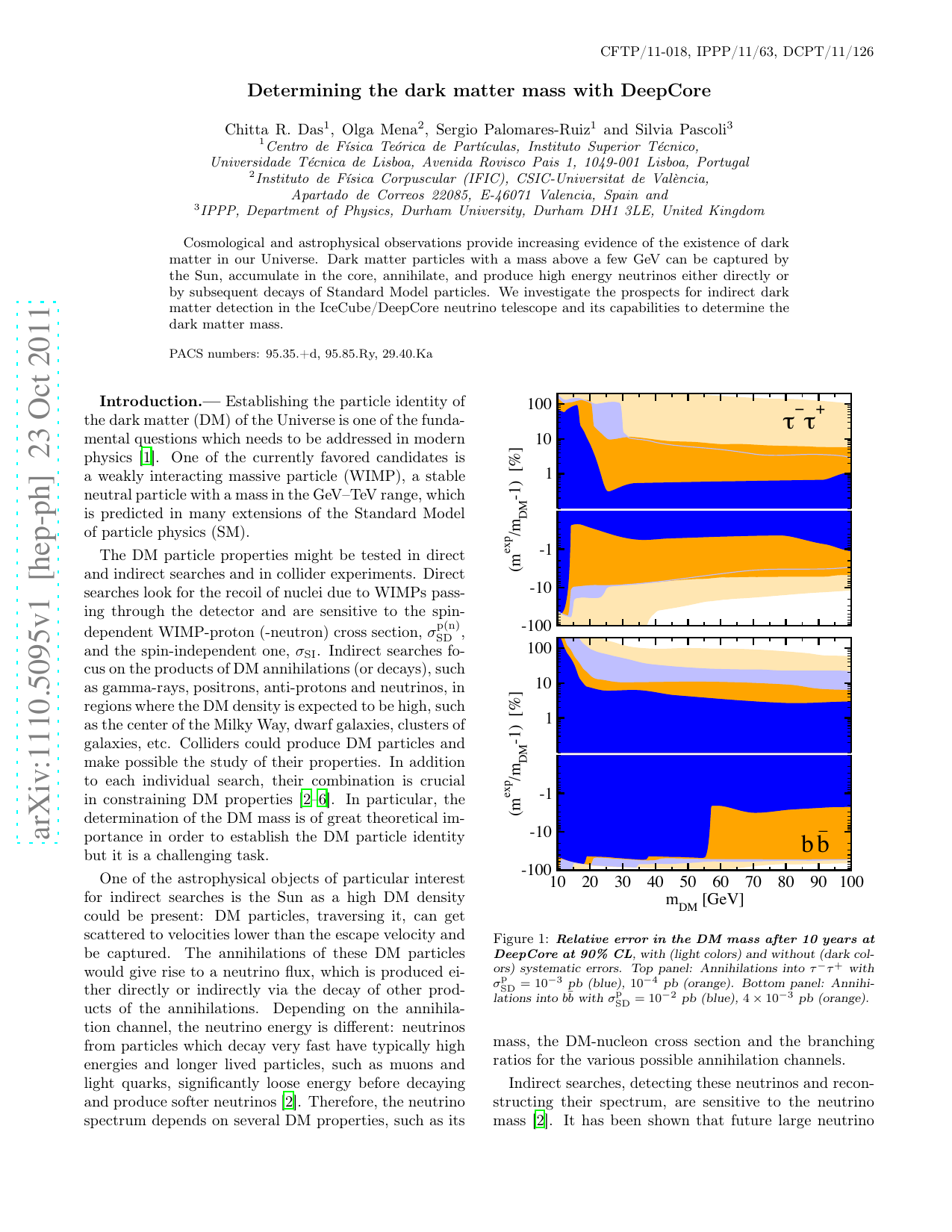
Indirect searches, detecting these neutrinos and reconstructing their spectrum, are sensitive to the neutrino mass [2]. It has been shown that future large neutrino detectors with good energy resolution, such as magnetized iron detectors, could measure the neutrino spectrum [7,8]. However, so far, no simulation of this effect in a neutrino telescope has been performed. These very large detectors cannot fully reconstruct the neutrino energy but measure the neutrino-induced muon spectrum, which is strongly correlated with the neutrino one. Here, we show for the first time (see Fig. 1) that, by studying the neutrino-induced muon energy spectrum, the Deep-Core Array [9], a huge compact Čerenkov detector located at the bottom center of the IceCube Neutrino Telescope, could reach an excellent precision in determining the DM mass. This detector extends the IceCube neutrino detection capabilities to neutrino energies as low as 10 GeV allowing to study low mass WIMPs with a detector with a huge effective volume, O(10) Mton.
Neutrinos from WIMPs annihilations in the Sun.-When a DM particle with a mass above a few GeV passes through the Sun, it might interact elastically with the nuclei and get scattered to a velocity smaller than the escape velocity, remaining gravitationally trapped. Then it undergoes additional scatterings, settling in the Sun core, giving rise to an isothermal distribution. For sufficiently high capture rate and annihilation cross section, equilibrium is reached and the annihilation rate Γ ann is related to the capture rate C ⊙ as [7,10]
where ρ local is the local DM density, vlocal is the DM velocity dispersion in the halo and σ is the DM-nucleon cross section. The spin-independent scattering cross section is very strongly constrained by direct searches [11] and hence, at the energies of interest, only signals due to a large spin-dependent cross section could be tested with neutrino telescopes. In many extensions of the SM the spin-dependent cross section can dominate, even by several orders of magnitude [12]. The current most stringent bounds on the WIMP-proton elastic scattering cross section, σ p SD , are provided by the SIMPLE experiment [13], whose Stage 1 and 2 combined results (only Stage 1 revised results) yield a lower limit with a minimum of σ p SD < 4.2 (8.3)×10 -3 pb at m DM = 35 GeV. This limit is already competitive with the indirect ones obtained from the non-observation of neutrinos from DM annihilations in the Sun at the Super-Kamiokande detector [14,15].
The DM accumulated in the Sun can annihilate into SM particles. Nevertheless, due to the absorption in the solar matter, among all the SM products of annihilations, only neutrinos can escape. Neutrinos could be produced
This content is AI-processed based on open access ArXiv data.