The ability of cells to undergo reversible shape changes is often crucial to their survival. For Red Blood Cells (RBCs), irreversible alteration of the cell shape and flexibility often causes anemia. Here we show theoretically that RBCs may react irreversibly to mechanical perturbations because of tensile stress in their cytoskeleton. The transient polymerization of protein fibers inside the cell seen in sickle cell anemia or a transient external force can trigger the formation of a cytoskeleton-free membrane protrusion of micrometer dimensions. The complex relaxation kinetics of the cell shape is shown to be responsible for selecting the final state once the perturbation is removed, thereby controlling the reversibility of the deformation. In some case, tubular protrusion are expected to relax via a peculiar "pearling instability".
The ability of cells to undergo reversible shape changes is often crucial to their survival. For Red Blood Cells (RBCs), irreversible alteration of the cell shape and flexibility often causes anemia.
Here we show theoretically that RBCs may react irreversibly to mechanical perturbations because of tensile stress in their cytoskeleton. The transient polymerization of protein fibers inside the cell seen in sickle cell anemia or a transient external force can trigger the formation of a cytoskeleton-free membrane protrusion of µm dimensions. The complex relaxation kinetics of the cell shape is shown to be responsible for selecting the final state once the perturbation is removed, thereby controlling the reversibility of the deformation. In some case, tubular protrusion are expected to relax via a peculiar “pearling instability”.
Red Blood Cells (RBCs) have been extensively studied by physicists as a relatively simple example of biological cells [1,2]. Their mechanical properties reflect the structure of the cell interface, including the (fluid) plasma membrane (PM) and the cytoskeleton (CSK), a two-dimensional network of flexible spectrin filaments connected to the membrane through node complexes [1]. This composite mechanics is responsible for a remarkable variety of equilibrium shape (stomatocyte-discocyteechinocyte) [2,3]. RBCs also exhibit a complex dynamical response to mechanical stress, characterized by viscoelasticity, and plastic deformation at high strain [4,5]. Some RBCs undergo major deformation during the respiratory cycle, and it appears important to understand the extent to which such large deformation might be reversible. In sickle-cell anemia, a mutation in the hemoglobin (Hg) gene leads to the formation of Hg fibers inside the cell and results in sickle shaped cells [6]. The fibers depolymerize in the lung because of oxygen intake, but polymerize again as oxygen is released. The cells loose their flexibility and may obstruct small blood capillaries, with serious medical consequences [7]. Unpublished observations suggest that in some case, rapid fiber depolymerization produces a large membrane bleb that fails to reincorporate the cell [8]. A (very) long membrane tether extracted from a RBC by a external force (e.g applied by optical tweezers) may also sometimes fail to retract into the cell when the force is switched off [9]. Such events, if they occurred in-vivo, could lead to repeated loss of cell membrane area and considerably shorten the lifetime of RBCs.
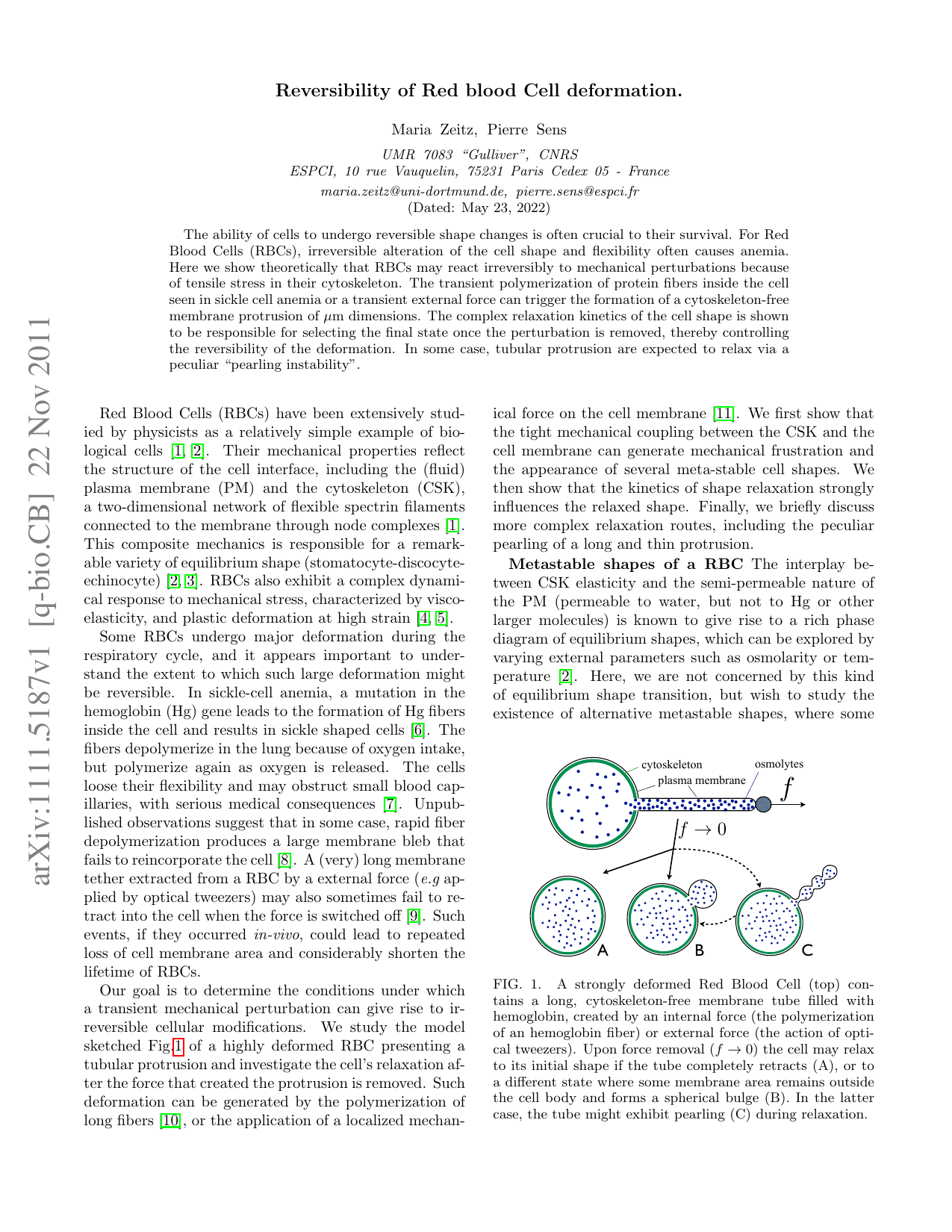
Our goal is to determine the conditions under which a transient mechanical perturbation can give rise to irreversible cellular modifications. We study the model sketched Fig. 1 of a highly deformed RBC presenting a tubular protrusion and investigate the cell’s relaxation after the force that created the protrusion is removed. Such deformation can be generated by the polymerization of long fibers [10], or the application of a localized mechan-ical force on the cell membrane [11]. We first show that the tight mechanical coupling between the CSK and the cell membrane can generate mechanical frustration and the appearance of several meta-stable cell shapes. We then show that the kinetics of shape relaxation strongly influences the relaxed shape. Finally, we briefly discuss more complex relaxation routes, including the peculiar pearling of a long and thin protrusion.
Metastable shapes of a RBC The interplay between CSK elasticity and the semi-permeable nature of the PM (permeable to water, but not to Hg or other larger molecules) is known to give rise to a rich phase diagram of equilibrium shapes, which can be explored by varying external parameters such as osmolarity or temperature [2]. Here, we are not concerned by this kind of equilibrium shape transition, but wish to study the existence of alternative metastable shapes, where some
plasma membrane cytoskeleton osmolytes FIG. 1. A strongly deformed Red Blood Cell (top) contains a long, cytoskeleton-free membrane tube filled with hemoglobin, created by an internal force (the polymerization of an hemoglobin fiber) or external force (the action of optical tweezers). Upon force removal (f → 0) the cell may relax to its initial shape if the tube completely retracts (A), or to a different state where some membrane area remains outside the cell body and forms a spherical bulge (B). In the latter case, the tube might exhibit pearling (C) during relaxation.
membrane separates from the cell body, or fail to reincorporate it when extracted. For this purpose, we assume that the reference state for the cell is a simple sphere of volume V, and that the total cell volume remains constant during shape transformation (we have check that relaxing this constraint does not alter our results). The elastic energy of the reference state includes contribution for the elastic energy of the CSK (assumed quadratic: = K c (S -S 0 ) 2 /2S 0 , with a stiffness K c and a reference area S 0 , and where S = (36π) 1/3 V
This content is AI-processed based on open access ArXiv data.