A 2-component $mu$-Hunter-Saxton equation
📝 Original Info
- Title: A 2-component $mu$-Hunter-Saxton equation
- ArXiv ID: 1010.4454
- Date: 2015-05-20
- Authors: ** 논문에 명시된 저자 정보가 제공되지 않았습니다. (원문에 저자 명단이 포함되어 있지 않음) **
📝 Abstract
In this paper, we propose a two-component generalization of the generalized Hunter-Saxton equation obtained in \cite{BLG2008}. We will show that this equation is a bihamiltonian Euler equation, and also can be viewed as a bi-variational equation.💡 Deep Analysis
📄 Full Content
Let D(S 1 ) be a group of orientation preserving diffeomorphisms of the circle and G = D(S 1 ) ⊕ R be the Bott-Virasoro group. In [6], Ovsienko and Khesin showed that the KdV equation is an Euler equation, describing a geodesic flow on G with respect to a right invariant L 2 metric. Another interesting example is the Camassa-Holm equation, which was originally derived in [4] as an abstract equation with a bihamiltonian structure, and independently in [9] as a shallow water approximation. In [10], Misiolek showed that the Camassa-Holm equation is also an Euler equation for a geodesic flow on G with respect to a right-invariant Sobolev H 1 -metric.
In [13], Khesin and Misiolek extended the Arnold’s approach to homogeneous spaces and provided a beautiful geometric setting for the Hunter-Saxton equation, which firstly appeared in [8] as an asymptotic equation for rotators in liquid crystals, and its relatives. They showed that the Hunter-Saxton equation is an Euler equation describing the geodesic flow on the homogeneous spaces of the Bott-Virasoro group G modulo rotations with respect to a right invariant homogeneous Ḣ1 metric. Furthermore, by using extended Bott-Virasoro groups, Guha etc. [11,16,21] generalized the above results to two-component integrable systems, including several coupled KdV type systems and 2-component peak type systems, especially 2component Camassa-Holm equation which was introduced by Chen, Liu and Zhang [17] and independently by Falqui [18]. Another interesting topic is to discuss the super or supersymmetric analogue, see [6,12,16,20,23,24] and references therein.
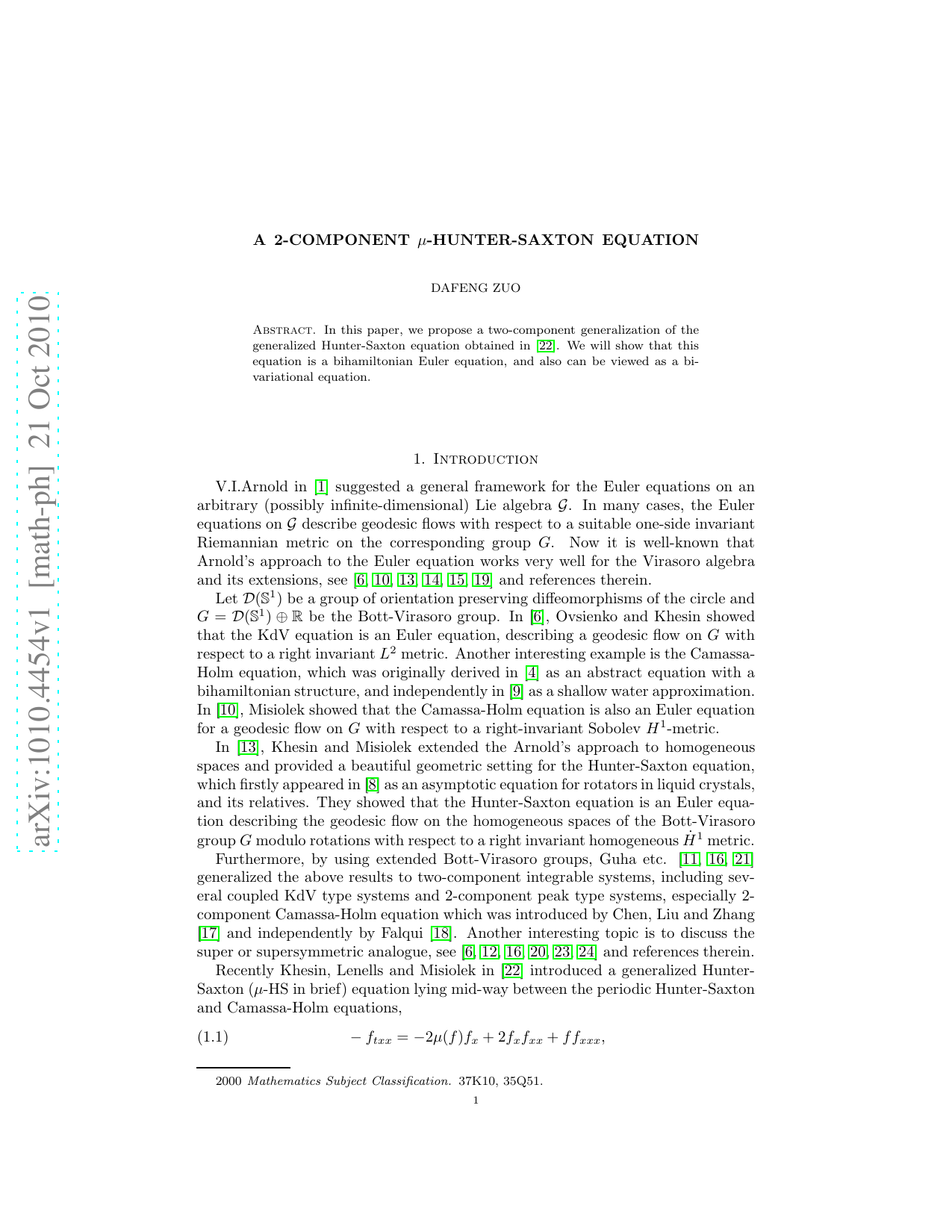
Recently Khesin, Lenells and Misiolek in [22] introduced a generalized Hunter-Saxton (µ-HS in brief) equation lying mid-way between the periodic Hunter-Saxton and Camassa-Holm equations, (1.1) -
where f = f (t, x) is a time-dependent function on the unit circle S 1 = R/Z and µ(f ) = S 1 f dx denotes its mean. This equation describes evolution of rotators in liquid crystals with external magnetic field and self-interaction. Let D s (S 1 ) be a group of orientation preserving Sobolev H s diffeomorphisms of the circle. They proved that the µ-HS equation (1.1) describes a geodesic flow on D s (S 1 ) with a right-invariant metric given at the identity by the inner product
They also showed that (1.2) is bihamiltonian and admits both cusped as well as smooth traveling-wave solutions which are natural candidates for solitons. In this paper, we want to generalize these to a two-component µ-HS (2-µHS in brief) equation. Our main object is the Lie algebra G = Vect s (S 1 ) ⋉ C ∞ (S 1 ) and its three-dimensional central extension G. Firstly, we introduce an inner product on G given by
where γ j ∈ R, j = 1, 2, 3.
Actually from the geometric view, if we extend the inner product (1.3) to a left invariant metric on G = D s (S 1 ) ⋉ C ∞ (S 1 ) ⊕ R 3 , we could view the 2-µHS equation (1.4) as a geodesic flow on G with respect to this left invariant metric. Obviously, if we choose v = 0 and γ j = 0, j = 1, 2, 3 and replace t by -t, (1.4) reduces to (1.1). Furthermore, we show that This paper is organized as follows. In section 2, we calculate the Euler equation on G * reg . In section 3, we study the Hamiltonian nature and the Lax pair of the 2-µHS equation (1.4). Section 4 is devoted to discuss the variational nature of (1.4). In the last section we describe the interrelation between bihamiltonian natures and bi-variational natures.
Let D s (S 1 ) be a group of orientation preserving Sobolev H s diffeomorphisms of the circle and let T id D s (S 1 ) be the corresponding Lie algebra of vector fields, denoted by Vect s (S 1 ) = {f (x) d dx |f (x) ∈ H s (S 1 )}. The main objects in our paper will be the group D s (S 1 )⋉C ∞ (S 1 ), its Lie algebra G = Vect s (S 1 ) ⋉ C ∞ (S 1 ) with the Lie bracket given by
and their central extensions. It is well known in [3,7] that the algebra G has a three dimensional central extension given by the following nontrivial cocycles
). Notice that the first cocycle ω 1 is the well-known Gelfand-Fuchs cocycle [2,5]. The Virasoro algebra V ir = Vect s (S 1 ) ⊕ R is the unique non-trivial central extension of Vect s (S 1 ) via the Gelfand-Fuchs cocycle ω 1 . Sometimes we would like to use the modified Gelfand-Fuchs cocycle
which is cohomologeous to the Gelfand-Fuchs cocycle ω 1 , where c 1 , c 2 ∈ R.
Definition 2.1. The algebra G is an extension of G defined by
with the commutation relation
) ⊕ R 3 denote the regular part of the
📸 Image Gallery