Title: Decoherence and Ontology, or: How I Learned To Stop Worrying And Love FAPP
ArXiv ID: 1111.2189
Date: 2015-02-02
Authors: Sean M. Carroll —
📝 Abstract
I make the case that the Universe according to unitary (no-collapse) quantum theory has a branching structure, and so can literally be regarded as a "many-worlds" theory. These worlds are not part of the fundamental ontology of quantum theory - instead, they are to be understood as structures, or patterns, emergent from the underlying theory, through the dynamical process of decoherence. That they are structures in this sense does not mean that they are in any way unreal: indeed, pretty much all higher-level ontology in science, from tables to phonons to tigers, is likewise emergent. Unitary quantum theory is therefore a "many-worlds" theory without any modification of the mathematical structure of the theory: the Everett interpretation does not consist in adding worlds to the formalism, but in realising that they are there already. Our grounds for accepting the reality of those worlds is no more, but no less, than our grounds for accepting any other not-directly observable consequence of an empirically very successful theory.
💡 Deep Analysis
📄 Full Content
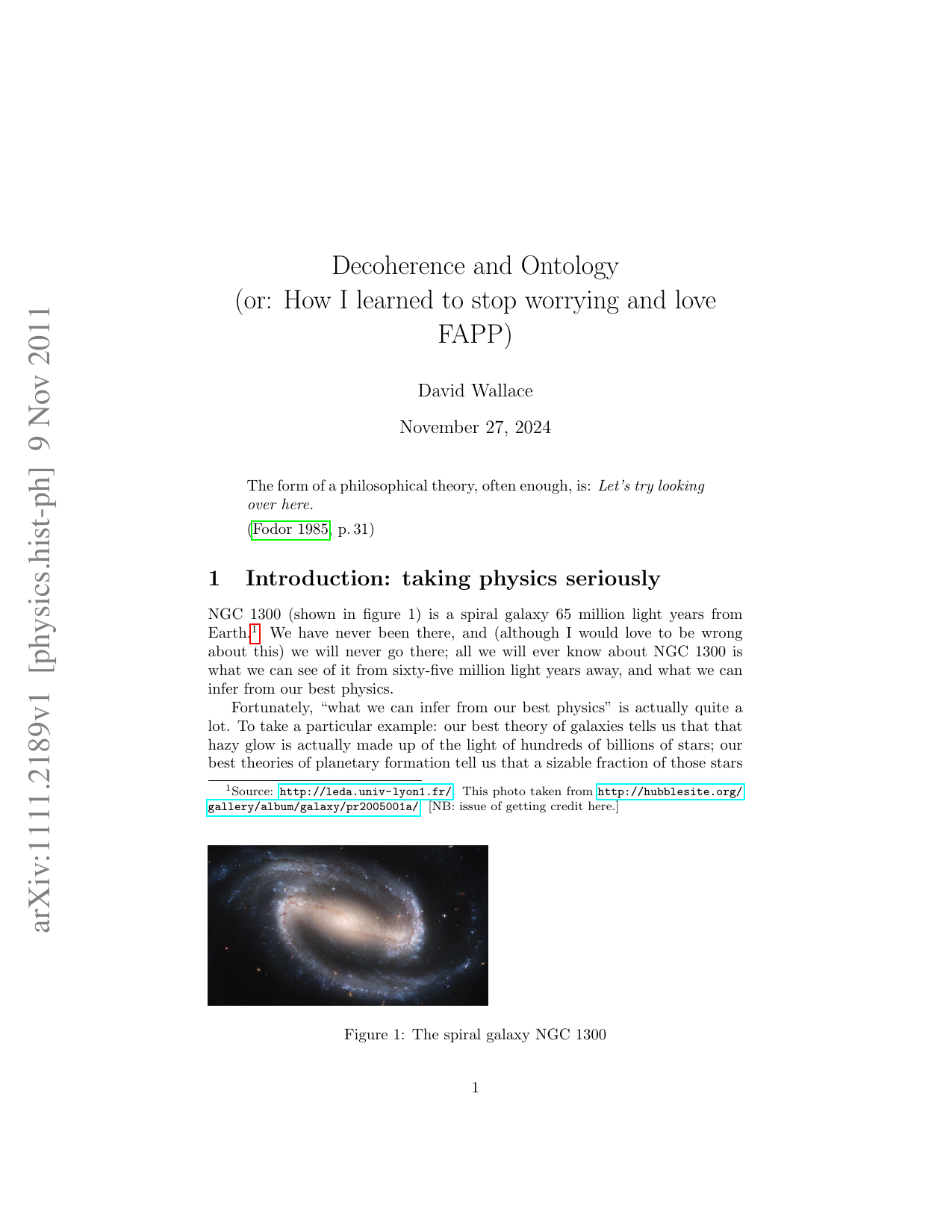
1 Introduction: taking physics seriously NGC 1300 (shown in figure 1) is a spiral galaxy 65 million light years from Earth. 1 We have never been there, and (although I would love to be wrong about this) we will never go there; all we will ever know about NGC 1300 is what we can see of it from sixty-five million light years away, and what we can infer from our best physics.
Fortunately, “what we can infer from our best physics” is actually quite a lot. To take a particular example: our best theory of galaxies tells us that that hazy glow is actually made up of the light of hundreds of billions of stars; our best theories of planetary formation tell us that a sizable fraction of those stars 1 Source: http://leda.univ-lyon1.fr/
. This photo taken from http://hubblesite.org/
gallery/album/galaxy/pr2005001a/. [NB: issue of getting credit here.]
Figure 1: The spiral galaxy NGC 1300 have planets circling them, and our best theories of planetology tells us that some of those planets have atmospheres with such-and-such properties. And because I think that those “best theories” are actually pretty good theories, I regard those inferences as fairly reliable. That is: I think there actually are atmospheres on the surfaces of some of the planets in NGC 1300, with pretty much the properties that our theories ascribe to them. That is: I think that those atmospheres exist. I think that they are real. I believe in them. And I do so despite the fact that, at sixty-five million light years’ distance, the chance of directly observing those atmospheres is nil.
I present this example for two reasons. The first is to try to demystifydeflate, if you will -the superficially “philosophical” -even “metaphysical” -talk that inevitably comes up in discussions of “the ontology of the Everett interpretation”. Talk of “existence” and “reality” can sound too abstract to be relevant to physics (talk of “belief” starts to sound downright theological!) but in fact, when I say that “I believe such-and-such is real” I intend to mean no more than that it is on a par, evidentially speaking, with the planetary atmospheres of distant galaxies.
The other reason for this example brings me to the main claim of this paper. For the form of reasoning used above goes something like this: we have good grounds to take such-and-such physical theory seriously; such-and-such physical theory, taken literally, makes such-and-such ontological claim; therefore, suchand-such ontological claim is to be taken seriously. 2Now, if the mark of a serious scientific theory is its breadth of application, its explanatory power, its quantitative accuracy, and its ability to make novel predictions, then it is hard to think of a theory more “worth taking seriously” than quantum mechanics. So it seems entirely apposite to ask what ontological claims quantum mechanics makes, if taken literally, and to take those claims seriously in turn.
And quantum mechanics, taken literally, claims that we are living in a multiverse: that the world we observe around us is only one of countless quasi-classical universes (“branches”) all coexisting. In general, the other branches are no more observable than the atmospheres of NGC 1300’s planets, but the theory claims that they exist, and so if the theory is worth taking seriously, we should take the branches seriously too. To belabour the point:
According to our best current physics, branches are real.
Everett was the first to recognise this, but for much of the ensuing fifty years it was overlooked: Everett’s claim to be “interpreting” existing quantum mechanics, and de Witt’s claim that “the quantum formalism is capable of yielding its own interpretation” were regarded as too simplistic, and much discussion on the Everett interpretation (even that produced by advocates such as Deutsch (1985)) took as read that the “preferred basis problem” -the question of how the “branches” were to be defined -could be solved only by adding something additional to the theory. Sometimes that “something” was additional physics, adding a multiplicity of worlds to the unitarily-evolving quantum state (Deutsch (1985), Bell (1981), Barrett (1999)). Sometimes it was a purpose-built theory of consciousness: the so-called “many-minds theories” (Lockwood (1989), Albert and Loewer (1988)). But whatever the details, the end result was a replacement of quantum mechanics by a new theory, and furthermore a new theory constructed specifically to solve the quantum measurement problem. No wonder interest in such theories was limited: if the measurement problem really does force us to change physics, hidden-variables theories like the de Broglie-Bohm theory3 or dynamical-collapse theories like the GRW theory4 seem to offer less extravagantly science-fictional options.
It now seems to be widely recognised that if Everett’s idea really is worth taking seriously, it must be taken on Everett’s own terms: as an understanding of what (unitary) quantum mechanics already claims,