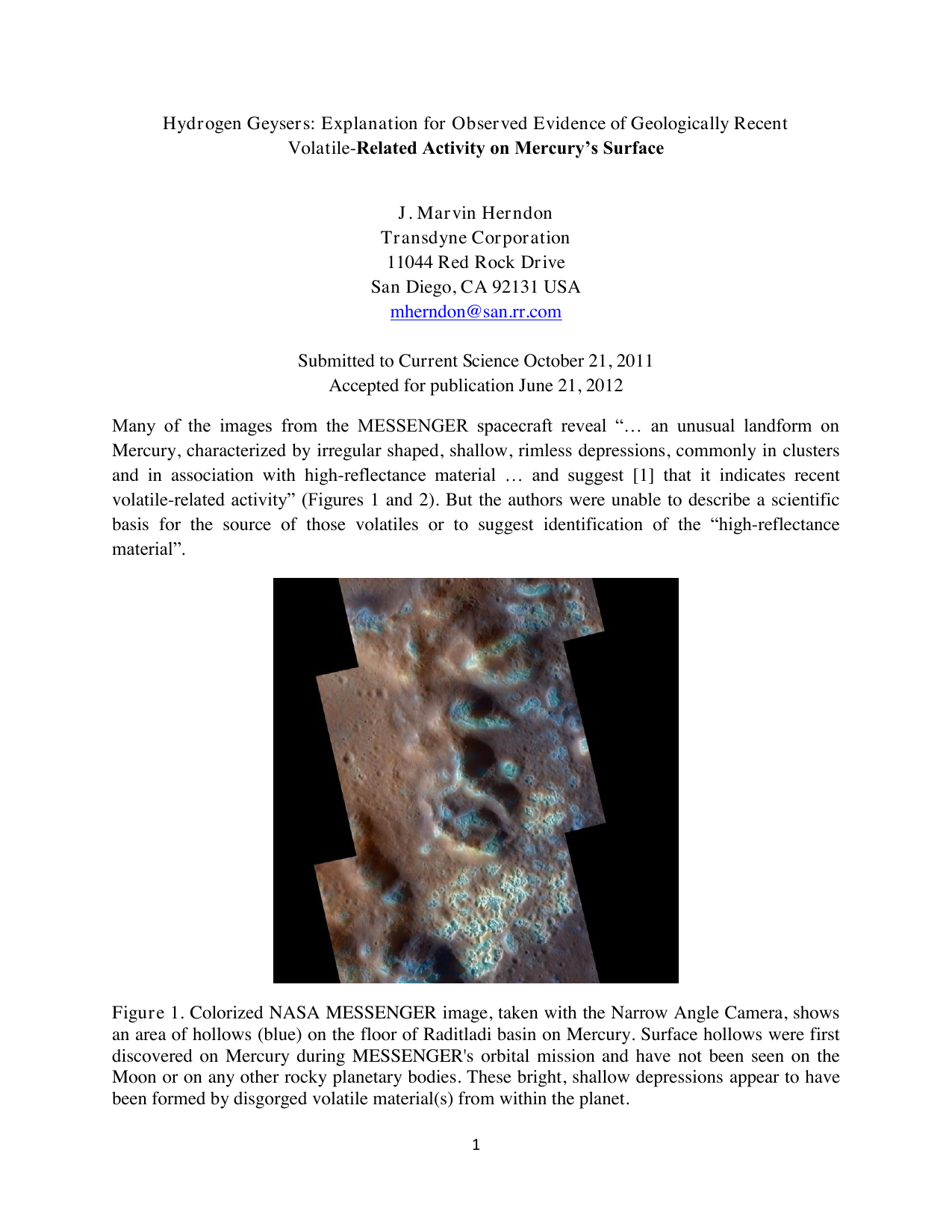
High resolution images of Mercury's surface, from the MESSENGER spacecraft, reveal many bright deposits associated with irregular, shallow, rimless depressions whose origins were attributed to volatile-related activity, but absent information on the nature and origin of that volatile matter. Here I describe planetary formation, unlike the cited models, and show that primordial condensation from an atmosphere of solar composition at pressures of one atmosphere or above will lead to iron condensing as a liquid and dissolving copious amounts of hydrogen, which is subsequently released as Mercury's core solidifies and escapes from the surface, yielding the observed pit-like features with associated highly-reflecting matter. The exiting hydrogen chemically reduces some iron compound, probably iron sulfide, to the metal, which accounts for the bright deposits.
I agree with the authors' interpretation of volatile activity being responsible forming those "unusual landforms" and agree that "…Mercury's interior contains higher abundances of volatile elements than are predicted by several planetary formation models for the innermost planet." Here I describe a basis of planetary formation, not considered by the authors and unlike their cited models, and show that primordial condensation from an atmosphere of solar composition at pressures of one atmosphere or above leads to the incorporation of copious amounts of hydrogen in Mercury's core, much of which is released as the core solidifies. The release of hydrogen escaping at the surface, I posit, is responsible for the formation of said "unusual landform on Mercury", sometimes referred to as pits, and for the formation of the associated "highreflectance material", bright spots, which I suggest is iron metal reduced from an iron compound, probably iron sulfide, by the escaping hydrogen.
Thermodynamic considerations led Eucken [2] to conceive of Earth formation from within a giant, gaseous protoplanet where molten-iron rained out to form the core, followed by the condensation of the silicate-rock mantle. By similar, extended calculations I verified Eucken’s results and deduced that oxygen-starved, highly-reduced matter characteristic of enstatite chondrites and, by inference, also the Earth’s interior (Table 1), condensed at high temperatures and high pressures from primordial Solar System gas under circumstances that isolated the condensate from further reaction with the gas at low temperatures [3,4], circumstances that I extend here to planet Mercury.
Ideally, in a cooling atmosphere of solar composition, iron starts to condense when the partial pressure of iron gas exceeds the vapor pressure of iron metal [5], P V (Fe), according to
Where the A’s are primordial elemental abundance ratios [6] and the pressure of hydrogen gas, H 2, is approximately equal to the total pressure. Thus, at higher H 2 -pressures, iron can condense at higher temperatures, even the temperatures at which iron is liquid. Hydrogen is readily soluble in molten iron, where for an ideal solution, the solubility of hydrogen, C H , in mL per 100 g. of iron is given by [7] lnC H = 5.482-4009/T+½ ln [ P(H 2 )/P(reference= 1 atm.) ]
The solid curve in Figure 3 shows the range of temperatures and pressures at which molten iron will ideally begin to condense from an atmosphere of primordial (solar) composition, calculated from equation ( 1). The dashed curve in Figure 3 shows the amount of hydrogen that could ideally dissolve in Mercury’s molten iron (estimated at one-half Mercury’s mass) in equilibrium with primordial hydrogen gas, calculated at points along the solid curve and expressed as volume of dissolved H 2 at STP [standard temperature and pressure, 293K, 1 atm.] relative to the volume of planet Mercury. These calculations are not intended to model Mercury’s formation; too many unknowns are involved for precise determinations, such which alloying elements enhance or deenhance gas solubility, or which precise range of temperatures might be involved. Rather, the calculations are intended to illustrate within a broad range of conditions that planetary condensation at H 2 -pressures of one atmosphere or above can lead to copious amounts of hydrogen incorporated in Mercury’s core, which as it subsequently solidifies, will be released.
The release of dissolved hydrogen during Mercury’s core solidification is, by Figure 3, certainly sufficient in amount to account for the “unusual landform” on Mercury’s surface and is possibly involved in the exhalation of iron sulfide, which is abundant on the planet’s surface, and some of which may have been reduced to iron metal thus accounting for the associated “high-reflectance material”, bright spots. So, here is a test. Proving that the “high-reflectance material” is indeed metallic iron will provide strong evidence that the exhausted gas is hydrogen and evidence of the basis of planetary formation at pressures at or above about one atmosphere as described here; a negative result, however, would not disprove hydrogen disgorgement and might suggest the highly reflective material is enstatite, MgSiO 3 .
I have suggested that only three processes, operant during the formation of the Solar System, are primarily responsible for the diversity of matter in the Solar System and are directly responsible for planetary internal compositions and structures [3]. These are: (i) High-pressure, hightemperature condensation from primordial matter associated with planetary-formation by raining out from the interiors of giant-gaseous protoplanets; (ii) Low-pressure, low-temperature condensation from primordial matter in the remote reaches of the Solar System or in the interstellar medium; and, (iii) Stripping of the primordial volatile components from the inner portion of the Solar System by super-intense T-Tauri phase outburs
This content is AI-processed based on open access ArXiv data.