We report on the discovery of two gamma-ray sources at E > 200 GeV with VERITAS: RX J0648.7+1516 and VER J0521+211. Both sources are located at low galactic latitudes (|b| < 10 deg), and were previously classified as active galactic nuclei of unknown type. The discovery and characterization of gamma-ray emission together with follow-up optical spectroscopy permitted the identification of RX J0648.7+1516 and VER J0521+211 as BL Lac-type blazars. In the case of RX J0648.7+1516, a spectroscopic redshift of z = 0.179 was derived.
Blazars are active galactic nuclei (AGN) hosting supermassive black holes, with relativistic jets pointing along the line of sight to the observer. The small viewing angle of the jet makes it possible to observe strong relativistic effects, such as a boosting of the emitted power and a shortening of the characteristic time scales. Blazars are typically identified through radio and optical surveys, being radio loudness, flat spectrum and compact morphology in the radio band, some degree of optical polarization, and fast, large amplitude variability their defining observational characteristics. Close to the Galactic plane (|b| < ∼ 10 • ), diffuse radio emission and confusion with local radio sources make candidate blazars difficult to select. Heavy optical extinction due to interstellar dust [1] further complicates spectroscopical identification of blazars at low latitudes. These observational challenges give us only a fragmentary knowledge of the blazar population in the galactic plane a region. Several blazar catalogs directly avoid galactic latitudes in order not to deal with the inevitable incompleteness of radio and optical surveys in the region [e.g., 2,3,4].
A fraction of blazars are detected in the gamma-ray band. The second catalog of Fermi-detected AGNs [2LAC, 5] identifies 861 blazars in the energy band between 100 MeV and 300 GeV. In the very high energy range (VHE, E > 100 GeV), ground-based imaging atmospheric Cherenkov telescopes (IACTs) have detected 43 blazars so far [6]. Gamma-rays do not suffer from significant absorption at low galactic latitudes. Even if the gamma-ray diffuse emission is brighter close to the galactic plane, observations in the gamma-ray band have shown to be a successful tool to identify blazars located behind the Galactic plane, which are heavily absorbed at other wavelengths. Two low-latitude blazars were discovered by association with EGRET sources [7,8,9]. More recently, associations with unidentified Fermi-LAT sources have led to the identification of new blazars located behind the galactic plane [10,11,12].
Identifications, blazar counterparts are found for 102 Fermi-LAT sources at |b| < ∼ 10 • in 2LAC. In the VHE band, MAGIC J2001+435 [13] and HESS J1943+213 [14] are recent examples of the capability of groundbased IACTs to reveal new blazars shining through the galactic plane by their gamma-ray emission.
This proceedings report the VHE detection of two low-latitude gamma-ray-emitting blazars with VERI-TAS: RX J0648.7+1516 and VER J0521+211. VER-ITAS [15] is an array of four imaging atmospheric Cherenkov telescopes located at the Fred Lawrence Whipple Observatory (FLWO) in southern Arizona (31 40 N, 110 57 W, 1.3 km a.s.l.). It combines a large effective area over a wide range of energies (100 GeV to 30 TeV) with an energy resolution of 15-25% and an angular resolution of less that 0.1 • . The high sensitivity of VERITAS allows the detection of sources with a flux of 0.01 times that of the Crab Nebula in about 25 hours. The standard VERITAS analysis methods are described in [16,17]. A more detailed description of the gamma-ray detections of RX J0648.7+1516 and VER J0521+211 together with a complete multi wavelength characterization can be found in [18, 19, respectively].
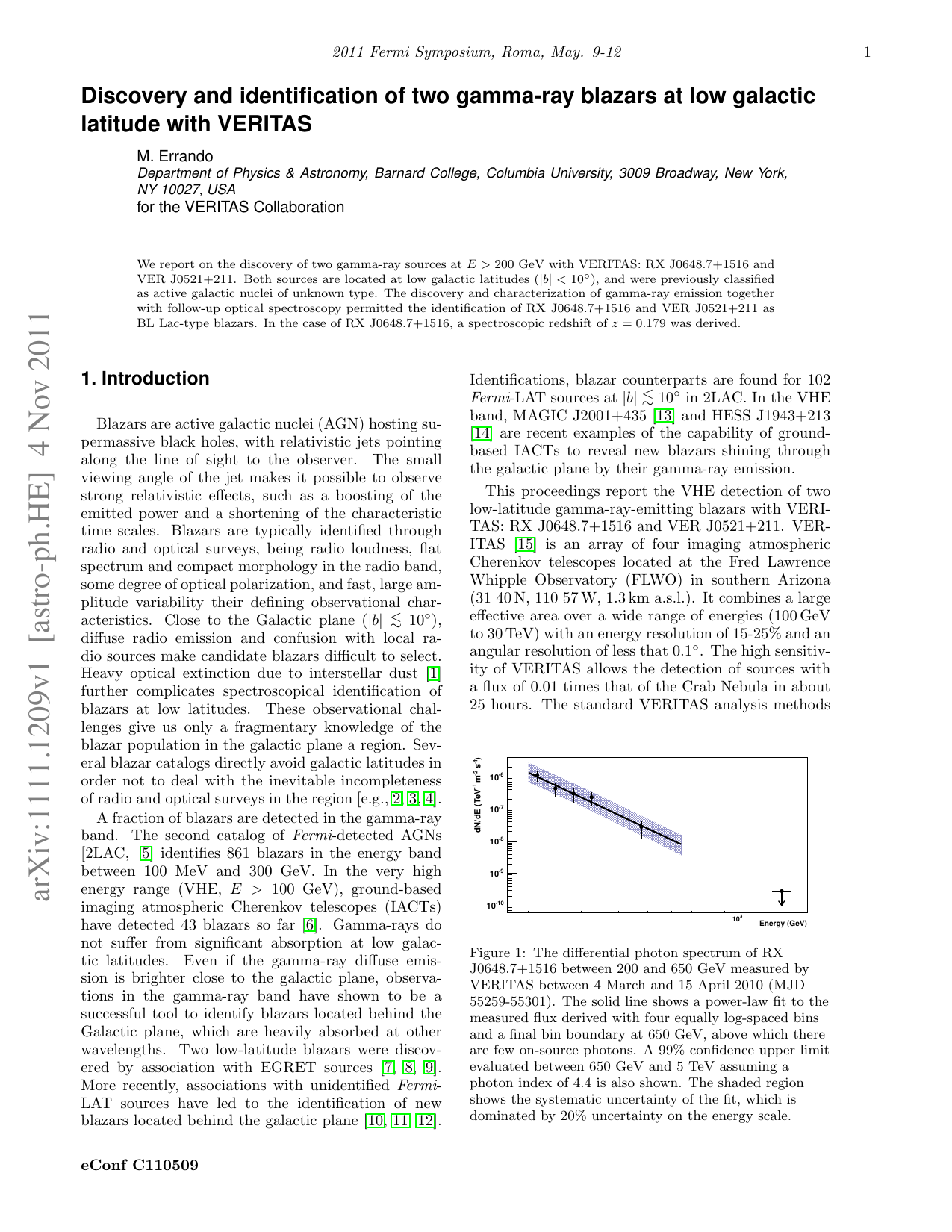
RX J0648.7+1516 is a ROSAT-detected X-ray source associated with a compact flat-spectrum radio source [20], located 6.3 • off of the galactic plane. Having the typical characteristics of a radio-loud AGN, no definitive optical identification was found in the literature, with several unsuccessful attempts to find an optical counterpart [21,22,23]. Fermi-LAT discovered a gamma-ray source associated with RX J0648.7+1516 [24]. The source was identified as a promising VHE candidate by the Fermi-LAT collaboration, and this information triggered VERITAS observations of the source. RX J0648.7+1516 was observed with VERITAS between 4 March and 15 April 2010 (MJD 55259-55301), for a total exposure of 19.3 hours after rejecting data taking under poor weather conditions or with hardware problems. After event parameterization and background rejection, an excess of 283 gamma-ray-like events from the direction of RX J0648.7+1516 was found, corresponding to a significance of 5.2σ. Figure 1 shows the differential energy spectrum of the obtained signal, which can be parametrized by a power law of the form dN/dE = N 0 × (E/0.3 TeV) -Γ with N 0 = (2.3 ± 0.5) × 10 -11 cm -2 s -1 and Γ = 4.4 ± 0.8.
The excess event distribution of the signal is consistent with a point-like source and compatible within errors with the radio position of RX J0648.7+1516. A VHE light curve in 1-day bins does not show significant variability during VERITAS observations. The detection in the VHE band strongly suggests the source being a blazar, since most of the VHEdetected AGNs are of the blazar class. To test that hypothesis, optical spectroscopy measurements were triggered after the VERITAS detection. Two spectra were obtained with t
This content is AI-processed based on open access ArXiv data.