A natural process is defined as an act, by which a system organizes itself with time. Any natural process drives a system to a state of greater organization. Organization is a progressive change, while evolution is expressed in the effects of accumulating marks acquired from contingent encounters. Co-existence of the system in states of maximum organization as well as maximum action forms the core idea of the paper. Major influences have been drawn from the Principle of Least Action. This allows us to see how this most basic law of physics determines the development of the system towards states with less action i.e. organized states. Based on this, it has been proposed, that the development of a system towards states of greater organization is cyclic in nature and thus evolution is a cyclic process.
Introduction: Organization 1, 2 is a progressive change and can be modelled as a part of nature. Nature comprises of open systems. An open system is a continually evolving dynamical system. All natural processes 3,4 occurring in the universe are rooted in physics and have physical explanation. All of the structures in the universe exist, because they are in their state of least action 5 or tend towards it. In any system, simple or complex, the system spontaneously calculates which path will use least effort for that proce ss 6,7 . A system comprises of elements and constraints, both internal as well as external. The internal constraints could be the configurations of the system or the state of elements themselves, whereas, the external constraints are those that define the geometry of the system. The elements apply work on the constraints to modify the organization and minimize the action, which takes finite amount of time, making the reorganization a process 6,7 . Reorganization is a process of optimization. A system thrives to organize itself and in the course of development destroys its previous identity. The dynamical systems that are present in nature are generally very complex exhibiting various levels of complexity present within themselves. Order implies a state of lesser action hence, greater organization. A complex system with a structure and emergence is said to self-organizing 1,2 . The process of self-organization of the systems can be called a "Process of achieving a least action state by a system". It could last billions of years or indefinitely.
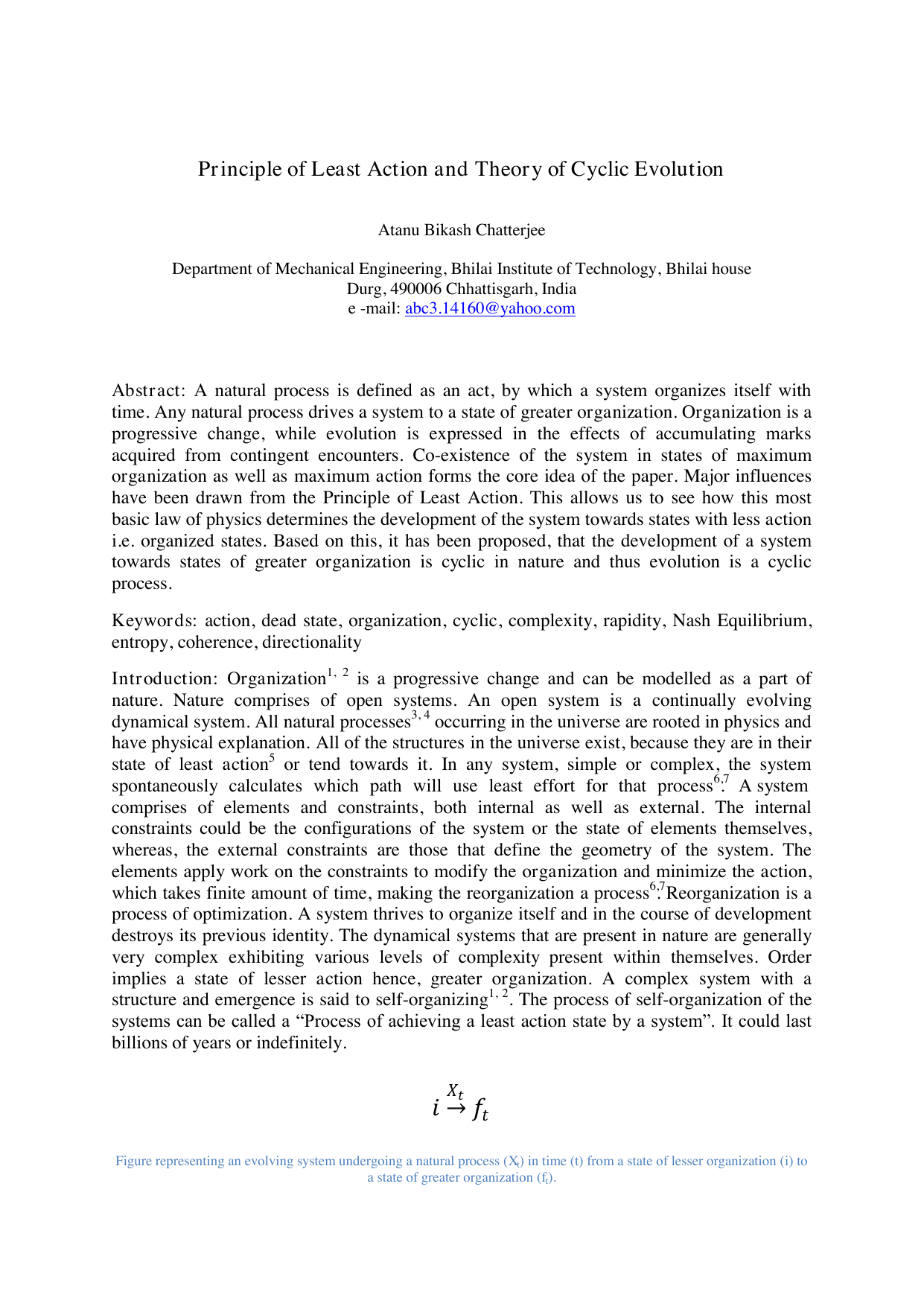
Figure representing an evolving system undergoing a natural process (X t ) in time (t) from a state of lesser organization (i) to a state of greater organization (f t ).
Evolution of a system towards a greater state of organization is a coherent action of the organization of each system elements towards their optimal states of organization 8 . The extent of organization achieved by a system element depends upon its work potential or its exergy 7, 9 compared to its surrounding media. This energy gradient acts as a driving force enabling a dynamical system to organize itself with continuous evolution of time. In an open system, there is always an influx and out flux of energy between the system and surrounding media, causing the exergy of the system elements to vary continuously. So, the action of a single element will not be at minimum, but the sum of the action of all the elements in the system will be at minimum. The action of a single element is not maximal as well, because by definition this will destroy the system, so this intermediate state represents an optimum 6,10 .
Figure representing an exchange of energy between a system and the surrounding
The extent of organization achieved by a system element depends upon its work potential or its exergy compared to its surrounding media. In an open system there is always an influx and out flux of energy between the system and surrounding media, causing the exergy of the system elements to vary continuously. This exchange of energy is accompanied with exchange in entropy between system and surrounding 11, 12, 13, 14. The sum total of the entropy generated within the system and the entropy exchanged gives the entropy generated in a natural process.
Where, 𝜕𝑆 𝑔𝑒𝑛 represents total entropy generated 8 , 𝜕𝑆 𝑖𝑛𝑡 represents total internal entropy of the process and 𝜕𝑆 𝑒𝑥 represents total exchange of entropy between system and surrounding media.
Where, 𝜕𝑆 𝑒𝑥 is the sum total of the influx and out flux of entropy. A natural process is also accompanied by the increase in number of microstates of the system. Thermodynamically, entropy is simply our lack of knowledge of the actual state of the system 8 . Thus, with increase in time and hence, increase in organization the system elements tend to lose track of their evolutionary history. The lack of information with increasing organization thus, renders a system towards greater levels of complexity 8,15 .
𝜕𝑆 𝑖𝑛𝑡 > 0
Let a system be initially in a state “i” and make a transition into the t th final state “f t " through a natural process X t causing an increase in the amount of organization, where “t” represents the time elapsed while undergoing the process and 𝑡 ∈ 0, ∞ .
The final state of the system is unknown since the system under consideration is open to surrounding media 5 hence; it has been subscripted with “t”. Thus, the final fate of the system can assume any out of the infinite states, 𝑓 𝑡 = 𝑓 0 , 𝑓 1 , 𝑓 2 , 𝑓 3 … … … . 𝑓 ∞ Where, f 0 is same as the initial state “i'.
The figure represents the transition diagram for a system from i th state to f th state where, transition from i to f 1 is denoted by the natural process X 1 and so on. Each process can occur in an infinite number of ways, thus, leading the system towards infinite number of final states. But the Principle of Least Action 5,6,7 imposes constraint, by causing the system to undergo a spe
This content is AI-processed based on open access ArXiv data.