A graph theoretical Gauss-Bonnet-Chern Theorem
📝 Original Info
- Title: A graph theoretical Gauss-Bonnet-Chern Theorem
- ArXiv ID: 1111.5395
- Date: 2011-11-24
- Authors: Oliver Knill, et al. —
📝 Abstract
We prove a discrete Gauss-Bonnet-Chern theorem which states where summing the curvature over all vertices of a finite graph G=(V,E) gives the Euler characteristic of G.💡 Deep Analysis
📄 Full Content
We introduce here an Euler curvature form K(p) for graphs which only depends on the number V k of k-dimensional pieces of the unit sphere S(p) at p with k = 1, . . . , d -2. Since by definition, we have a d-dimensional graph G, the unit sphere S(p) at a point is a (d -1)-dimensional graph. While Puiseux type formulas allow to discretize curvature in two dimensions, the lack of a natural second order difference calculus for graphs prevents a straightforward translation of the classical Euler curvature form to graph theory so that we construct it from scratch using some assumptions on graphs so that everything stays elementary. For four dimensional graphs for example, the curvature form K(p) at p depends only on the number of edges and faces of the three dimensional sphere S(p) centered at p.
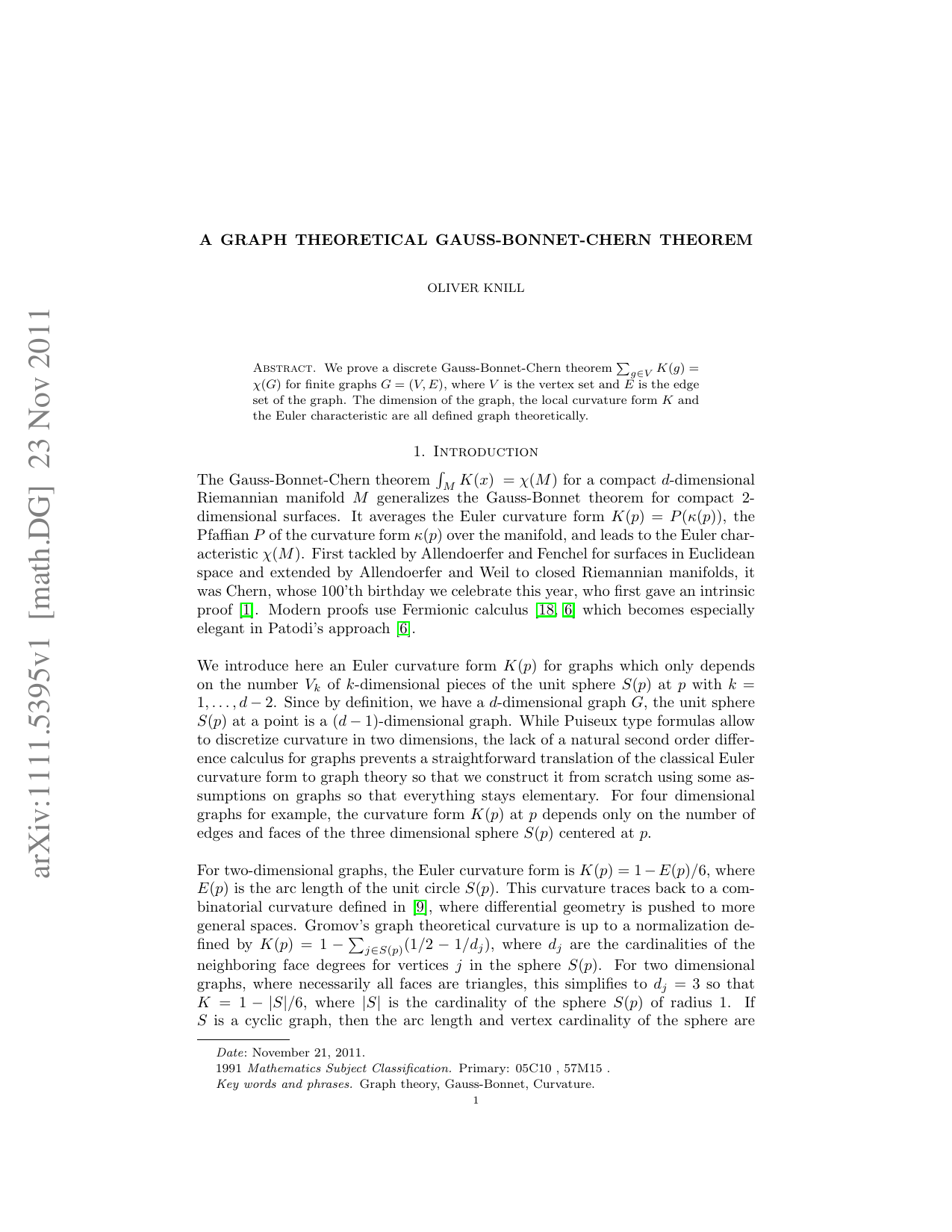
For two-dimensional graphs, the Euler curvature form is K(p) = 1 -E(p)/6, where E(p) is the arc length of the unit circle S(p). This curvature traces back to a combinatorial curvature defined in [9], where differential geometry is pushed to more general spaces. Gromov’s graph theoretical curvature is up to a normalization defined by K(p) = 1 -j∈S(p) (1/2 -1/d j ), where d j are the cardinalities of the neighboring face degrees for vertices j in the sphere S(p). For two dimensional graphs, where necessarily all faces are triangles, this simplifies to d j = 3 so that K = 1 -|S|/6, where |S| is the cardinality of the sphere S(p) of radius 1. If S is a cyclic graph, then the arc length and vertex cardinality of the sphere are The graph shown here has dimension 32549/20580 and Euler characteristic -4.
The curvatures -21, -31/2, -19/6, -5/3, -3/2, -1, 1/4 appear once, -1/2 six times, -1/4 3 times, 60 vertices have zero curvature, 50 have curvature 1/6 and 70 have curvature 1/2. These locally computed quantities add up to -4.
the same. The combinatorial curvature illustrates the 1/5-condition |S(p)| > 5 for non-positive curvature and that |S| > 6 leads to strictly negative curvature. For two-dimensional graph with or without boundary, the result appears in [14], where K = 6 -E(p) was scaled to avoid fractions. We do not rescale the discrete Euler form in this article because with increasing dimensions, the denominator terms become larger and would have to be scaled in a dimension-dependent manner to be rendered integer valued. We could work with (d + 1)!K(p) which is an integer but leave the fractions. For two dimensional graphs, the sphere S(p) of a vertex p is one-dimensional graph without boundary, a cyclic graph. In three dimensions, the Euler curvature form K vanishes identically. For four-dimensional graphs, which is already a new case, the curvature form is K = 1 -E/6 + F/10, where E is the number of edges of the unit sphere S(p) and where F is the number of faces in S(p). For 5 dimensional graphs, the curvature form is K = -E/6 + F/4 -C/6. It would be zero if 3F = 2(C + E). We do not know yet whether it is always identically zero, even so the sum over the entire graph is. Also the examples of 5-dimensional graphs we looked at, K = 0.
The core mechanism for relating global Euler characteristic and local curvature for general finite undirected graphs G = (V, E) is the following: the total number v k of k dimensional simplices in G is related to the number V k (p) of k -1 dimensional simplices in the unit sphere S 1 (p) by
where we use that p∈V 1 = v 0 . We have just seen a very general Gauss-Bonnet theorem relating a local curvature form with a global quantity:
For any finite graph G = (V, E) without self-loops and multiple connections, we have p∈V K(p) = χ(G), where K(p) is a curvature form defined in Equation ( 1) which depends only on the unit sphere S 1 (p) of a vertex p.
Here are some examples. For a discrete graph P n with n vertices without edges, the unit spheres are all empty and K(p) = 1 sums up to χ(P n ) = n. For the complete graph K n , we have
k /(k + 1) = 1/n adding up to 1. For a tree, the curvature of a vertex p is 1 -deg(p)/2. The sum of the curvatures of a single tree is 1 and the total curvature of a forest the number of trees. For a wheel graph W n with n + 1 vertices and 2n edges and n faces, we have
, the other n points q have K(q) = 1 -3/2 + 2/3 = 1/6. The total curvature is 1. For an octahedron G, we have v 0 = 6, v 1 = 12, v
📸 Image Gallery