Title: Subphotospheric heating in GRBs: analysis and modeling of GRB090902B as observed by Fermi
ArXiv ID: 1111.0308
Date: 2011-11-03
Authors: T. Nymark, M. Axelsson, C. Lundman, E. Moretti, F. Ryde, A. Peer
📝 Abstract
We analyze the spectral evolution of GRB 090902B and show that subphotospheric dissipation can explain both the spectra and the spectral evolution. The emission from a GRB photosphere can give rise to a variety of spectral shapes. The spectrum can have a shape close to that of a Planck function (as is observed during the first half of GRB090902B) or be broadened, resembling a typical Band function (as is observed during the second half of GRB090902B). The shape mainly depends on the strength and location of the dissipation in the jet, the ratio of the energy densities of thermal photons and of the electrons at the dissipation site, as well as on the strength of the magnetic field. We further discuss numerical models of the dissipation and relate these to the observed spectra.
💡 Deep Analysis
📄 Full Content
2011 Fermi Symposium, Roma., May. 9-12
1
Subphotospheric heating in GRBs: analysis and modeling of GRB090902B as
observed by Fermi
T. Nymark, M. Axelsson, C. Lundman, E. Moretti, F. Ryde
Department of physics, KTH, Stockholm, Sweden
A. Pe’er
Harvard-Smithsonian Center for Astrophysics, Cambridge, MA, USA
We analyze the spectral evolution of GRB 090902B and show that subphotospheric dissipation
can explain both the spectra and the spectral evolution. The emission from a GRB photosphere can
give rise to a variety of spectral shapes. The spectrum can have a shape close to that of a Planck
function (as is observed during the first half of GRB090902B) or be broadened, resembling a typical
Band function (as is observed during the second half of GRB090902B). The shape mainly depends
on the strength and location of the dissipation in the jet, the ratio of the energy densities of thermal
photons and of the electrons at the dissipation site, as well as on the strength of the magnetic field.
We further discuss numerical models of the dissipation and relate these to the observed spectra.
I.
INTRODUCTION
After more than 40 years of observations the prompt
emission in gamma ray bursts is still not fully un-
derstood.
The most widely accepted model for the
emission is the fireball model [1], [2], in which the
emission is caused by dissipation in a relativistically
expanding fireball. This model predicts the presence
of a thermal component arising from the photosphere,
where the flow which is initially opaque becomes opti-
cally thin. A reasonable, first assumption is that this
component has a shape resembling a Planck function,
although this is expected to be slightly modified by
relativistic and geometric effects (e.g. [3], [4], [5], [6],
[7]). However, the majority of GRB spectra are well
fit with a Band function and do not show clear signs
of black body emission. On the other hand, Planck-
like spectra have been observed in a few bursts [8, 9]
and, in addition, in several cases there is evidence of
a subdominant thermal component accompanying the
non-thermal emission, e.g. in GRB110724B [10]. This
has led to a renewed interest in the existence of pho-
tospheric emission in GRB spectra.
The presence of dissipation in the GRB outflow is
unquestionable, since the spectrum is non-thermal,
containing a high energy tail.
The nature of the
dissipation process is, however, not known, but pos-
sible scenarios include magnetic reconnection in a
Poynting-flux dominated outflow [11],[12],[2], internal
shocks in the flow [13], [1] and collisional heating [6].
The location of the dissipation is also unknown, but
in the internal shock scenario shocks due to colliding
shells with different Lorentz factors are expected to
occur mainly in the optically thin region of the flow,
while oblique shocks can lead to dissipation below the
photosphere. In addition, a change in the Lorentz fac-
tor of the flow can lead to a shift in the location of the
photosphere, so that the dissipation shifts from being
located above the photosphere to occurring below the
photosphere, with corresponding changes in the ob-
served spectrum. This sub-photospheric dissipation is
the subject of the present study.
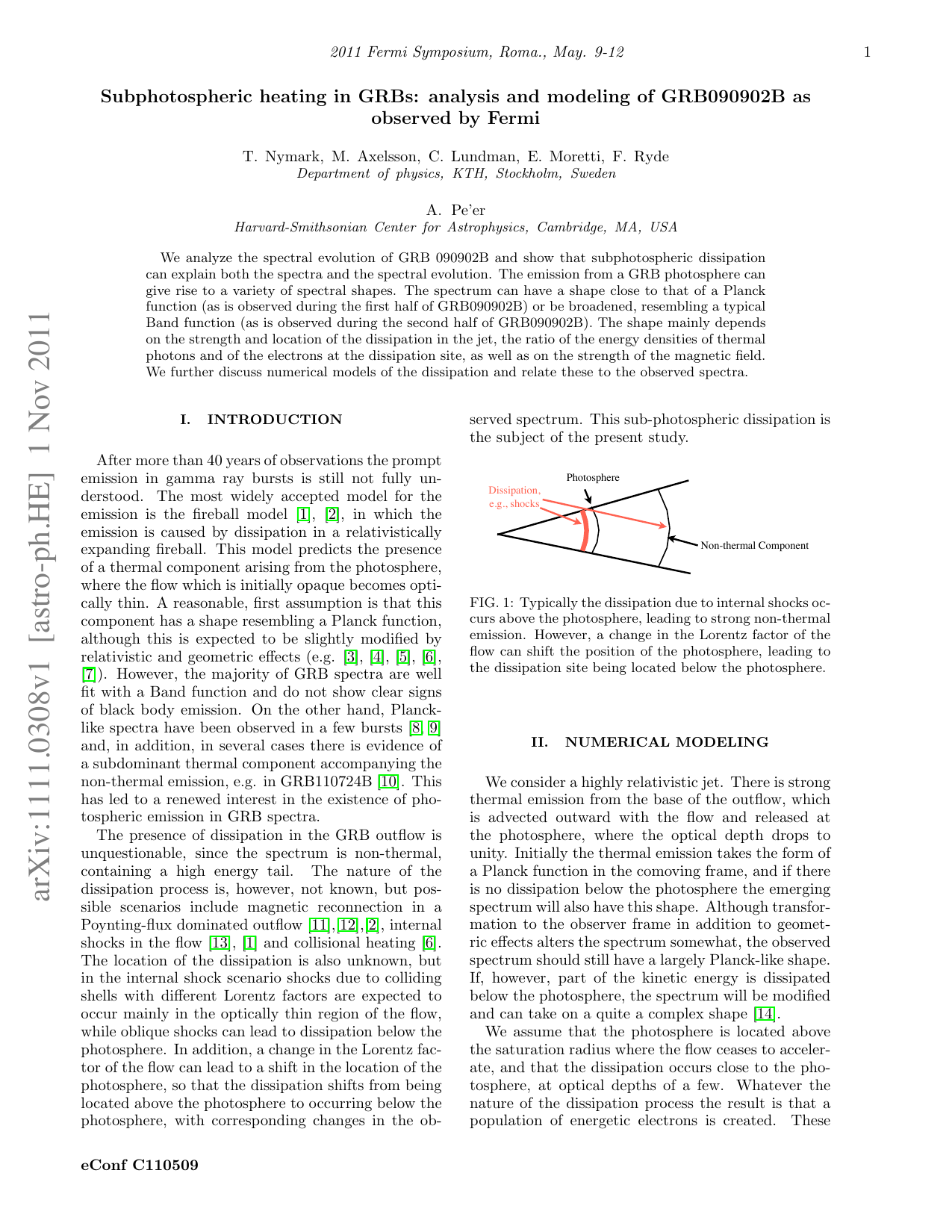
Non-thermal Component
Photosphere
Dissipation,
e.g., shocks
FIG. 1: Typically the dissipation due to internal shocks oc-
curs above the photosphere, leading to strong non-thermal
emission. However, a change in the Lorentz factor of the
flow can shift the position of the photosphere, leading to
the dissipation site being located below the photosphere.
II.
NUMERICAL MODELING
We consider a highly relativistic jet. There is strong
thermal emission from the base of the outflow, which
is advected outward with the flow and released at
the photosphere, where the optical depth drops to
unity. Initially the thermal emission takes the form of
a Planck function in the comoving frame, and if there
is no dissipation below the photosphere the emerging
spectrum will also have this shape. Although transfor-
mation to the observer frame in addition to geomet-
ric effects alters the spectrum somewhat, the observed
spectrum should still have a largely Planck-like shape.
If, however, part of the kinetic energy is dissipated
below the photosphere, the spectrum will be modified
and can take on a quite a complex shape [14].
We assume that the photosphere is located above
the saturation radius where the flow ceases to acceler-
ate, and that the dissipation occurs close to the pho-
tosphere, at optical depths of a few. Whatever the
nature of the dissipation process the result is that a
population of energetic electrons is created.
These
eConf C110509
arXiv:1111.0308v1 [astro-ph.HE] 1 Nov 2011
2
2011 Fermi Symposium, Roma., May. 9-12
cool via synchrotron emission and Compton scattering
of low energy photons. The energetic photons which
are created through these processes may in turn un-
dergo inverse Compton scattering. In addition pair
production and annihilation modifies the particle and
photon popu