Here we report our recent study on the spectral energy distribution (SED) of the high frequency BL Lac object Mrk 421 in different luminosity states. We used a full-fledged chi2-minimization procedure instead of more commonly used "eyeball" fit to model the observed flux of the source (from optical to very high energy), with a Synchrotron-Self-Compton (SSC) emission mechanism. Our study shows that the synchrotron power and peak frequency remain constant with varying source activity, and the magnetic field decreases with the source activity while the break energy of electron spectrum and the Doppler factor increase. Since a lower magnetic field and higher density of electrons result in increased electron-photon scattering efficiency, the Compton power increases, so does the total emission.
💡 Deep Analysis
📄 Full Content
arXiv:1111.0265v1 [astro-ph.HE] 1 Nov 2011
2011 Fermi Symposium, Roma., May. 9-12
1
Environment and properties of emitting electrons in blazar jets:
Mrk 421 as a laboratory
Nijil Mankuzhiyil
INFN Trieste and Universit`a di Udine, via delle Scienze 208, I-33100 Udine, ITALY
Stefano Ansoldi
International Center for Relativistic Astrophysics (ICRA), Rome and Universit`a di Udine, via delle Scienze 208,
I-33100 Udine, ITALY
Massimo Persic
INAF-Trieste, via G. B. Tiepolo 11, I-34143 Trieste, ITALY
Fabrizio Tavecchio
INAF-Brera, via E. Bianchi 46, I-23807 Merate, ITALY
Here we report our recent study on the spectral energy distribution (SED) of the high frequency BL Lac object
Mrk 421 in different luminosity states.
We used a full-fledged χ2-minimization procedure instead of more
commonly used ”eyeball” fit to model the observed flux of the source (from optical to very high energy), with
a Synchrotron-Self-Compton (SSC) emission mechanism.
Our study shows that the synchrotron power and
peak frequency remain constant with varying source activity, and the magnetic field (B) decreases with the
source activity while the break energy of electron spectrum (γbr) and the Doppler factor (δ) increase. Since a
lower magnetic field and higher density of electrons result in increased electron-photon scattering efficiency, the
Compton power increases, so does the total emission.
1. Introduction
Active galactic nuclei (AGN) involve the most pow-
erful, steady sources of luminosity in the Universe. It
is believed that the center core of AGN consist of super
massive black hole (SMBH) surrounded by an accre-
tion disk. In some cases powerful collimated jets are
found in AGN, perpendicular to the plane of accretion
disk. The origin of jets are still unclear. AGNs whose
jets are viewed at a small angle to its axis are called
blazars.
The overall (radio to γ-ray) spectral energy distri-
bution (SED) of blazars shows two broad non-thermal
continuum peaks. The low-energy peak is thought to
arise from electron synchrotron emission.
The lep-
tonic model suggests that the second peak forms due
to inverse Compton emission.
This can be due to
upscattering, by the same non-thermal population of
electrons responsible for the synchrotron radiation,
and synchrotron photons (Synchrotron Self Compton:
SSC) Maraschi et al. [1992].
Blazars often show violent flux variability, that may
or may not appear correlated in the different energy
bands. Simultaneous observation are then crucial to
understand the physics behind variability.
2. χ2-minimized SED fitting
In this section we discuss the code that we have
used to obtain an estimation of the characteristic pa-
rameters of the SSC model. The SSC model assumes a
spectrum for the accelerated electron density k, which
is a broken power law with exponents n1 and n2. The
minimum, maximum and break Lorentz factors for the
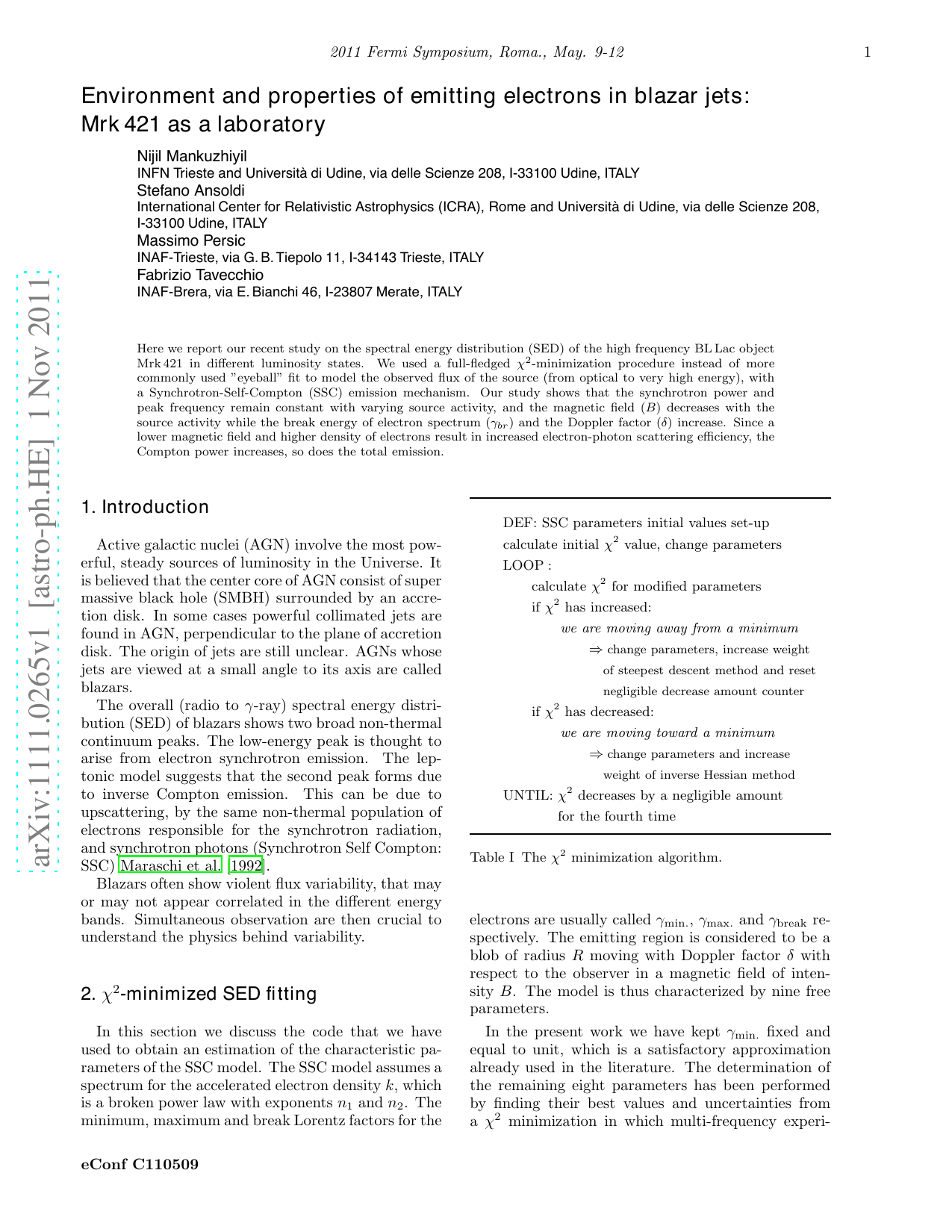
DEF: SSC parameters initial values set-up
calculate initial χ2 value, change parameters
LOOP :
calculate χ2 for modified parameters
if χ2 has increased:
we are moving away from a minimum
⇒change parameters, increase weight
of steepest descent method and reset
negligible decrease amount counter
if χ2 has decreased:
we are moving toward a minimum
⇒change parameters and increase
weight of inverse Hessian method
UNTIL: χ2 decreases by a negligible amount
for the fourth time
Table I The χ2 minimization algorithm.
electrons are usually called γmin., γmax. and γbreak re-
spectively. The emitting region is considered to be a
blob of radius R moving with Doppler factor δ with
respect to the observer in a magnetic field of inten-
sity B. The model is thus characterized by nine free
parameters.
In the present work we have kept γmin. fixed and
equal to unit, which is a satisfactory approximation
already used in the literature. The determination of
the remaining eight parameters has been performed
by finding their best values and uncertainties from
a χ2 minimization in which multi-frequency experi-
eConf C110509
2
2011 Fermi Symposium, Roma., May. 9-12
mental points have been fitted to the SSC spectrum
modelled as in Tavecchio et al. [1998]. Minimization
has been performed using the Levenberg-Marquardt
method Press et al. [1994], which is an efficient stan-
dard for non-linear least-squares minimization that
smoothly interpolates between two different minimiza-
tion approaches, namely the inverse Hessian method
and the steepest descent method. For completeness,
we briefly present the pseudo-code for the algorithm
in table I.
A crucial point in our implementation is that from
Tavecchio et al. [1998] we can only obtain a numeri-
cal approximation to the SSC spectrum, in the form
of a sampled SED. On the other hand, from table I,
we understand that at each step the calculation of the
χ2 requires the evaluation of the SED for all the ob-
served frequencies. Although an observed point will
likely not be one of the sampled points coming from
Tavecchio et al. [1998], it will fall between two sam-
pled points, so that interpol