Education and Outreach in Particle Physics
📝 Original Info
- Title: Education and Outreach in Particle Physics
- ArXiv ID: 1109.6928
- Date: 2011-10-03
- Authors: R. Michael Barnett
📝 Abstract
There are many varied programs of education and outreach in particle physics. This report for the Division of Particles and Fields of the American Physical Society 2001 meeting reviews the impact of these programs in general, and also gives several examples of ongoing programs with a primary focus on those in the US.💡 Deep Analysis
📄 Full Content
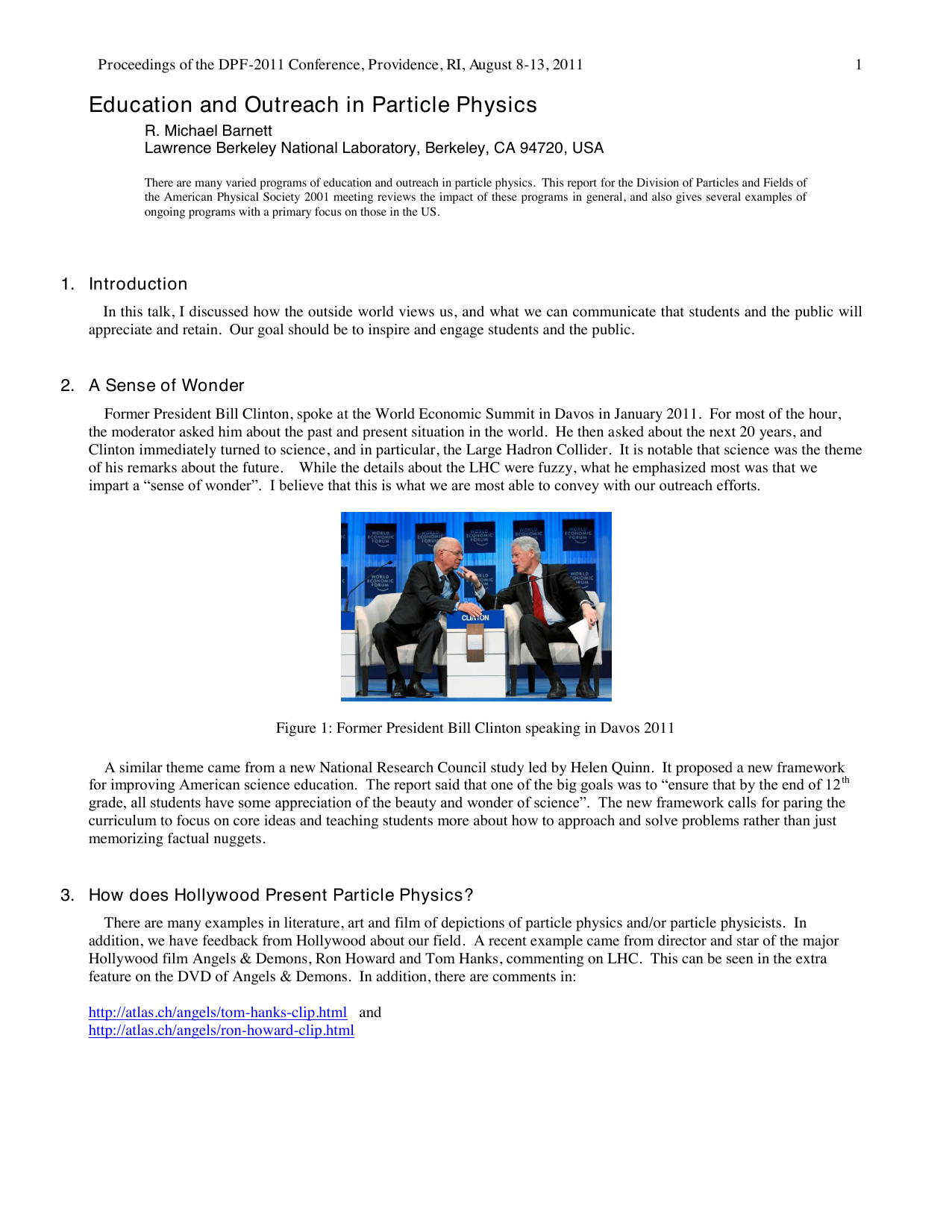
Former President Bill Clinton, spoke at the World Economic Summit in Davos in January 2011. For most of the hour, the moderator asked him about the past and present situation in the world. He then asked about the next 20 years, and Clinton immediately turned to science, and in particular, the Large Hadron Collider. It is notable that science was the theme of his remarks about the future. While the details about the LHC were fuzzy, what he emphasized most was that we impart a “sense of wonder”. I believe that this is what we are most able to convey with our outreach efforts. The report said that one of the big goals was to “ensure that by the end of 12 th grade, all students have some appreciation of the beauty and wonder of science”. The new framework calls for paring the curriculum to focus on core ideas and teaching students more about how to approach and solve problems rather than just memorizing factual nuggets.
There are many examples in literature, art and film of depictions of particle physics and/or particle physicists. In addition, we have feedback from Hollywood about our field. A recent example came from director and star of the major Hollywood film Angels & Demons, Ron Howard and Tom Hanks, commenting on LHC. This can be seen in the extra feature on the DVD of Angels & Demons. In addition, there are comments in: http://atlas.ch/angels/tom-hanks-clip.html and http://atlas.ch/angels/ron-howard-clip.html
I think it is informative to look at three contrasting views of accelerators and collision events. The first is a recent example from the New York Times. The Outreach program of the ATLAS Experiment produced an animation of the LHC and then a collision within ATLAS, which can be seen at: http://www.atlas.ch/multimedia/actual-events.html
A very nice example of the use of comics to communicate science appears in the comic called PhD Comics. Some of these are also animated, see an example about dark matter at: http://www.phdcomics.com/comics.php?f=1430 The forthcoming Muppets movie (due out in November 2011) apparently has a scene appearing to be taken in the ATLAS cavern. This we only know from the trailer: http://www.youtube.com/watch?v=C4YhbpuGdwQ
The CMS e-Lab allows students to analyze data to calibrate the detector and participate in discovery science. Calibrating the detector to “rediscover” previous measured results is an important part of the early scientific activity at CMS.
Physicists look at CMS particle collisions in event displays to see what happened or in histograms of multiple events. On Masterclass Day, it is students who are physicists for a day. In 2011 the CMS Masterclass had 197 students in the U.S., 13 institutes in the U.S. plus approx 30 non-US institutes.
The IceCube has an extensive and ongoing program of education and outreach. Some of the emphasis is on informal learning Figure 17: Informal learning by the IceCube collaboration Some of the informal learning occurs at the Adler Planetarium in Chicago. Some 500,000 visitors per year see a dynamic display of real data. In Madison, Wisconsin, they participate in a hands-on ice drilling activity. It simulates the building of the IceCube detector and is appropriate for all ages IceCube also has blogs and broadcasts from the South Pole, covering wintering over at the Pole, hot water drilling, and computing, running and maintaining the IceCube detector. Their curriculum covers: introduction to particle physics, access to real IceCube data, and generalization of concepts to illustrate abstract ideas.
Quarked!
Quarked! is a physics education project for ages 7 and up (based in at the University of Kansas). Project components include:
Interactive web site (www.quarked.org ) with animated videos, games, lesson-plans, FAQS, glossary, videos, etc. Hands on science programs for elementary and middle school students Links with QuarkNet, NSF informal science education and other grants The unusual aspect of this program is the target audience. This age group was chosen because at “this stage young people are open to everything and don’t know that physics is hard.” The organizers believe that you can engage elementary & middle school aged children with concepts related to particle physics. They point out that over 5000 children participated from Kansas, Missouri, and Colorado in hands-on shows. Assessment has been done with students and their teachers and shows that the program is successful. The website continues to have over 5000 visitors per month.
The Ligo programs in a variety of outreach efforts and feature the Louisiana Science Education Center, which is a 5000 sq. foot Science Education Center. They conduct tours, present exhibits, and focus on K-12 and teacher development.
The Sanford Underground Lab at the Ho
📸 Image Gallery