In recent years, a large number of geosynchronous satellites are being planned to provide augmentation services for enhancing the precision to global positioning systems, e.g., GPS, in applications such as aircraft landing. In this paper, we present a scheme for co-locating passive satellite observational facilities with a radio astronomy facility to open a new possibility of providing valuable data for radio astronomical imaging, ionospheric studies and satellite orbit estimation.
I N recent years, an increasing number of geosynchronous satellites are being planned to cope with the need of providing regional navigation services or augmentation to global systems like the GPS. From various announcements made by the Indian Space Research Organization (ISRO), one can expect at least 9 geosynchronous satellites to be commissioned by ISRO within the next few years with dual frequency synchronized payloads [1] [2]. Among these, the first satellite, GSAT-8, has been launched recently and is likely to commence regular broadcast of WAAS messages from September 2011, as part of the GAGAN project [1]. GAGAN aims to enhance the precision achievable by GPS-based systems for assisting air-craft landing. A second geosynchronous satellite with a GAGAN payload has been announced for launch during early 2012. Both these broadcast WAAS messages on the L1 (1575 MHz) and L5 (1176 MHz) carriers.
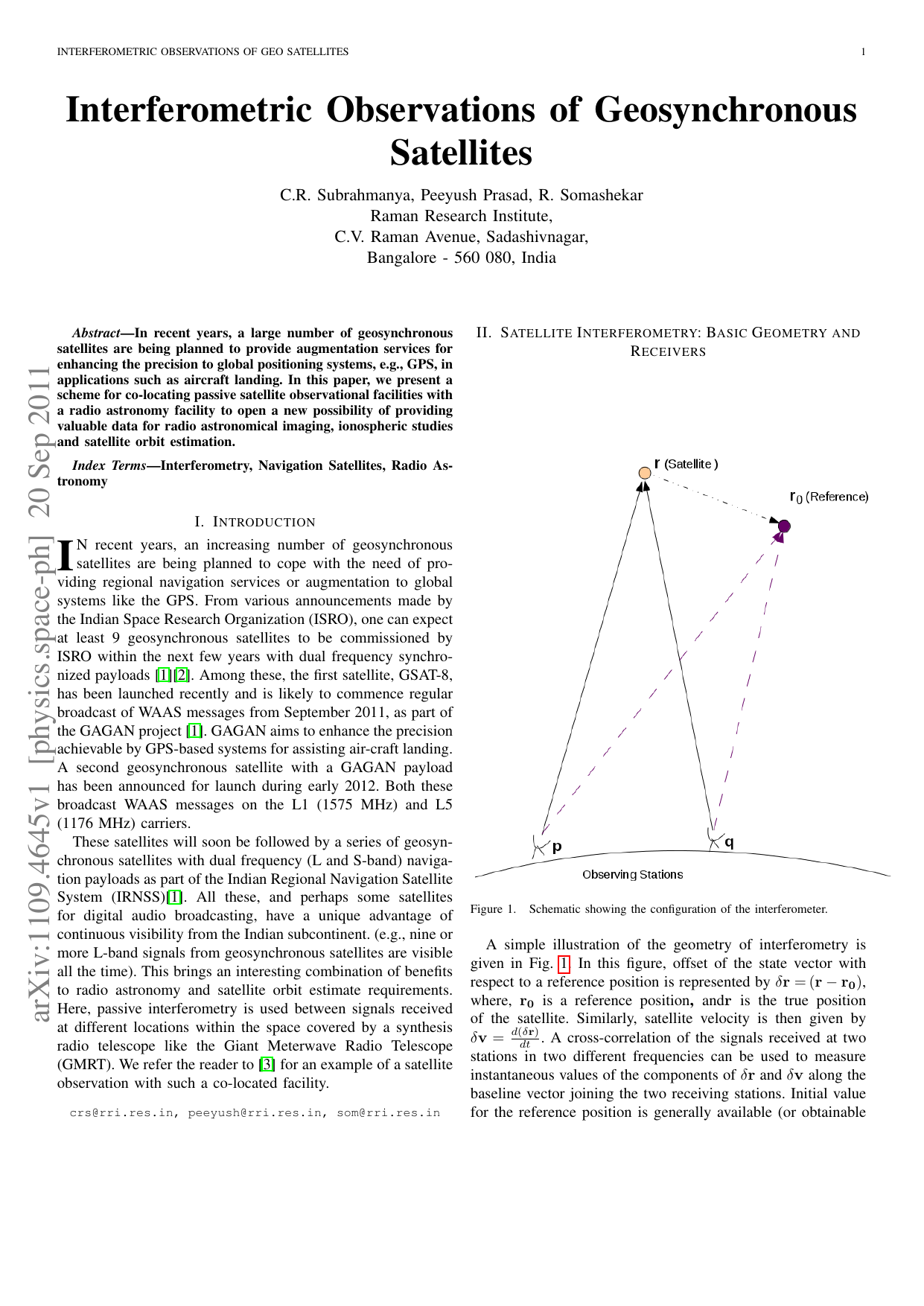
These satellites will soon be followed by a series of geosynchronous satellites with dual frequency (L and S-band) navigation payloads as part of the Indian Regional Navigation Satellite System (IRNSS) [1]. All these, and perhaps some satellites for digital audio broadcasting, have a unique advantage of continuous visibility from the Indian subcontinent. (e.g., nine or more L-band signals from geosynchronous satellites are visible all the time). This brings an interesting combination of benefits to radio astronomy and satellite orbit estimate requirements. Here, passive interferometry is used between signals received at different locations within the space covered by a synthesis radio telescope like the Giant Meterwave Radio Telescope (GMRT). We refer the reader to [3] for an example of a satellite observation with such a co-located facility. crs@rri.res.in, peeyush@rri.res.in, som@rri.res.in A simple illustration of the geometry of interferometry is given in Fig. 1. In this figure, offset of the state vector with respect to a reference position is represented by δr = (r -r 0 ), where, r 0 is a reference position, andr is the true position of the satellite. Similarly, satellite velocity is then given by δv = d(δr) dt . A cross-correlation of the signals received at two stations in two different frequencies can be used to measure instantaneous values of the components of δr and δv along the baseline vector joining the two receiving stations. Initial value for the reference position is generally available (or obtainable arXiv:1109.4645v1 [physics.space-ph] 20 Sep 2011 as two-line elements from the Internet) and can be updated using the interferometric measurements using a suitable orbit propagation software.
In view of the wide variety of inexpensive antennas and receivers available off-the-shelf for receiving satellite signals, it is possible to construct a simple system for satellite interferometry (and co-locating with a Radio Astronomy facility) to obtain valuable data for radio astronomical imaging, ionospheric studies and satellite orbit estimation. A preliminary attempt for realizing such a co-located system with the GMRT was attempted by us in 2005. The subsystems developed for this project are being augmented to establish a simple facility at the Raman Research Institute. A conceptual description of the system constituting this facility has been given in Fig. 2.
This facility consists of a common L-band subsystem interfaced to off-the-shelf RF units corresponding to the satellite C, L or Ku-band. It may be noted that the primary navigation signals are in the L-band, and provide the most valuable information on the satellite range/Doppler or ionospheric delay along the line of sight. While this is the most useful band for measuring ionospheric contribution to interferometric phases for observing a celestial radio source, the satellite orbit estimation problem itself requires supplementary data using interferometric observations which are sensitive to satellite state vector components along directions perpendicular to the line of sight. In this connection, we note that the information related to components orthogonal to the line of sight is a natural outcome of radio interferometry.
Furthermore, since radio interferometry provides a measure of the arrival time differences of signals reaching different array elements, it does not require any knowledge of the nature of signals broadcast by the satellite. Hence, any bandlimited signal transmitted by the satellite can be used for this purpose. A cross-correlation of the signals -(after compensating for delay differences resulting from an assumed reference), provides an estimate of the arrival time differences in excess of those that can be traced to the reference.
In view of the inherent signal strength coming from satellites, the required bandwidths and integration times are well within simple processing capabilities of a normal workstation. However, the angular resolution which can be achieved by this method (which improves with decreasing wavelength) depen
This content is AI-processed based on open access ArXiv data.