Peak Nothing: Recent Trends in Mineral Resource Production
📝 Original Info
- Title: Peak Nothing: Recent Trends in Mineral Resource Production
- ArXiv ID: 1107.4753
- Date: 2011-07-26
- Authors: James R. Rustad
📝 Abstract
The production histories of seventeen raw materials are analyzed with the logistic model. Although many of these resources have exhibited logistic behavior in the past, they now show exponential or super-exponential growth. In most cases, the transition has occurred in the last ten to twenty years.💡 Deep Analysis
📄 Full Content
Peak Nothing: Recent Trends in Mineral Resource Production
James R. Rustad1,2
1Corning Inc., Corning, NY, 14831, 2University of California, Davis, Davis, CA 95616
Abstract-The production histories of seventeen raw materials are analyzed with the
logistic model. Although many of these resources have exhibited logistic behavior in the
past, they now show exponential or super-exponential growth. In most cases, the
transition has occurred in the last ten to twenty years.
Underpinning the recent focus on sustainability is the assumption that, for many raw
materials, resource depletion is imminent (1). The degree of concern has been
compounded by increasing public awareness of the 'Hubbert's Peak' approach to oil
production (2). In this model, the consequences of resource depletion are apparent not
near the end of production, but immediately after the peak of production where falling
supplies meet rising demand. In such a context, the era of depletion is widely thought to
have already begun. Applied initially to oil, the logistic Hubbert approach can shed light
on the reserves of other elements.
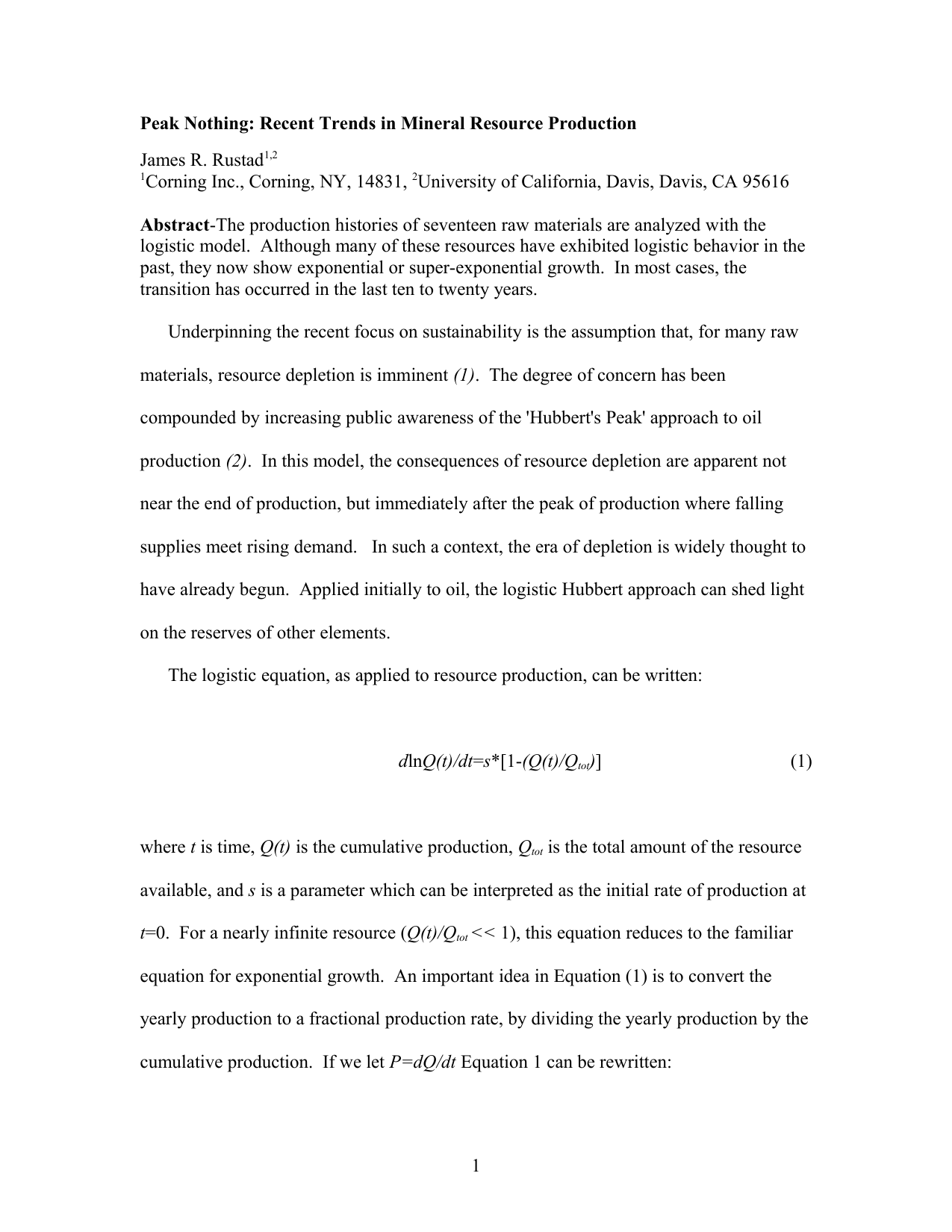
The logistic equation, as applied to resource production, can be written:
dlnQ(t)/dt=s*[1-(Q(t)/Qtot)]
(1)
where t is time, Q(t) is the cumulative production, Qtot is the total amount of the resource
available, and s is a parameter which can be interpreted as the initial rate of production at
t=0. For a nearly infinite resource (Q(t)/Qtot << 1), this equation reduces to the familiar
equation for exponential growth. An important idea in Equation (1) is to convert the
yearly production to a fractional production rate, by dividing the yearly production by the
cumulative production. If we let P=dQ/dt Equation 1 can be rewritten:
1
P /Q=s−s
Qtot
Q
Yearly production histories for a number of non-renewable resources have been
compiled by the United States Geological Survey (3). These data P(n∆t)=(∆Q(n∆t)/∆t)
(where n is an integer ∆t is one year) may analyzed within the logistic model by plotting
cumulative production Q(n∆t) on the x-axis and the fractional growth rate P(n∆t)/Q(n∆t)
on the y-axis (4). In this picture, cumulative production has replaced time as the
independent variable, and yearly production has been normalized by cumulative
production.
If the use of a given resource is increasing exponentially, this type of plot gives a flat
line, indicating that the fractional growth rate P/Q is a constant percent per year,
independent of cumulative production. If the production is logistic, P/Q starts at some
initial rate at Q=0 and decreases linearly with cumulative production until the resource is
exhausted. At this point, cumulative production equals the total amount of the resource
available, Qtot , and P/Q goes to zero.
Figure 1 gives P/Q versus Q plots made from world production histories of a variety
of non-renewable resources taken from (3). Data for world oil production from 1930-
2005 were obtained from (4). In each case, the cumulative production has been
normalized by dividing by the current cumulative production. For the data in (4), pre-
historical production is taken to be zero. This assumption has negligible effect on
cumulative production values greater than ten percent of the current cumulative
production. Thus the independent variable ranges between 0.1 and 1.
As shown in Figure 1, world oil production passes through an early super-exponential
phase of growth up to about 1970, followed by a first logistic trend from about 1970 to
2
the early 1980s pointed at an apparent Qtot of approximately 700-900 gigabarrels. This
phase is followed by a second logistic trend from the early 1980's to the present, pointing
to a second Qtot of approximately 2000 gigabarrels.
In many cases, the plots for other non-renewable resources resemble the one for oil.
An initial trend is established pointing towards some apparent Qtot
* which is then replaced
by a different trend, pointing toward a new Qtot >> Qtot
*. Plots made in 1990 for bismuth
and phosphorous; 1995 for platinum, germanium, cobalt and tellurium; and 2000 for
zirconium, manganese, and molybdenum would have resulted in apparent Qtot values
nearly equal to current cumulative production. Subsequently, production of these
resources has transitioned to exponential or super-exponential growth. Several resources
often popularly perceived as exhibiting “peak” or logistic behavior, such as the rare earth
elements, lithium, and helium show no evidence for a finite Qtot at any point in their
production histories. Because of the tendency of established trends to change abruptly,
the logistic model cannot be used to estimate a convincing Qtot for any of the resources
displayed in Figure 1.
The implications of Figure 1 are not necessarily optimistic. The fact that production
of a given resource is growing exponentially does not imply that the resource is
inexhaustible. The main implication of
📸 Image Gallery
Reference
This content is AI-processed based on open access ArXiv data.